Select a photo
Or scroll down the page to view them all.
- 1874: Fritz Burmeister, Helena Petersen
- 1876: August Breetzke, Emelia Genrich
- 1878: Hans Petersen, Catharina Petersen
- 1885: Friedrich Kruschke, Elizabeth Wienand
- 1887: William G. Jatho, Jennie Müller
- 1889: Andrew Petersen, Marie Johansen
- 1889: Albert Riemer, Rosalia Meyer
- 1894: Christ. Feldschau, Anna Brodersen
- 1895: John Schuchmann, Rosa Sippel
- 1895: Matthias Petersen, Esther Möller
- 1895: Ernst Lehrmann, Mary Kaufmann
- 1899: Martha Gaul, Herman Zick
- 1900: Louis Petersen, Anna Majoros
- 1902: Hermann Breetzke, Mathilde Moede
- 1902: George Schuchmann, Ida Baumgartner
- 1903: Henry Trabant, Louise Nolting
- 1904: Ernest Ledebuhr, Bertha Laske
- 1905: Unknown wedding couple
- 1906: Edward DeLuryea, Ida Trabant
- 1906: Paul Conrad Gohr, Franziska Schmude
- 1906: John Walter Glawe, Anna Gohr
- 1911: George H. Bruns, Bertha Gohr
- 1911: Otto Krack, Dorothea Gersch
- 1911: Hedwig Kebschull, Clarence Zumbrun
- 1912: Frank Gaul, Grace Kolberg
- 1915: Louisa Gohr, Fred Erickson
- 1917: Celestia Bray, Walter Petersen
- 1917: Marie Petersen, George H. Schmidt
- 1920: Albert Kruschke, Emma Wendt
- 1920: Harry Peterson, Edith Kebschull
- 1921: Henry A. Petersen, Marie Malatinka
- 1923: Albert Petersen, Mae Thelen
- 1924: Adolph Olson, Dorothea Kruschke
- 1924: Hans Petersen, Marie Siebels
- 1925: Celia Gratz, William H. Gatz
- 1925: Emma Gohr, Harry Olson
- 1926: Fritz Petersen, Anna Goohs
- 1927: Elsie Lehrmann, Myrton Hackert
- 1928: Elizabeth Petersen, Stephen Zahar
- 1929: Walter Gohr, Emily Kruck
- 1930: Martha Petersen, Herbert Allen
- 1930: Anna Petersen, Fritz Politz
- 1930: Marge Petersen, Arthur Lehrmann
- 1935: Evelyn Petersen, Horton Leverenz
- 1935: Myrtle Petersen, Harvey Doerr
- 1936: Anna Majoros Petersen, Emil Wuske
- 1940: Violet Petersen, James MacEntee
- 1940: William Petersen, Virginia Nory
- 1941: Marie MacLaughlan, Walter Miller
- 1942: Everett Zumbrun, Alice Burris
- 1944: Carl Julius Jatho, unknown lady
- 1945: Leo Skiba, Lolus Bruns
- 1947: Thomas MacLaughlan, Lorraine Bruns
- 1949: James Jatho, Jacqueline Gratz
- 1950: John Petraitis, Shirley Petersen
- 1951: Paul Malek, Mary Elizabeth Jatho
- 1953: Henry F. Petersen, Mary C. Dorsey
- 1957: Carl J. Jatho, Mary C. Chaney
- 1958: Gene Parish Bruns, Cherlyn Hughes
- 1960: John Murphy, Carol Ann Ostrom
- 1965: Clifford Jack Bruns, Nancy Lorraine Taff
- 1966: Louise Zettel, James A. Stackpole
- 1973: Theodore Maynard, Diane Fellmer
- 1974: Gary S. Simmons, Sandra Dumes
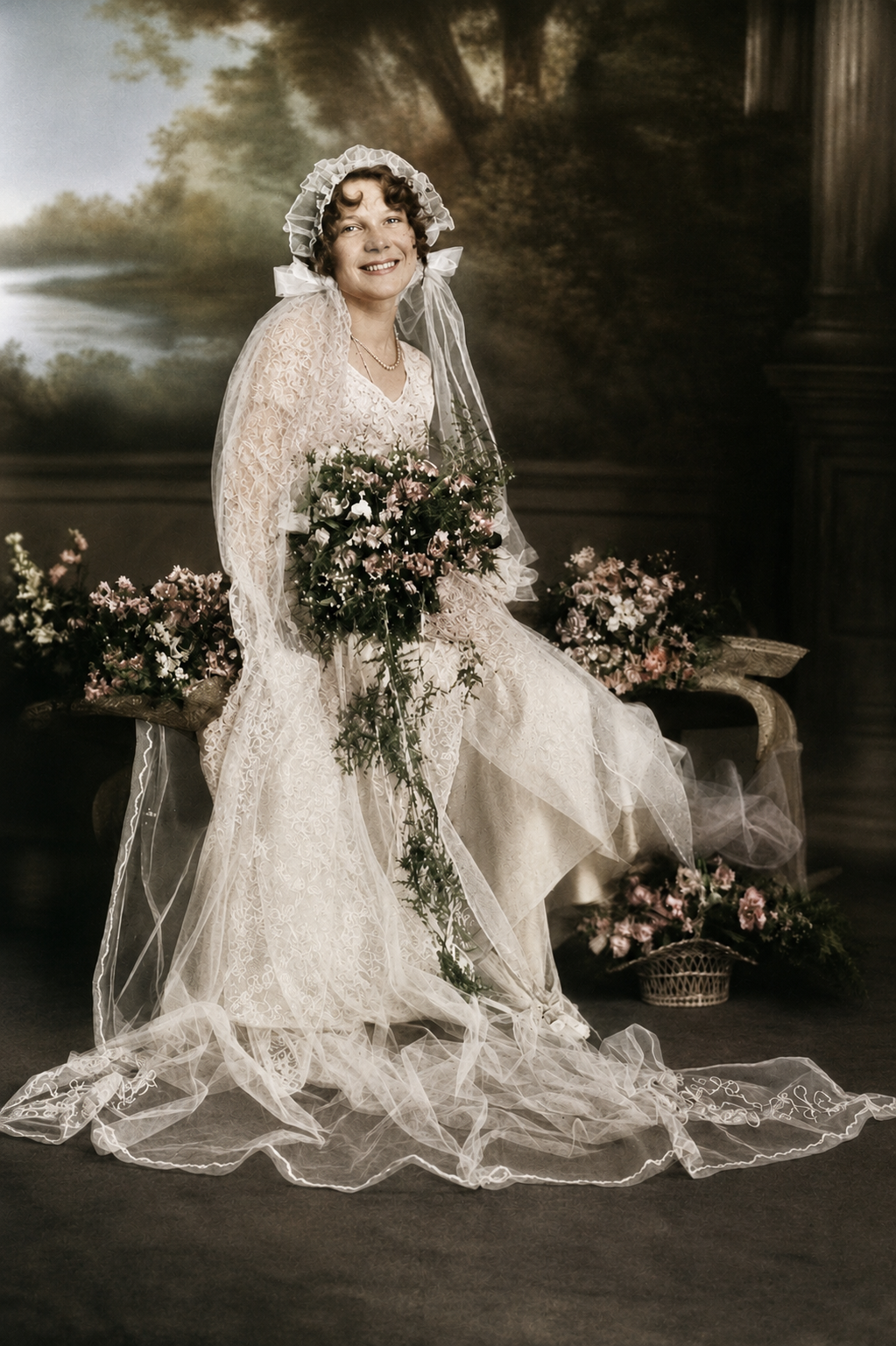
One hundred years of weddings
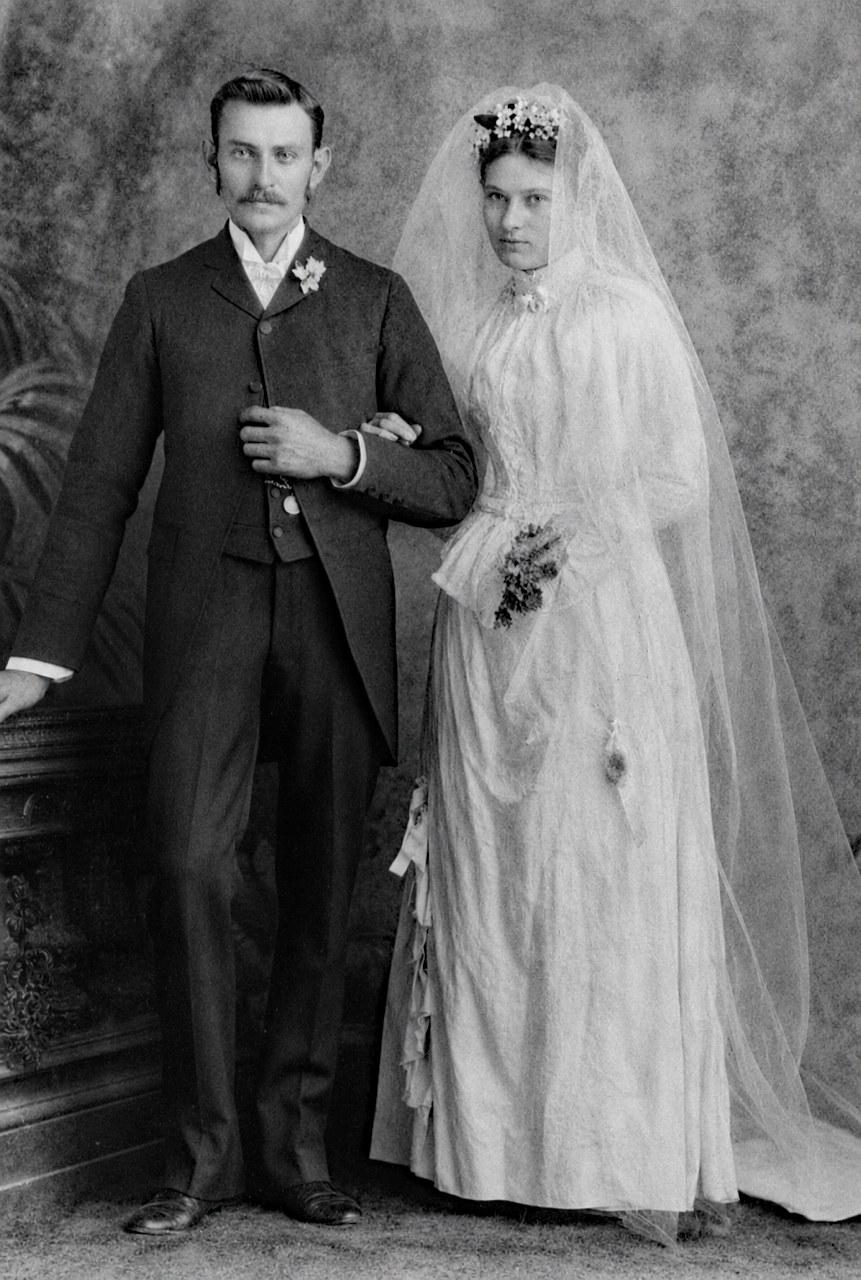
Over the years our photo gallery has grown, thanks to the generosity of relatives and friends who have shared their family pictures.
Our ancestors shared similar paths. They traveled from the old country to the new. They dealt with hardships in strange cities and homesteads. They made their way through hard and lean times. And when they could afford it, they'd bundle themselves off to the local photo studios to commemorate celebratory events, such as a marriage, a child's confirmation or graduation, or an anniversary.
Before home cameras were available and affordable this was the standard way to celebrate a rite of passage. And one of the most plentiful portrait types we have in our collection is a wedding.
Photography began -- and was accessible to many people -- about 1840, and families were anxious to document their own special events. Weddings were right at the top of desirable occasions.
In the middle of the 1800s wedding portraits were not always done in wedding clothes, but in best suits and day dresses after the service. The clue to indicate that it's a wedding portrait is the familiar pose of the couple: both standing, or one seated, signs of affection, one or both displaying a wedding ring. European portraits could show the bride wearing her wedding ring on the right hand rather than the left, which was customary in those regions.
Bridal white was not common until the 1880s and even later, so look for dark fabric dresses (which could be worn after the event for special occasions) with flowers or a distinctive veil.
Men wore their best suits, often with a boutonniere or a jeweled watch fob. Wedding photos were treasured and often copied, so the inscription on the cabinet card may reflect a later duplication rather than an original issue.
We have a plethora of wedding photos in our collection. It's fun (and instructive) to explore those images for details of the happy event. And if you have any wedding photos you'd like to share, please feel free.
If you'e interested in a good article on how to date wedding photos, try this one by Jayne Shrimpton.
For more information about photos on this page, click the image to be directed to the Photo Gallery webpage.
Latest updates
October 25, 2026: The weddings page is updated regularly with scans of family photos (some colorized for modern viewing) shared with us over the years. Have fun exploring!
If you have specific questions, find out more by contacting us.
1874: Fritz Burmeister and Helena Petersen, Leck, Schleswig-Holstein
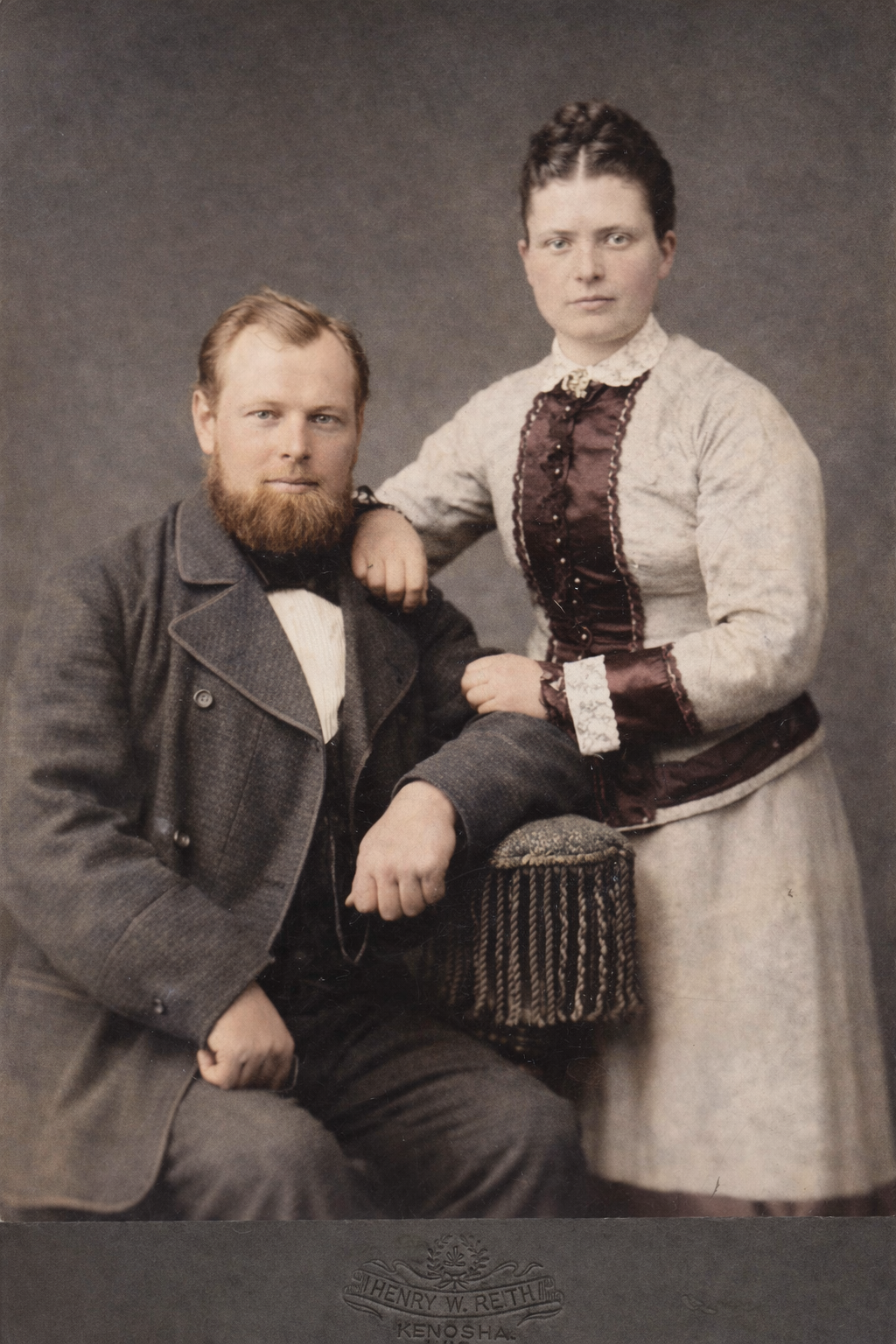
Helena Petersen was born in 1848 in Tinningstedt, the elder daughter of Peter Hansen Petersen and Elise Momsen. She was one of eleven siblings.
“Citation: Digital reproduction of a photograph, front side, collection of Cathie Meyer: Fritz Burmeister and Helena Petersen, 1874; original photograph shared by the owner, accessed 31 July 2026.
Helena may possibly have had an understanding with a Matthias Tygesen in 1871 -- perhaps a non-official betrothal -- but a marriage never occurred, and their son Matthias was born in December 1871. His godparents were Peter Hansen Petersen (his grandfather) of Leckfeld, Hans Peter Petersen (his cousin) of Tinningstedfeld, Maria Sievertsen (another cousin) of Leck.
In 1874 Helena married Carl Friedrich Heinrich Burmeister of Leckfeld. The verbose marriage document is actually online here at Archion.de (subscription required). Known to the family as Fritz, the happy couple posed for a wedding portrait. Helena is wearing a light-colored day dress with dark trim and Fritz wears a dark dress suit.
The bride stands, the groom is seated. I think this pose (common for the time) allows viewers to see the bride's dress in detail. Sharp-eyed viewers (see the enlargement here) can also discern a wedding band on Helena's right hand. Neither couple wears flowers. That was customary for post-services portraits.
Helena and Fritz never emigrated to the USA, unlike her parents and some of her siblings. She and Fritz raised Helena's son Matthias and ran a guest house in nearby Sillerup. This photo was probably taken in one of the photography studios in the region but has been copied by the Henry Reith studio in Kenosha, Wisconsin, where Helena's youngest brother Andrew lived. Interestingly our Nebraska Petersen cousins owned a duplicate cabinet card of Helena and Fritz.
1876: Carl August Friedrich Breetzke and Johanna Emelia Louisa Genrich, Nebraska
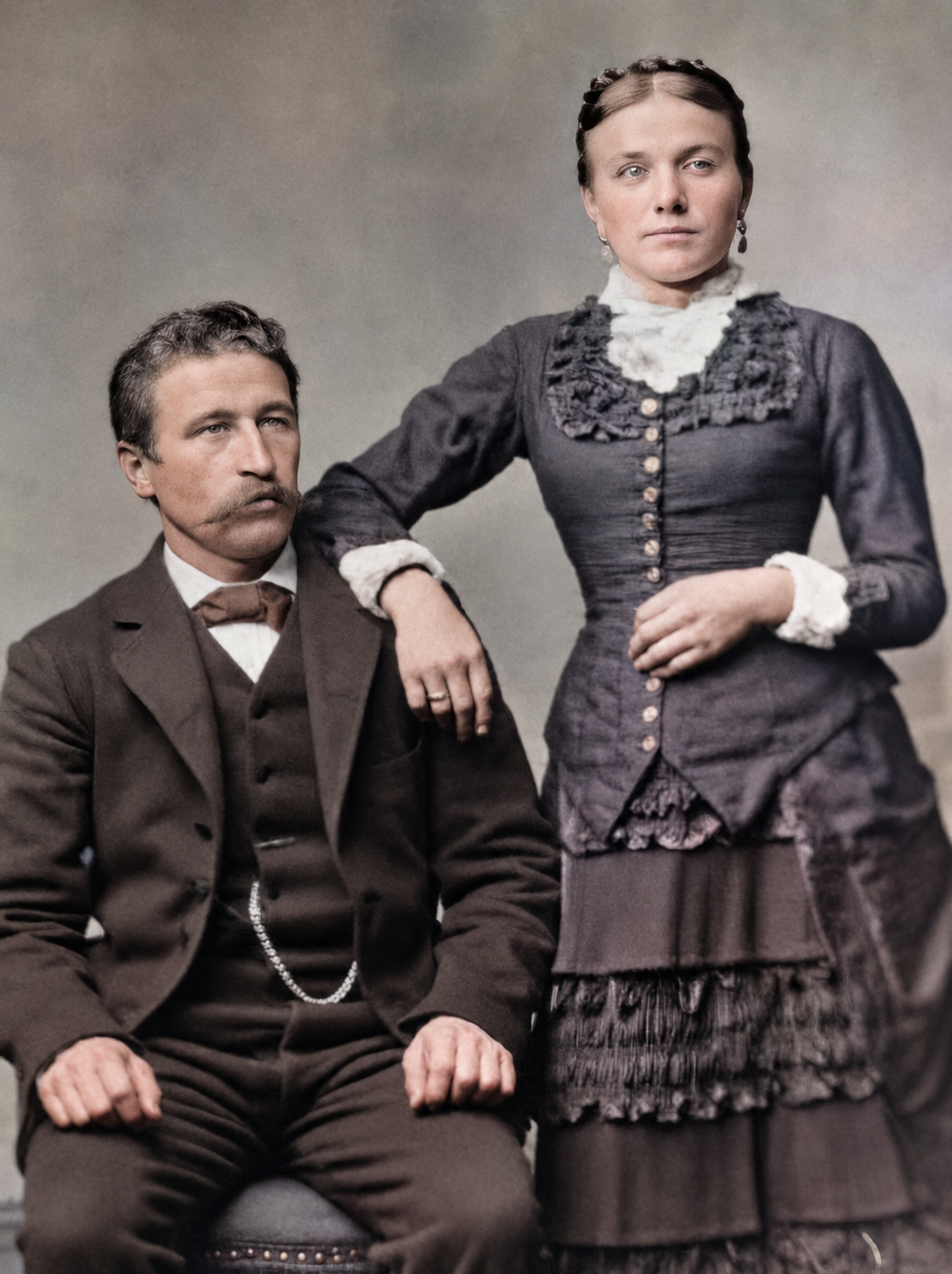
The Breetzke family wasn't part of our Chicago clan until the early 1930s, when Walter Breetzke married our cousin Florence Mikkelsen, but Breetzke relatives had been emigrating from the area near Woltersdorf, Pomerania for a generation or two. They particularly liked Cuming County, Nebraska, probably because of the cheap (or free) land, perfect for establishing a farm.
“Citation: Digital reproduction of a photograph, front side, media gallery collection of Rick Cochran: August Breetzke and Emilie Genrich, Cuming County, Nebraska, 1876, accessed 2 August 2026.
August, as he was known, was the son of Wilhelm Breetzke and Wilhelmine Köhler, and his baptism in 1852 in Woltersdorf was such an event that he had six godparents (two or three was the norm).
August emigrated to Nebraska in 1874 and married Johanna Emelia Louisa Genrich in 1876. This is their post-wedding portrait. As was typical for the time, Emilia wears a dark day dress, probably her best one, which would be useful for special occasions throughout the coming years. The dress has elaborate braiding. Emilie also wears earrings and displays her new wedding band on her right hand in the European custom.
August is seated, wearing a nicely tailored suit and deftly tied bowtie, with a prominent watch chain displayed from his vest.
The towns of Cuming and Wisner were replete with August's brothers, including William and Robert. We know how these folks are related to our Walter Breetzke of Chicago because a newspaper article celebrating Walter's marriage to Florence in 1934 refers to his uncle Robert of Nebraska, and Robert was August's younger brother.
August and Emilie had seven children. August died in 1910. His will left everything to Emilie "as long as she remains my widow," a curious way of suggesting that his wife not remarry...and as far as we know, she didn't, remaining a window until her own death in 1942.
1878: Hans Petersen and Catharina Petersen, Belle Prairie, Nebraska
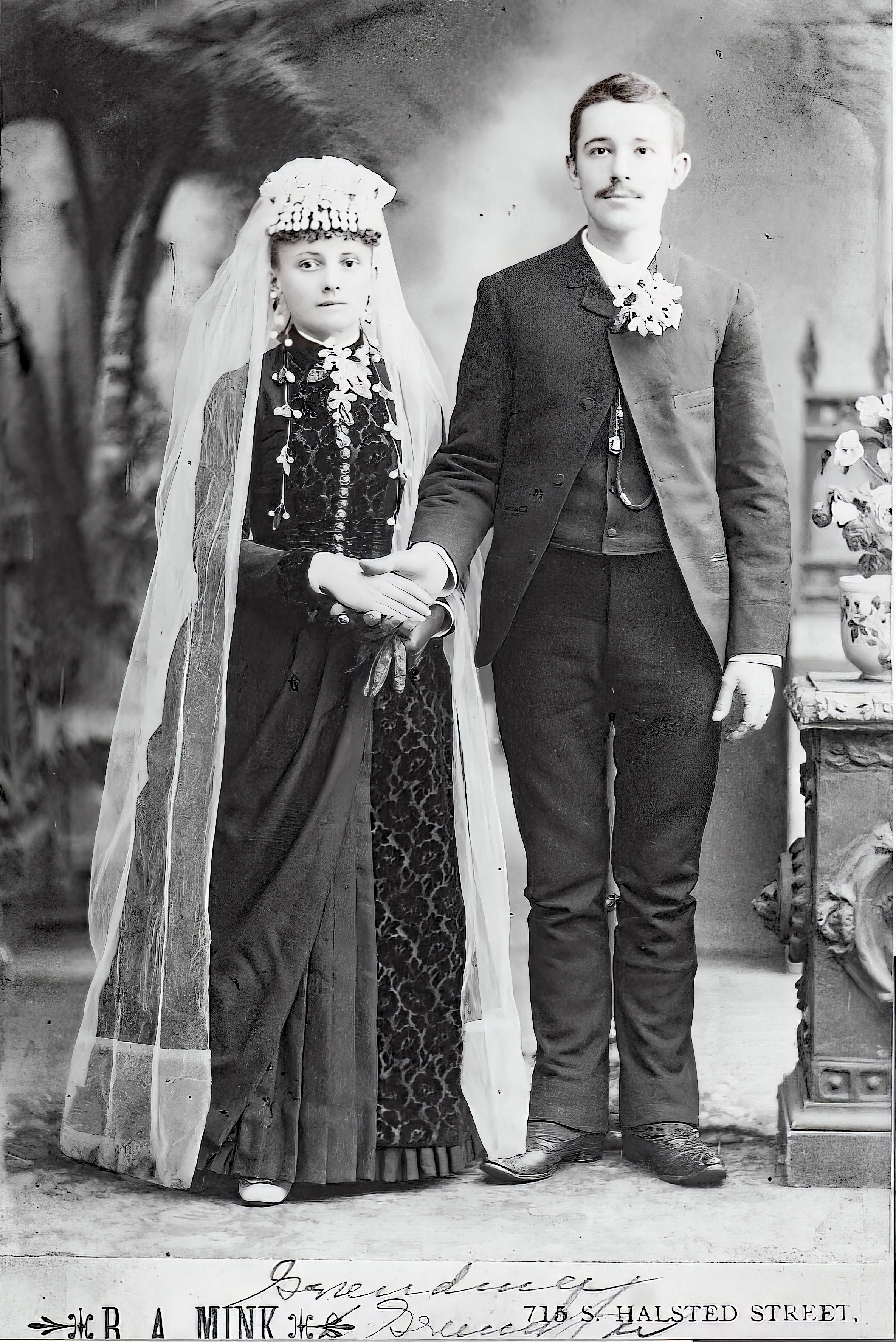
Not only was this the first antique wedding photo in our collection, it's my favorite as well. Hans and Catharina were my great-grandparents. They were first cousins too, marrying at a time when first cousin marriages were perfectly legal (if not common) both in Nebraska but also in Schleswig-Holstein where they were both born.
“Citation: Digital reproduction of a photograph, front side, collection of Cathie Meyer: Hans Petersen and Catharina Petersen, 1878, original photograph shared by the owner, accessed 3 August 2026.
Hans and his parents, Lorenz Petersen and Magretta Jensen Petersen, emigrated to Belle Prairie in 1872 where they established a prosperous farm. Lorenz' brother Peter Hansen Petersen, his wife Elise Momsen Petersen, and most of their children emigrated in 1878. Three weeks after they arrived in November of that year they were in Belle Prairie for their sixteen-year-old daughter's wedding to Hans.
Hans was twenty-nine. The marriage must have been planned for some time. The photo suggests that Catharina's trousseau was carefully packed for the trip. Her gown is just right for the period, probably a dark brown, green, or blue that could be adapted for formal wear after the ceremony. She wears an elaborate veil and floral cap with a string of vine blossoms around her neck, a style common in immigrant brides from Germany and Scandinavia. In her left hand Catharina holds a pair of dress gloves. She looks a little terrified -- naturally, she was just a teenager in a new land marrying a cousin whom she hadn't seen for six years.
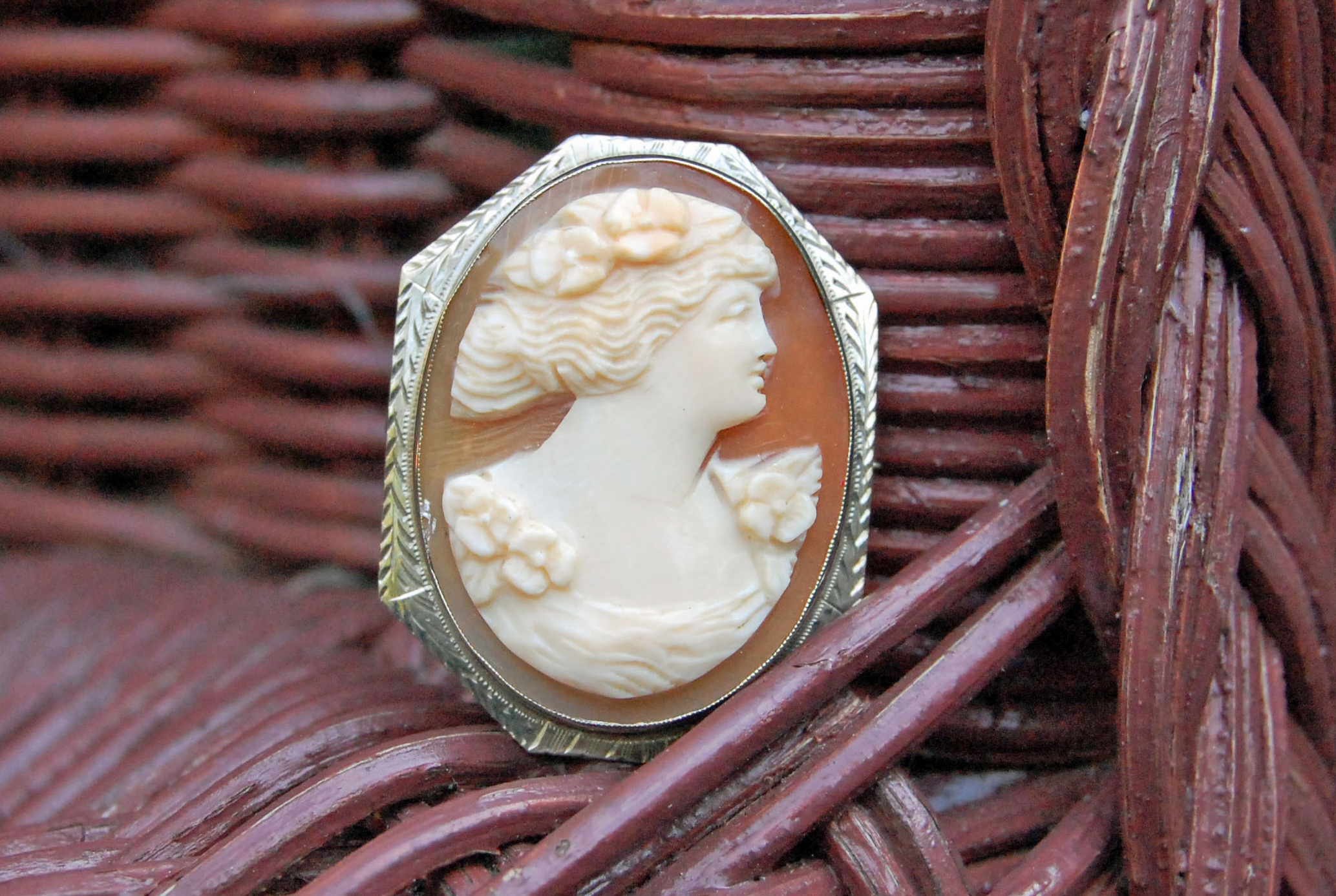
Hans wears his best suit, jacket buttoned at the top. His boots are a little worn but polished. The hand-holding is a nice touch. He has a nice corsage at his lapel. His watch fob includes a distinctive ornament: a cameo in an angular silver frame. The cameo, interestingly, survived and has been handed down to be part of our collection of jewelry.
The original photo was probably taken at a local studio and was later copied at R.A. Mink studio in Chicago, where Hans and Catharina, plus their eleven children, later lived. The pencilled inscription "Grandma and Grandpa" was written by one of the grandchildren, of whom there were many, and we're lucky to have it. So far as we know it's the only photo of Hans, who died in 1905. Catharina kept this in her collection until her death in 1944.
1885: Friedrich Kruschke and Elizabeth Wienand, Eau Claire, Wisconsin
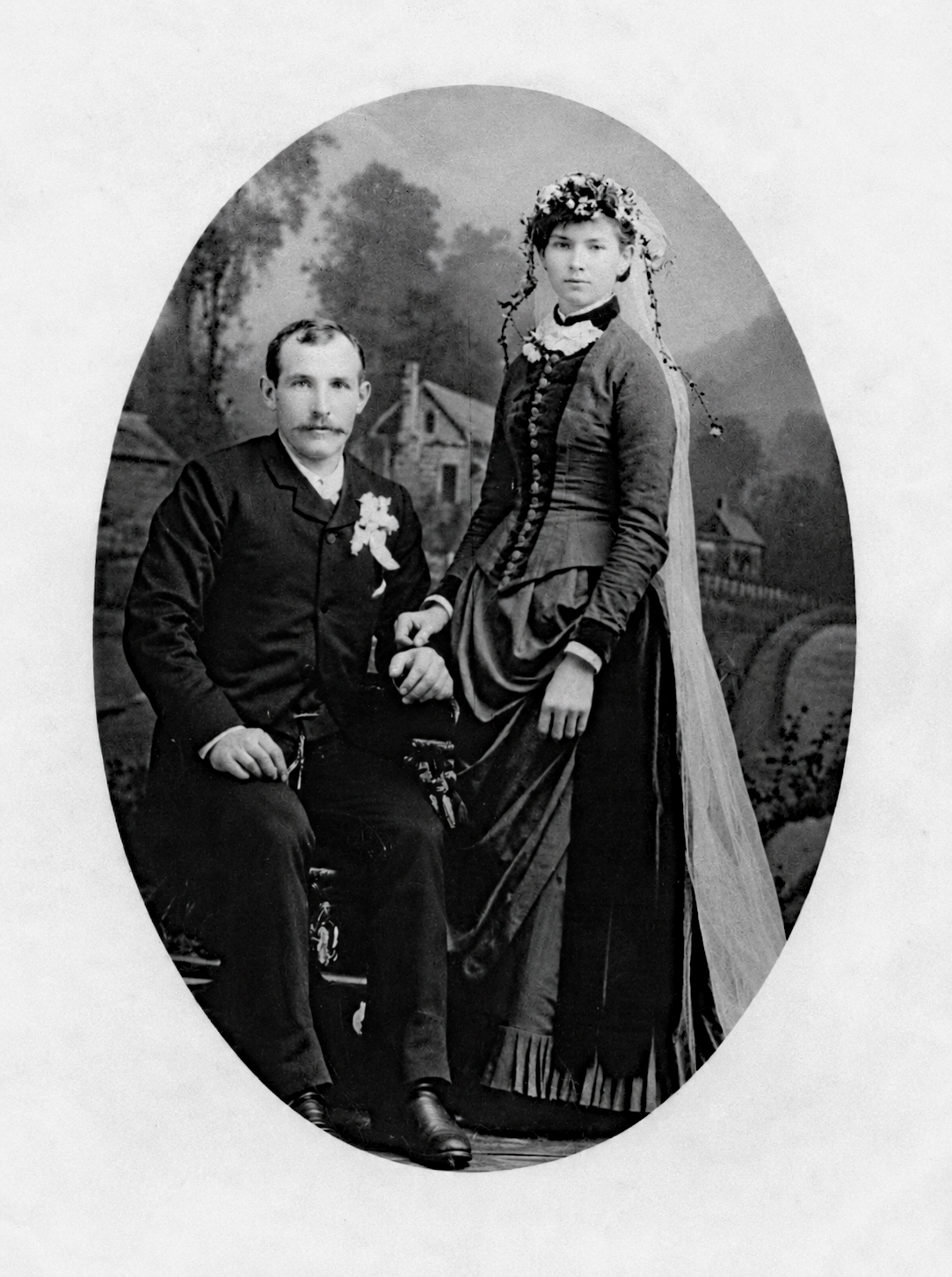
The Kruschke family of Eau Claire, Wisconsin have Friedrich Hermann Kruschke and Elizabeth Wienand at their helm. These two German immigrants (Friedrich was born in Köningsburg, Germany, Elizabeth from Zellin, Prussia) married at St. John's Lutheran Church in Eau Claire on November 25, 1885, which was Thanksgiving Day.
“Citation: Digital reproduction of a photograph, front side, collection of aprilbc3, Kruschke Family Tree: Friedrich Hermann Kruschke and Elizabeth (Elise) Wienand, Eau Claire, Wisconsin, 1885, accessed 3 August 2026.
The couple had seven children. Their eldest, Martha, married Louis Jatho of our Chicago Jatho clan in 1917. Without the voluminous photo collection of the Kruschke family we wouldn't have any photos of Louis. They loved documenting family gatherings and events.
Friedrich and Elizabeth were photographed in an unknown studio in Eau Claire in their wedding finery. Elizabeth maintains the custom of wearing a dark dress suitable for later evening wear, with velveteen trim and decorative buttons, plus a distinctive pleating at the hem of the dress. Her veil is attached to a floral wreath with a cascading vine of leaves.
Friedrich wears a good suit with what looks like an orchid in his lapel, a watch chain, and nicely polished new boots. He's seated, she's standing, with her right hand shyly touching his arm. The background is fanciful and pastoral.
In 1935 the Kruschkes celebrated their 50th wedding anniversary at their home at 415 Maple Street, Eau Claire and were feted in their local newspaper for this accomplishment. Over 100 guests attended the Golden Anniversary celebration with four guests who were present at their wedding all those years ago.
1887: William George Jatho and Jennie Juliana Caroline Müller, Charleston
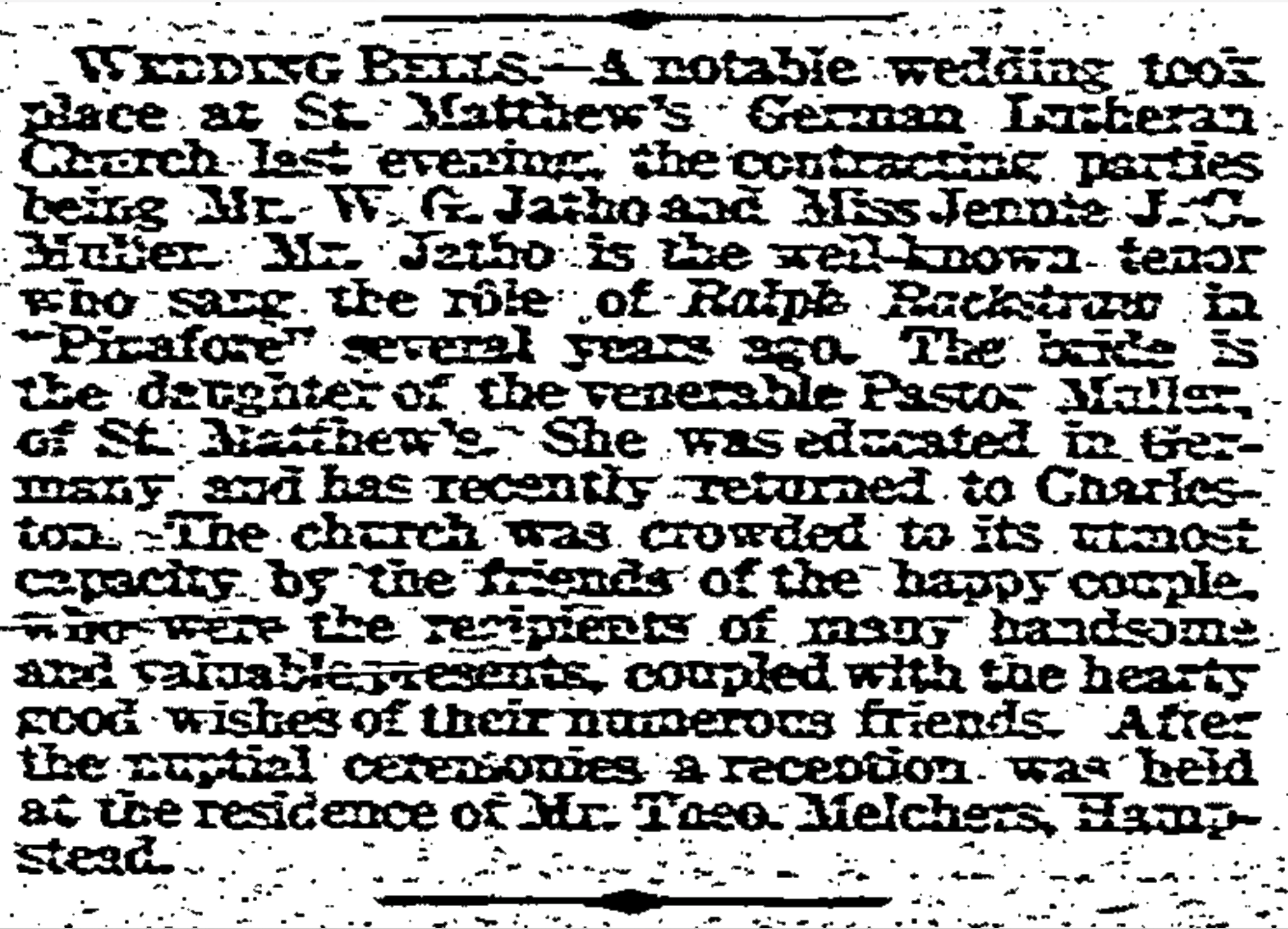
So where's the photo of this happy couple? Goodness knows. One of the areas where we're missing images, wedding and otherwise, includes the Jatho and Müller families of Charleston, South Carolina. All we have is this news clipping to prove that it happened.
“Citation: Digital reproduction of a newspaper article, Genealogybank.com, "Wedding Bells," Charleston (South Carolina) New and Courier, Thursday June 2, 1887, page 8, accessed 3 August 2026.
Considering how relatively prominent this couple and their families were in Charleston you'd think that a wedding portrait would have been de rigueur, and perhaps it was. But it hasn't survived. No photos of this couple (my great-grandparents) has survived. We have very few of the Müller clan, almost none of the Jathos.
What happened? A flood, a fire, an archive left behind or thrown out? We have no clue.
In cases like this sometimes the newspapers come to our rescue. This sounds like it was a lively, well-attended event. The couple in their pre-married state was well known in town for their popularity as light opera singers. William's late father had been a jeweler and watchmaker in Charleston, and his mother was the daughter of the haberdasher Louis Schuckmann. Jennie needed no introduction in the newspaper. Her father was the renown German Lutheran pastor, Rev. Ludwig Müller of the church where they were married.
Sometimes if you're lucky the newspaper reporter will comment on the flowers, the colors of the bridesmaids' dresses, the details of the reception. That can be helpful to paint a picture when the image itself is lost.
Perhaps in time some archive will open and provide the missing photographs. We can only hope.
1889: Andrew Petersen and Karen Marie Johansen, Nebraska
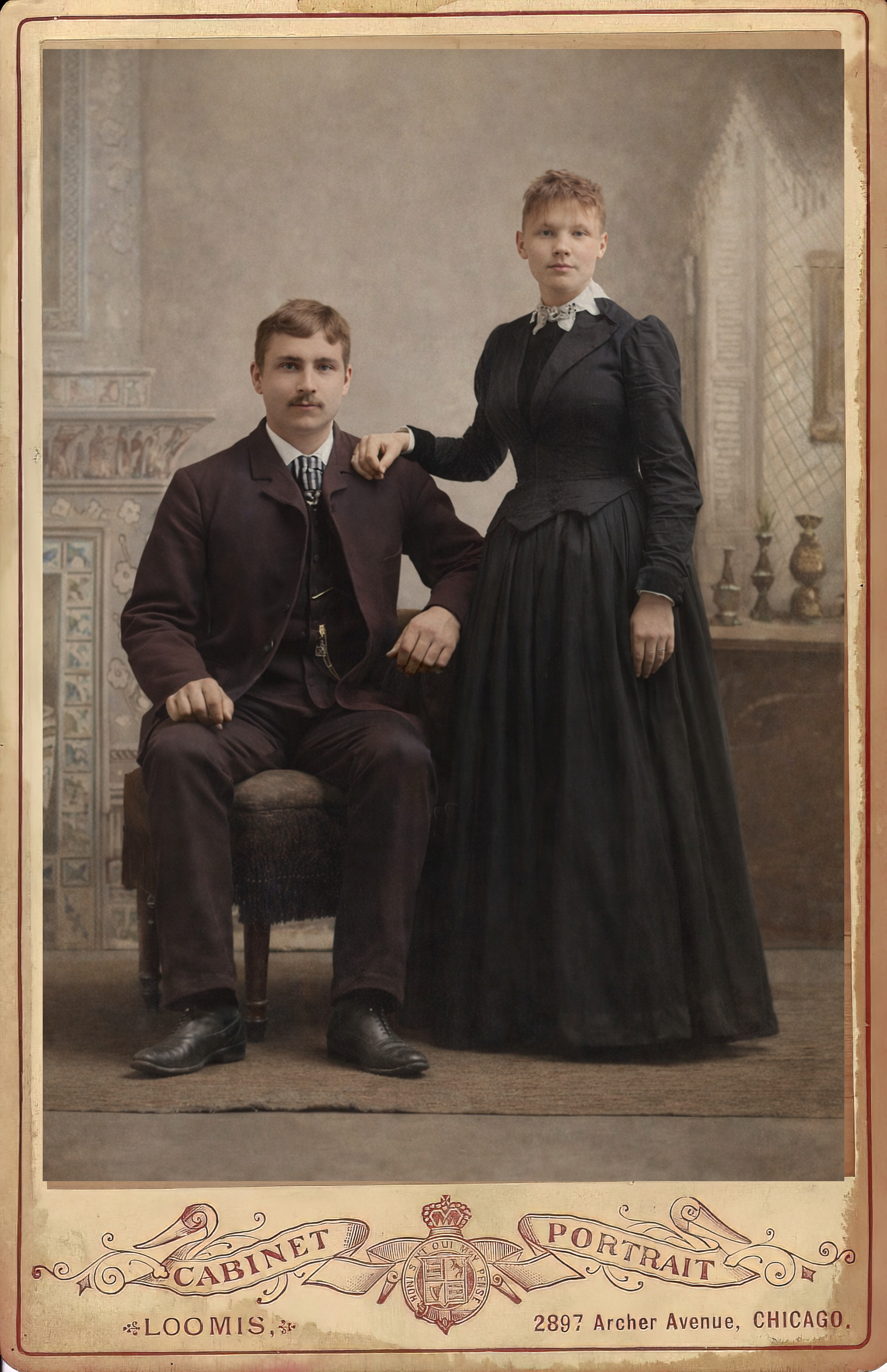
Andreas (Andrew) Petersen, one of twins (his brother was Ludwig/Louis) was born in January 1867, the son of Peter Hansen Petersen and Elise Momsen. He and his siblings emigrated to Nebraska in 1878 for their sister Catharina's wedding to cousin Hans Petersen.
“Citation: Digital reproduction of a photograph, front side, collection of Cathie Meyer: Andrew Petersen and Karen Marie Johansen, 1889, original photograph shared by the owner, accessed 4 August 2026.
Andrew's bride, Karen Marie Johansen, was the younger sister of two other Petersen brides in Nebraska. She was born in 1870 in Maribo, Denmark (a true Dane!) to Johann Carl Semelin and Kristin Maren Nielsen. Semelin seems to have been an occupational or location surname that her father used. She and her two sisters used the patronym Johansen when they married in the USA.
For their 1889 wedding portrait Karen Marie wore a dress of dark fabric with a white lace collar, her hair fashionably frizzed in front and fastened in a bun at the top of her head. The sleeves show a hint of puckered gathers that would become full puffs several years later. Her right hand is draped affectionately on Andrew's shoulder.
Andrew, seated, was twenty-two years old. His dark suit is fashionable for the time, with a striped cravat or tie and a jaunty watch chain decorating his ensemble. New boots, it appears.
The original photo was probably taken in the county of York, Nebraska where the marriage took place. It was later copied at the Loomis Studio on Archer Avenue in Chicago. It was around this time that Andrew and his older sister Catherine Petersen relocated to the Chicago area after their time farming in Nebraska. They left behind brothers Peter Edlef (Alfred), Peter Hansen, Louis (Andrew's twin), and Hans Peter, who remained in Nebraska.
Andrew and Karen Marie had six children, some born in Illinois, some in Kenosha, Wisconsin, where they finally settled. Andrew died in 1918 at 51 years old. Karen Marie remarried a windower, Christian Feldschau, in 1919.
1889: Albert Heinrich Gustav Riemer and Rosalia Meyer, Wisconsin
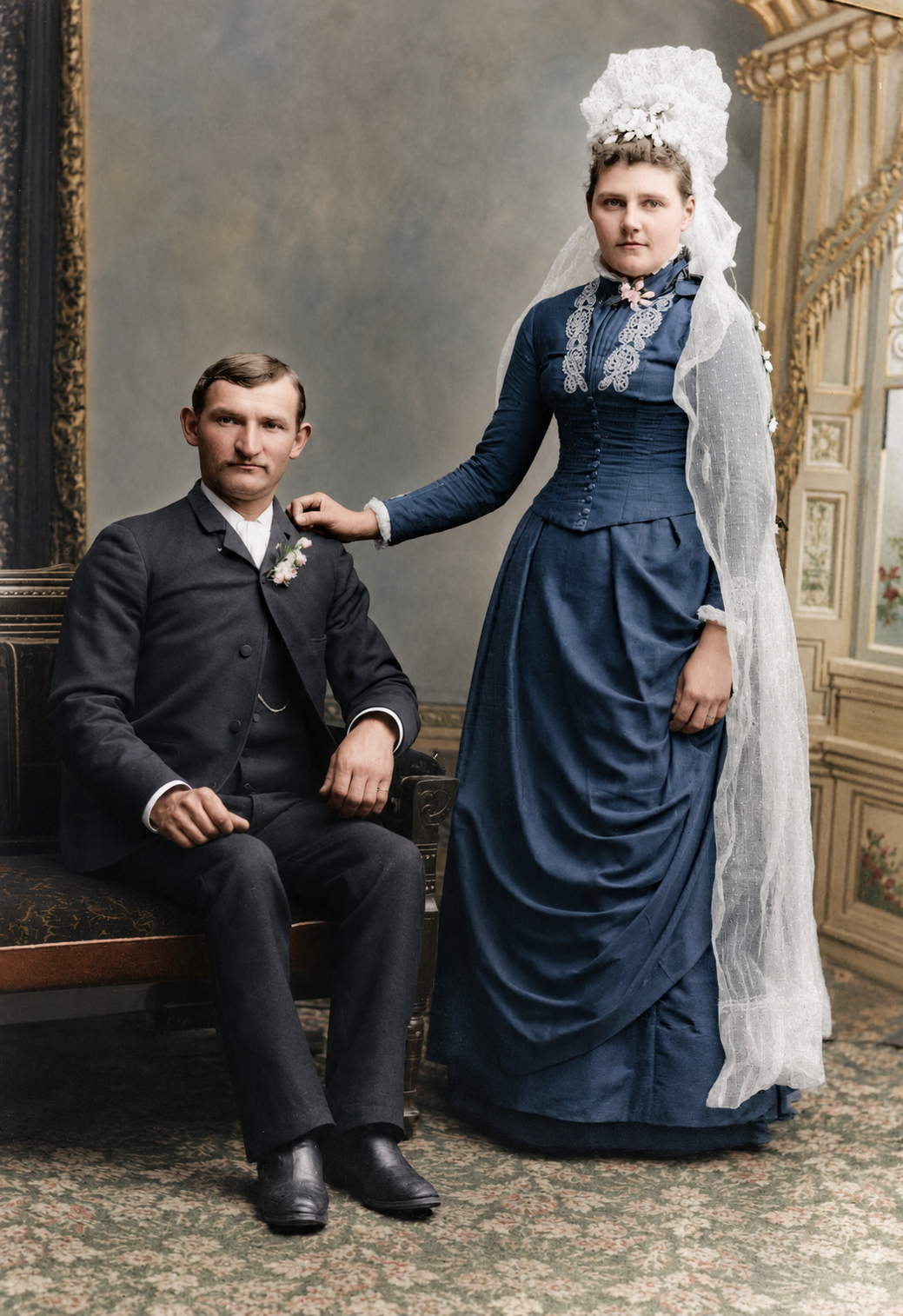
The Riemer clan emigrated from Pomerania to Jefferson County in Wisconsin during the middle 1860s and are related to our Petersen/Mikkelsen families by marriage. Albert Riemer, here pictured with his bride Rosalia Meyer, as an uncle of Adolph Riemer who married Catherine Bothilde Mikkelsen in 1908.
“Citation: Digital reproduction of a photograph, media gallery, collection of Richelle Ann Kemnow: Albert Heinrich Gustav Riemer and Rosalia (Rose) Meyer, 1889, original photograph shared by the owner, accessed 4 August 2026.
The bride, Rose, was actually born in Ellington, Outagamie County, Wisconsin, residing in Watertown from 1870 onward, hence the selection of the marriage place -- usually the bride's parish.
Rose wears a closely fitted dark gown with an elaborately folded overskirt and a vest-style top with lace decorating the bodice, closed with fabric-covered buttons. There appears to be a corsage at the collar, mirroring the floral cap she wears. Behind the cap is a kind of fabric fan, giving the whole arrangement a kind of towering appearance as her filmy veil cascades down to her feet. You can just make out a flowering vine following the lines of her shoulder and dropping down next to the veil.
Albert, seated, wears the standard tailored dress suit, no tie, white shirtfront, with a delicate lapel corsage and watch chain from his vest. As is customary with these poses, the bride's right hand rests on her bridegroom's shoulder. The background of this photo from an unknown studio in town seems to have actual decor (a mirror and curtains) rather than a painted backdrop more common in photos of this era.
Albert and Rose had nine children. Albert died in 1941, Rose in 1953.
1894: Christian Feldschau and Anna Katharina Brodersen, Flensburg
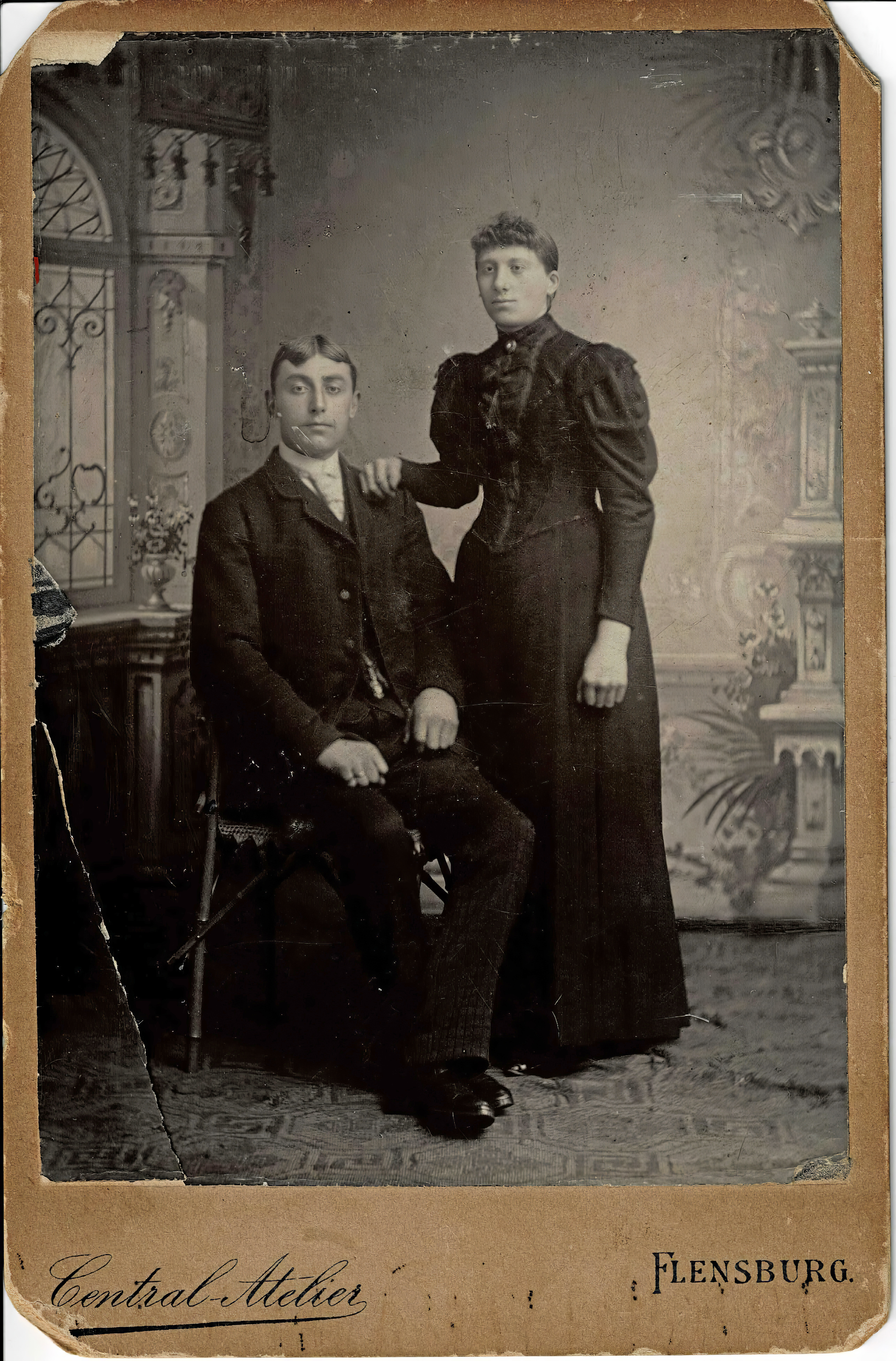
Although this photo was taken Central Atelier in Flensburg, Schleswig-Holstein, the portrait looks just like those produced at studios in the United States.
“Citation: Digital reproduction of a photograph, media gallery, collection of April Ober, McKechnie-Farrell Family Tree: Christian Feldschau and Anna Katharina Brodersen, 1894, original photograph shared by the owner, accessed 4 August 2026.
Christian Wilhelm Nicolai Feldschau was born in 1869, one of the largest cities in Schleswig-Holstein. He married Anna Katharina Brodersen in 1894.
The photo was taken at the Central Atelier (Studio) in Flensburg, using a painted backdrop similar to those used at American photo studios. Anna's dress is up-to-date for the time, showing the evolution of puffy sleeves that were popular in the middle of that decade. Dark in color, it's still form-fitting with a high collar and fabric trim under the buttons. There's a small cameo at her collar, perhaps a family heirloom. Like other wedding photos in our collection, her right hand rests on Christian's shoulder. This must have been a popularly-suggested pose.
Christian, seated in a wicker chair, displays his best suit with a white tie and shirt, a watch chain just visible under his partially open jacket. These are clothing styles suitable for after the wedding ceremony and practical for formal occasions of all types.
Christian and Anna had four children, two of whom died young. The couple and their two surviving children, Henry and Margaret, emigrated to Wisconsin in 1906 and settled in Kenosha. This is where Andrew and Karen Marie Petersen lived as well, and it may be that the Feldshau and Petersen families were acquainted there.
Anna Feldschau died in 1913. A year after Andrew Petersen died in 1918, Christian and Karen Marie Petersen were married, thus making Christian a part of our family.
1895: John Schuchmann and Rosa Anna Sippel, Carlyle, Illinois
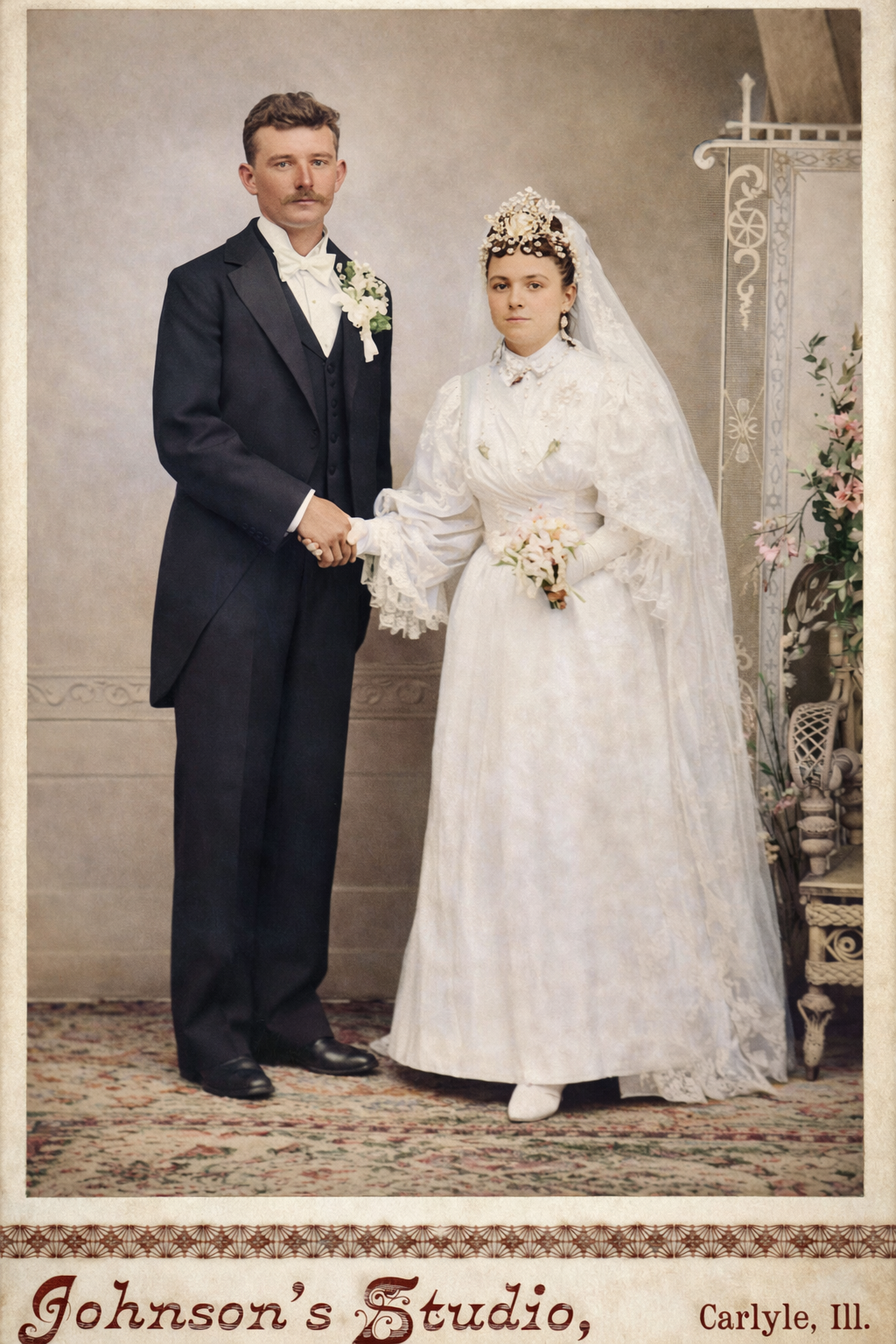
It's our first white wedding, and what a festive affair it was! John Schuchmann was part of our Schuchmann family, and tracing his line back with ours you'll reach the same ancestor, Peter Schuchmann, who was born in 1604 in the village of Hausen, Hesse-Darmstadt. John's family settled in Illinois, ours in South Carolina, but the ancestry remains the same.
“Citation: Digital reproduction of a photograph, media gallery, collection of Janet Adams Turnage Turnage-Schuchmann Family Tree : John Schuchmann and Rosa Anna Sippel, 1895, original photograph shared by the owner, accessed 4 August 2026.
John Schuchmann was the son of George Augustus Schuchmann. George Augustis emigrated to Clinton County, Illinois in 1855, married Elizabeth Gerold, where they farmed and raised seven children. John, born in 1869, married Rosa Anna Sippel in 1895 at the German Evangelical Church in Carlyle. She was the church organist and much admired in the community during her short life.
Rosa wears a white dress, a stle that had become popular ever since Queen Victoria's all-white wedding in England in 1840. It was somewhat daring because it was a color that didn't lend itself readily to post-wedding occasions unless it was altered by a dressmaker (à la May Welland Archer in Edith Wharton's "The Age of Innocence"). But it was the fashion when Rosa was married.
The sleeves are full and open, trimmed with white lace, Rosa wears earrings and a full white veil with a floral cap. Her wedding slippers are also white. Her bouquet is small and delicate.
The bridegroom wears white-tie-and-tails, also a break from the portraits we've seen heretofore because this is not a suit that could be worn after the wedding for anything but very formal situations. John wears an elaborate corsage and grasps the bride's gloved hand. The cabinet card portrait was local from Johnson's Studio in Carlyle.
John was 26, Rosa was 18. They had four children before Rosa suffered a fatal lung embolism and died at 27 years old in 1904. A newspaper clipping at Ancestry.com (subscription required) described the funeral cortege as the longest that had ever been seen in town.
1895: Matthias Petersen and Esther Luise Möller, Karlum, Schleswig-Holstein
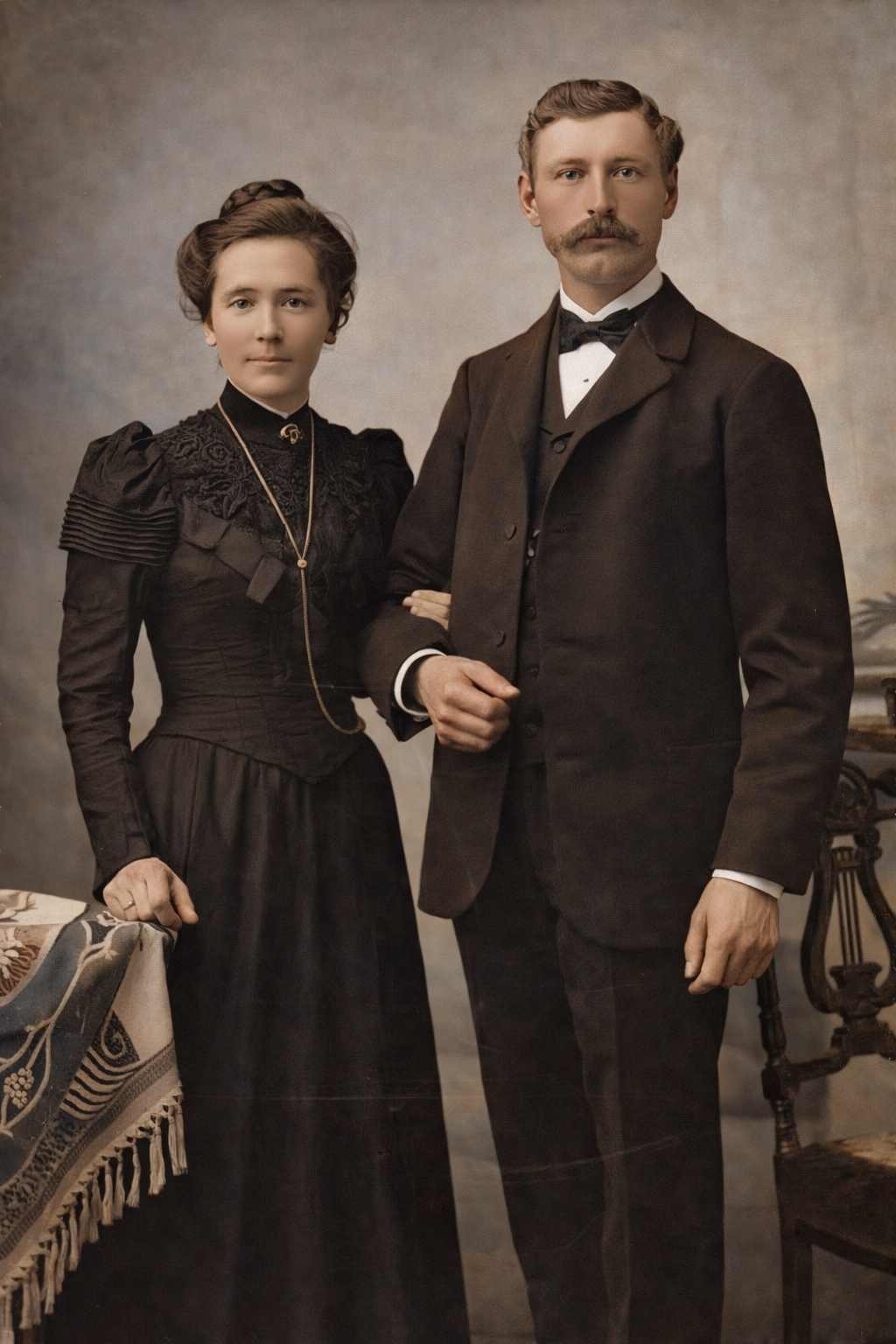
This distinguished couple belongs to our Petersen clan of Schleswig-Holstein, and their post-wedding attire looks just right for the era. Matthias Petersen was the son of Helena Marie Petersen, the lady at the beginning of our wedding photo exploration. On December 27, 1895 he married Esther (sometimes spelled Ester), daughter of Hans Hansen Möller and his wife Botilla Petersen in the nearby village of Weesby.
“Digital reproduction of a photograph, front side, collection of Mario Petersen: Esther Luise Möller and Matthias Petersen, Karlum, Schleswig-Holstein, 1895, original photograph shared by the owner, accessed 4 August 2026.
The parish where the marriage took place was Karlum, also close by. Some of our Petersen families were still living in the region where their cousin Matthias and his bride were married and may have attended the services.
Esther's dress is as practical as it is elegant, a dark fabric suitable for post-wedding fancy attire. It includes little cap sleeves and decorative lace and braid trim on the bodice, where a small (presumably gold) brooch is pinned to her collar. Her hair is coiled on her head, and she wears a chain that may include a watch in a pocket near her hip. You can see clearly her new wedding band on her right hand, European style.
Matthias has a stylish suit with a vest and dark tie. The couple pose in a local photography studio with a painted background and a table with a tasseled, embroidered cloth, Matthias offers his arm to his bride and she grasps it affectionately.
Matthias and Esther settled in the nearby village of Dithmarchen and had seven children together. They celebrated their anniversaries with family and relatives througout their fifty years of marriage.
1895: Ernst Lehrmann and Mary Anna Kaufmann, Milwaukee, Wisconsin
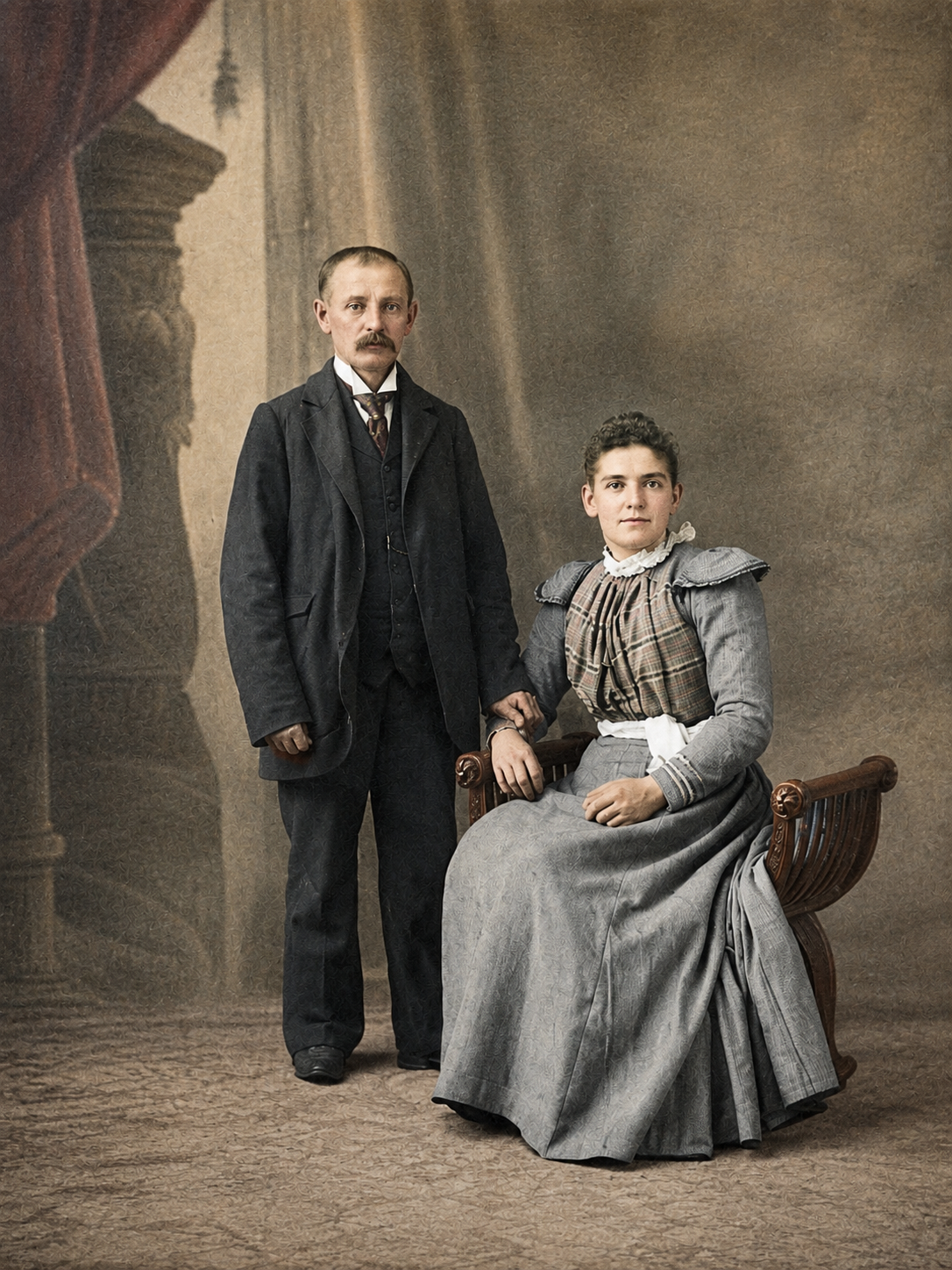
Cudahy was a small suburb of Milwaukee in the late 1900s. Ernst Lehrmann, born in Leipzig, Saxony, married Mary Anna Kaufmann, who had been born in Berlin. Their marriage was one of the first performed in Cudahy.
“Citation: Digital scan of a photograph, collection of Patrick Lehrmann, marriage of Ernst Otto Lehrmann and Mary Anna Kaufmann, 25 November 1897, Milwaukee, Wisconsin, accessed 5 August 2026.
Unlike some of our other wedding photos, Mary Anna is shown seated. She's wearing a formal gown with cap sleeves, which replaced the "leg-o-mutton" fashion of just a few years earlier. There's a distinctive plaid design on the bodice of her dress, echoed at the wrists, a white lace colar and white sash, and a full skirt. Her hair is arranged in a coil at the top of her head.
Ernst wears his best suit, cut a little long in the sleeves, with a black tie and white shirt with a starched collar. Just visible on his vest is a clasp to which a chain is attached, probably with a pocket watch at its end.
Ernst and Mary Anna had six children in Cudahy. One of them, Arthur Frank, married Margaret (Marge) Petersen in 1930.
1899: Martha Gaul and Herman Edward Zick, Stevensville, Michigan

The Gaul family of Berrien County, Michigan may not have known that they had cousins in Chicago, but they did. The Gaul surname was once spelled Gohl and these ancestors lived in Trzebiatkow, Kreis Bütow, Pomerania.
Our common ancestor was Johann Christian Gohl, born in 1767, who was married to Maria Elisabeth Grulich. One of their daughters, Dorothea Elisabeth, married Paul Kramp. The Berrien County Gauls were descended from Dorothea's brother August Gotthilff.
“Citation: Digital scan of a photograph, media gallery, collection of Thomas Owen, marriage of Martha Gaul and Herman Edward Zick, 20 JUne 1899, Berrien County, Michigan, accessed 5 August 2026.
Leo Frederick Gaul, Johann Christian's grandson, emigrated from Trzebiatkow in 1881 and settled in Berrien County, where he was a farmer. He and his wife Augusta Wilhelmine Kaufmann had four daughters and a son. Martha Gaul was the eldest child, born in 1882, so in this wedding portrait she was just shy of seventeen years old.
Martha wears a dress that's only slightly out of date, if the puffy sleeves are any indication. It might have been cut down from her mother's wardrobe. The neck and bodice are decorated with an alternating pattern of white and black stripes, she wears a floral corsage, and a chain at her collar drapes toward the left shoulder where a watch is probably pinned.
Herman stands next to his bride, holding her hand. His suit looks very new, and he also has a floral corsage and watch chain, plus a nice touch in his left hand, a book that may very well be a communion bible. The studio background is spare, a painted backdrop displaying an ornamented candelabra.
Martha and Herman had five children and made their home in Stevensville. Herman died in 1937, Martha in 1949.
1900: Louis Peter Petersen and Anna Majoros, Chicago, Illinois
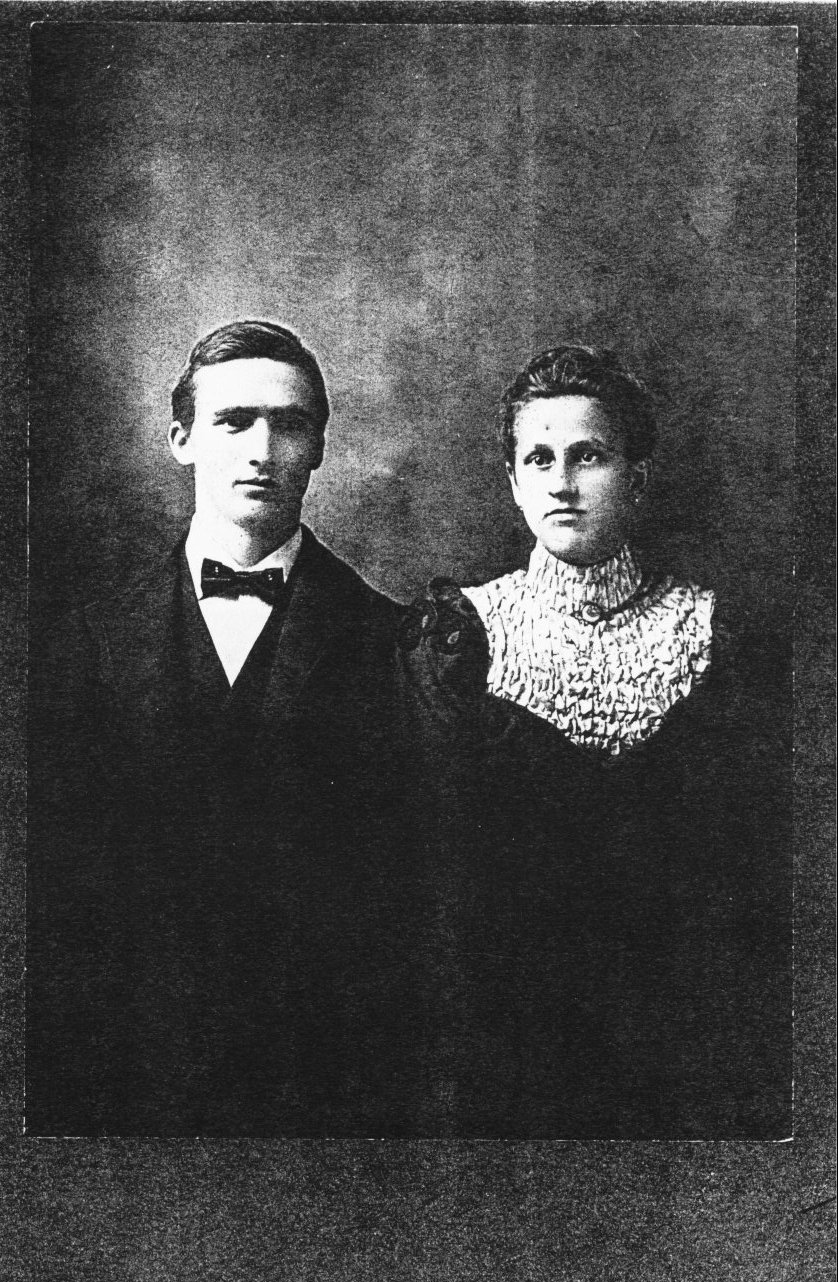
Louis originally Ludwig) Peter Petersen was the oldest child of my great-grandparents, Catherine and Hans Petersen. Born in 1880 in Fremont, Nebraska, he moved to Illinois and Wisconsin with his family as they sought their livelihood. Hans was a laborer and farmer, working to support the family of eleven children.
“Citation: Digital reproduction of a photocopy of a lost photograph, collection of Cathie Meyer: Louis Peter Petersen and Anna Majoros, 1900, photocopy shared by the owner, digitally restored by Bruce Dumes, accessed 5 August 2026.
It may have been in Brookfield, Wisconsin where Louis met Anna Majoros, who was born in 1883 either in Austria or Bohemia to Albert Majoros and maria Scholka. Their marriage record has not been located. Their first child, Henry Albert, was born in Wisconsin, the rest of their ten children in Illinois.
Louis and Anna pose in a rather unusual shadowy portrait, probably just after their wedding. The original photo is lost but a photocopy of the original exists without any studio information.
Anna wears a dark dress with a ruffled white colar and a hint of slightly puffed sleeves. A brooch of some sort is fastened to Anna's collar and her hair is piled on top of her head.
Louis wears a dark suit, white shirt, and dark tie with a contemporary-looking sideswept hairstyle. No jewelry appears present, but there may have been a watch chain or similar item out of the camera's range.
Interestingly Anna's younger sister Agnes Majoros, born in 1898, married another Petersen brother, George Christian, in 1917.
1902: Hermann Breetzke and Mathilde Moede, Woltersdorf, Pomerania
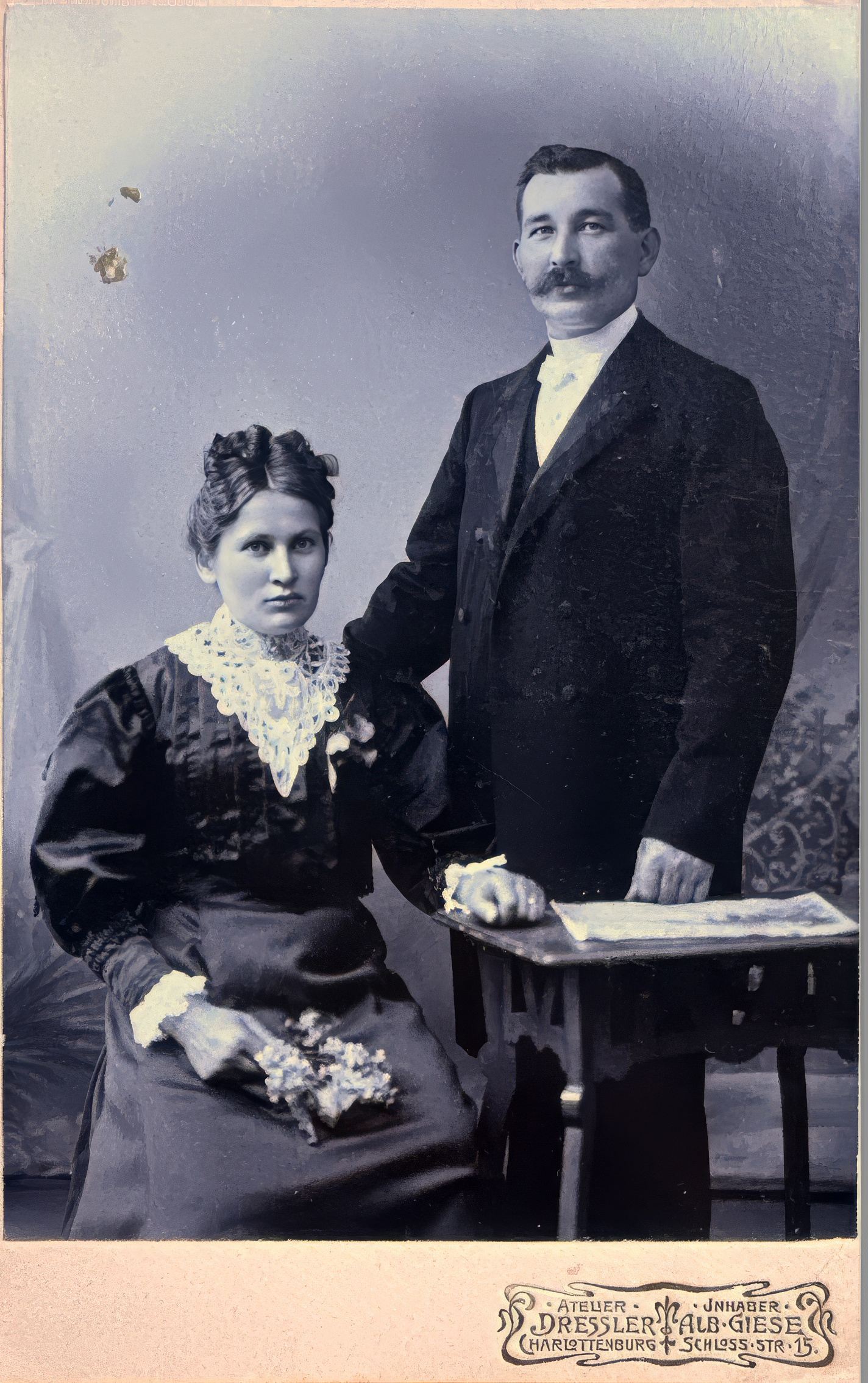
The Breetzke family was a prolific presence in the towns of Woltersdorg and Silberberg in Pomerania, which is where our ancestor Walter was born about 1902. He and his brother Erich both emigrated separately to Chicago, each reporting that their father was Hermann and their mother Mathilde. We're fortunate to have a picture of their parents on their wedding day about 1902.
“Citation: Digital reproduction of photograph, collection of Richard Hughes: Hermann Breetzke and Mathilde Moede, accessed 25 August 2026.
We lack any documentation for Hermann's and Mathilde's wedding but Erich's death certifictate in Chicago gives her first and last name, so we'll work with that for now.
The couple had their wedding photo taken at the Dressler Alb-Giese studio in Charlottenburg, near Berlin. As was typical for the time, the couple wore their wedding clothes to the photography studio for a post-ceremony portrait.
It was still customary for the bride to wear a dark but stylish dress, something she could wear to formal occasions later on, and Mathilde, seated, wears a dark satin dress with an elaborate lace collar, semi-puffed sleeves, and lace trim at the wrists.
Her hair is pinned up, as befits a young bride, and she wears a floral and leafy corsage on her left lapel. Her small wedding bouquet is held on her lap and she displays her wedding band, intriguingly on her left hand, which was not the German custom at the time (right-hand rings were much more common in Europe).
Hermann, standing with a protective arm on his bride's shoulder, wears what is probably his best dress suit and a white shirt and tie. He wears no boutonniere or other floral decoration. The studio setting is simple with a painted backdrop, a small table, and a pamphlet of some sort.
Hermann and Mathilde had at least five children plus an adopted son. Walter and Erich both emigrated to Chicago in the 1920s where they had an uncle living, plus extensive Breetzke realtives living in Nebraska. Walter married Florence Mikkelsen from our Mikkelsen clan in 1934, and that's how he fits into our family.
1902: Johann Georg Schuchmann and Ida Baumgartner, Iowa
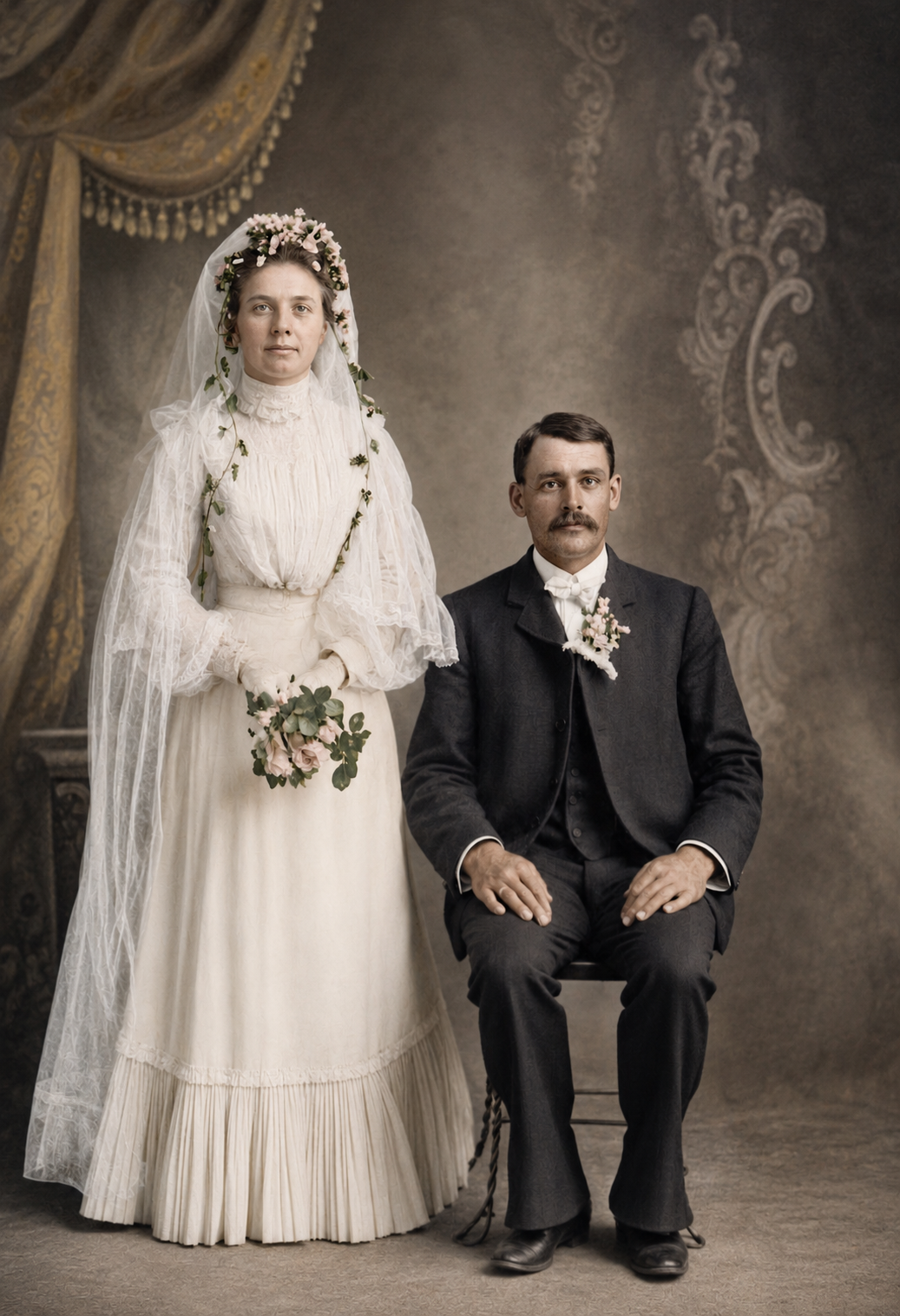
We've noted our connection to Schuchmann families in South Carolina and Illinois, but this branch went straight to Iowa where they farmed at Strawberry Point in Cass County, Iowa. We can trace them back to the same ancestors, to Peter Schuchmann and even earlier from Hausen, Hesse-Darmstadt. It's unclear whether they knew about these family connections. Free farmland in the American midwest was incentive enough.
“Citation: Digital reproduction of a photograph, collection of fenchelr/OWF 2 Family Tree: Johann Georg Schuchmann and Ida Baumgartner, 1902, accessed 5 August 2026.
Johann Georg (or John George) Schuchmann was actually born in Iowa in 1871, the son of German immigrantds Johann Georg Schuchmann and Marie Elisabethe Rosenhaeuser, and farmed with his father, later on his own, at Strawberry Point. Ida Baumgartner was born in Iowa as well, the daughter of Friedrich Baumgartner and Katherine Elisabethe Johanna Weege. The bridegroom in this portrait was thirty-one years old, the bride just eighteen.
Ida embraced the newly-popular white wedding look, with wide sleeves trimmed with lace, a pleated part of the skirt, and a voluminous veil capped with flowers. In a nod to German custom she wears a flowered vine across her shoulders, plus a small bouquet of blossoms and leaves.
Johann Georg, seated, wears a good suit, white shirtfront and tie, and a small corsage. The studio backdrop is painted and Johann Georg perches on a small padded wire seat. No signs of affection are visible in this portrait. They're a very formal couple.
The couple had nine children, some of whom were interviewed by family members and recalled their own grandfather (the senior Johann Georg) as a man constantly worried about the prosperity of the farm but who had the perspicacity to leave the family a thousand-dollar life insurance policy when he died in 1904. Johann Georg Junior died in 1931, Ida in 1955.
1903: Henry William Trabant and Louise Rosina Nolting, Indiana
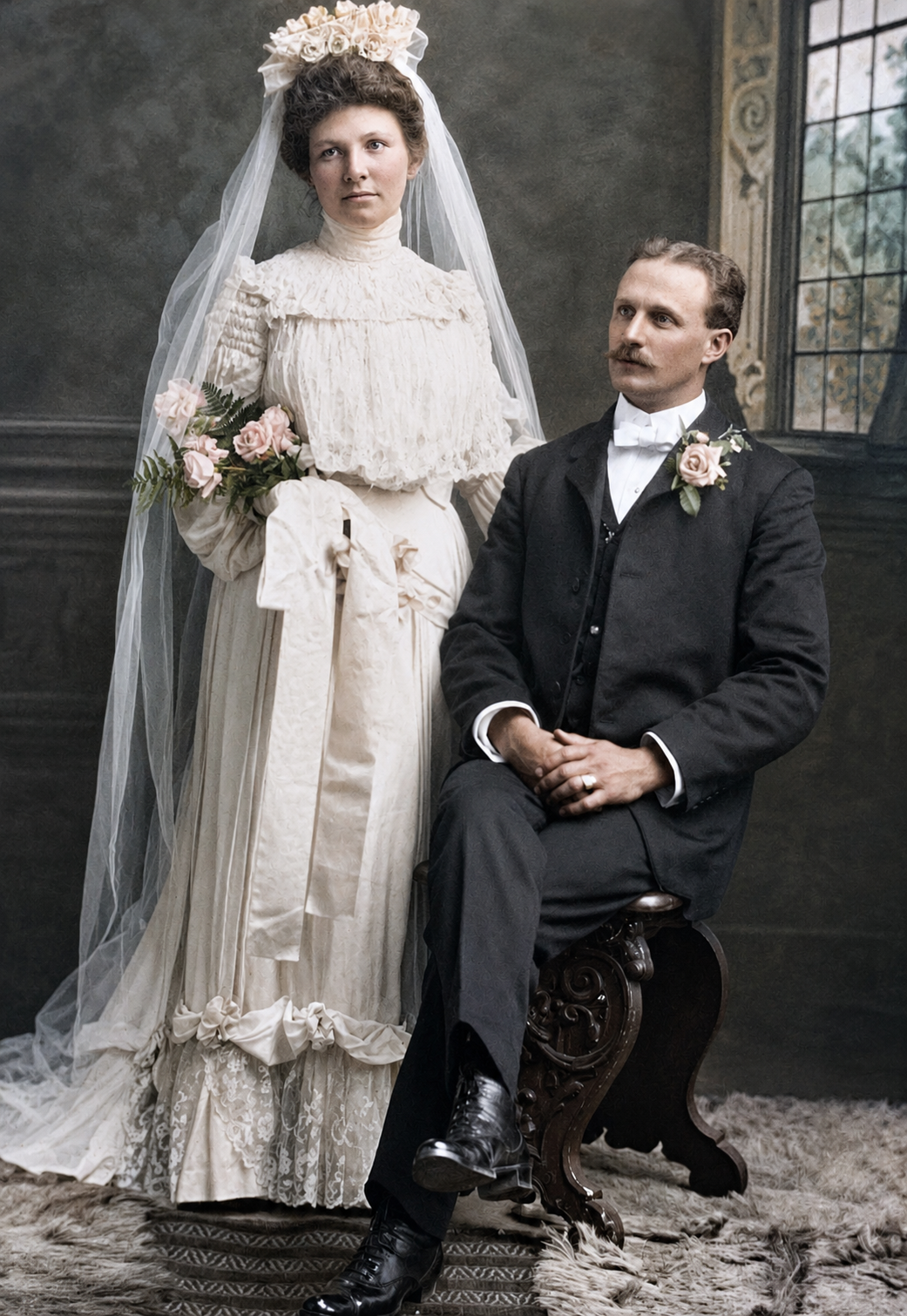
The Trabant clan is part of our Pomeranian ancestry with Klein Massowitz their home village, and wonder of wonders a member of the clan emigrated to Indiana in the 19th century. Ours didn't emigrate but some of their descendants did. What's the connection?
“Citation: Digital reproduction of a photograph, collection of mascotpro/Davis Family Tree: Henry William Trabant and Louise Rosina Nolting, Knox County, Indiana, accessed 6 August 2026.
The Indiana Trabant clan has Paul Ferdinand Trabant, born in 1805, as their ancestor while we have his brother, Carl Wilhelm Trabant (1802-1870). Their father was Michael Trabant, born in 1765. DNA testing confirms our connection to the Indiana family too so that supplements documentary evidence.
Henry William Trabant was born in Freelandville near Vincennes in Knox County in 1877, the son of Frederick M. Trabant and Pauline Diekmann. In 1903 Henry married Louise Rosina Nolting, also an Indiana native born to german immigrant parents.
It's a white wedding with the bride in a stylish gown trimmed with lace, braid work, and ribbon flounces at the hem. The veil cascades from a flowered headdress and Louise cradles a bouquet of roses.
Henry wears a rose in the lapel of his dark suit. His tie and shirt are white, a dark vest matches the suit, and his shoes are polished and stylish. Henry is seated on an elaborately carved wooden stool next to his standing bride, whose pose shows off the details of her dress.
Louise and Henry had six children. Louise died in 1926, Henry in 1961.
1904: Ernest Otto Frank Ledebuhr and Bertha Elwine Laske, Chicago
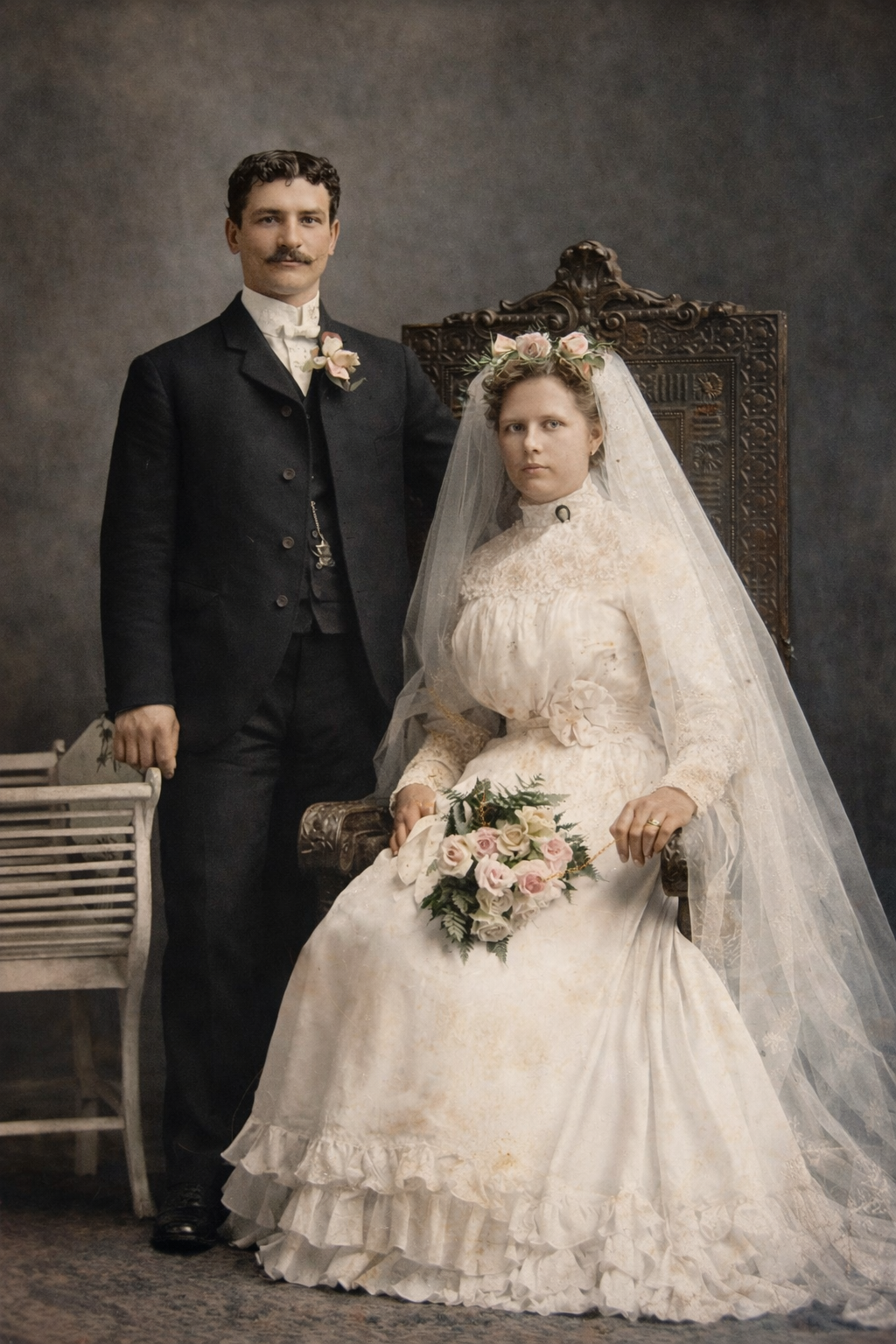
Here's a prime example of how one family can get an identification wrong without knowing how or why.
My guess is that the Ledebuhr family of Chicago passed down an erroneous memory of this couple being "Grandpa and Grandma Ledebuhr," the unknown parents of Ernest, who was born in Germany in 1875, possibly in the region of a town called Swinemünde (now Świnoujście in Poland), a place he visited in 1930.
“Citation: Digital reproduction of a photograph, collection of hrledebuhr/Ledebuhr Family Tree: Ernest Otto Frank Ledebuhr and Bertha Elwine Caroline Laske, April 1904, Chicago, Illinois, accessed 6 August 2026.
Ernest arrived in the USA in 1901, according to census records, and he and Bertha Laske took out a marriage license in Chicago in 1904, according to the Chicago Tribune for Saturday, Apr 23, 1904, page 9. From other photos in this series we can see that the clothing styles this couple wears correspond to wedding finery from the first few years of the twentieth century. It's unlikely that this couple represents Ernest's parents, who apparently didn't emigrate and wouldn't be wearing theses fashions in a German marriage from the 1870s.
So assuming we're comfortable with this identification, let's look at what Ernest and Bertha are wearing. Bertha is in white, seated in a carved high-backed wooden chair. Her gown reflects the styles of 1900-1906: lots of tulle and lace, a pleated bodice with a fabric rosette at her waist, and several overskirts with the popular ruffled hem. She wears a wreath of roses with a delicate embroidered lace veil. She has a beautiful bouquet of roses and clearly displays her wedding band on her left hand, American-fashion.
Ernest wears a new suit with a high collar popular in the early 1900s and a white tie. The suit jacket, buttoned at the top, shows off his watch chain and fob ornament at his vest, and he wears a single rose in his lapel.
Ernest and Bertha married at Gethsemane Lutheran Church in Chicago, where the records list them both as twenty-eight years old. There are four witnesses, including an Otto Laske (Bertha's brother, it appears) but no Ledebuhrs.
Why is this image in our collection? Ernest's and Bertha's son, Fred Otto Rudolph Ledebuhr, married one of our Gohr relatives, Valeira Gohr, in 1931 in Chicago. Valeira was the great-niece of William Gohr, my great-grandfather.
1905: Unknown wedding couple, Chicago, Illinois
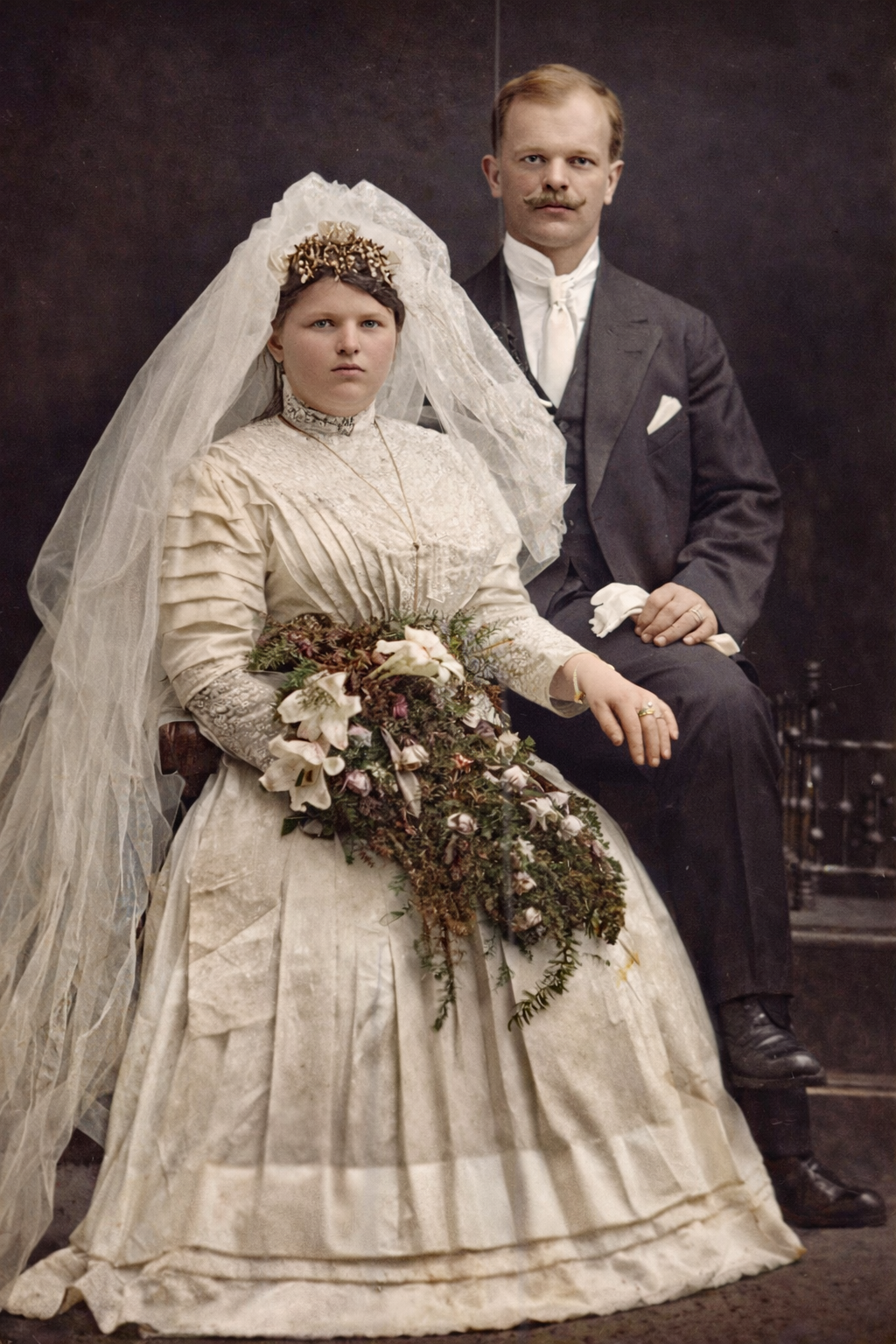
We have some folks in our family tree with photos of people who can't be identified. That's a sad circumstance, but it shouldn't prevent us from trying to analyze the details that we can discern from this photo.
This couple probably is related to the Gratz or Jatho family in some way because the photo is part of that collection. Unusually the backdrop at the studio is undecorated and the furniture very spare. There's no imprint on the photograph to suggest what studio took this picture.
“Citation: Digital reproduction of a photograph, collection of judiweber60463, Gratz/Jatho/Larsen/Weber/Carlstedt Family Tree: Unknown couple, circa 1905, Chicago, Illinois, accessed 7 August 2026.
The lady's bridal gown is white, generously pleated, and trimmed with lace on the sleeves. There's a modest floral cap from which the long veil cascades. She's wearing a chain with what looks like a stone ornament, and displays her left hand with a wedding band prominently displayed, American fashion. Her bouquet includes lilies and ferns.
The bridegroom, unusually, is perched either on the arm of her chair or on a separate chair just to her left. His new suit includes a white shirt and tie, a pocket square, and a pair of white gloves.
It's possible that at some point a descendant will recognize this couple and let us know so we can fit them into the family tree.
1906: Edward Michel DeLuryea and Ida Augusta Friedrike Trabant, Indiana
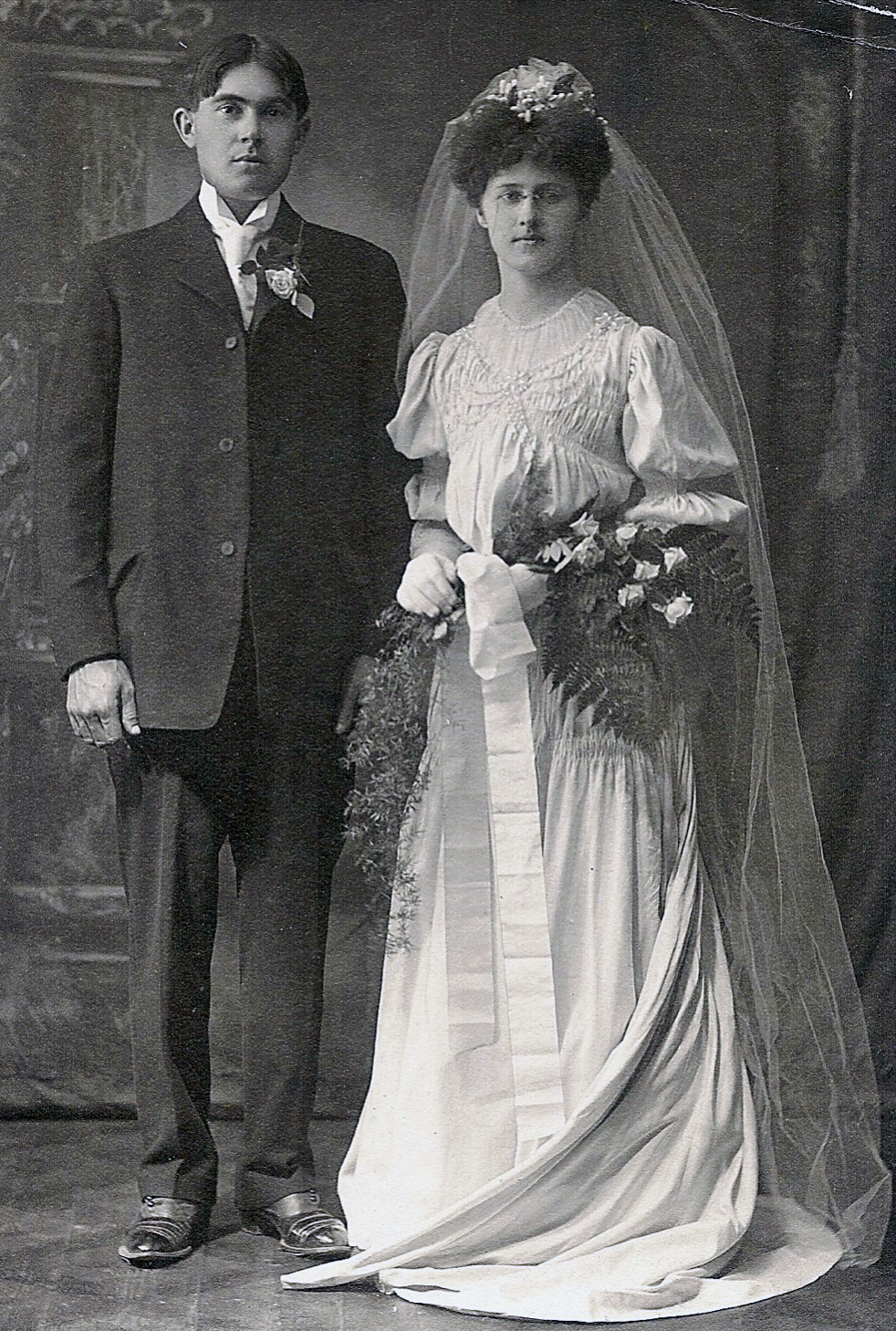
It's another Trabant marriage in Knox County, Indiana. This time we have Ida Augusta Friedrike Trabant, daughter of Fred Trabant and Pauline Diekmann, who married Edward Michel (sometimes spelled Mitchell) DeLuryea on June 10, 1906.
Ida's ancestry meets up with our Trabant clan in Klein Massowitz, Pomerania. Her family emigrated to Knox County in Indiana whereas ours went to Chicago, Illinois.
“Citation: Digital reproduction of a photograph, collection of LDeLuryea, DeLurya-Brown_2019_26_11_01 Family Tree: Edward DeLuryea and Ida Trabant, 1906, Knox County, Indiana, accessed 7 August 2026.
They're a young bridal couple, Edward was twenty-four and Ida twenty years old. Ida's gown is white with elaborate fluted sleeves, patterned bodice, and along flowing skirt. She has a small floral cap to which her veil is attached. She's our first glasses-wearing bride. Her bouquet includes roses and fern leaves.
Edward, looking a little nervous in his formal suit, wears an open coat, white shirt and tie, and has a rose pinned to his lapel.
Edward and Ida had two children, the fancifully-named Royal Edward and Rutherford William. Edward and Ida and their family lived in Vincennes, Indiana where Edward died in 1966. Ida returned to her birthplace, Freelandville, and died there in 1976.
1906: Paul Conrad F. Gohr and Franziska Schmude, Chicago, Illinois
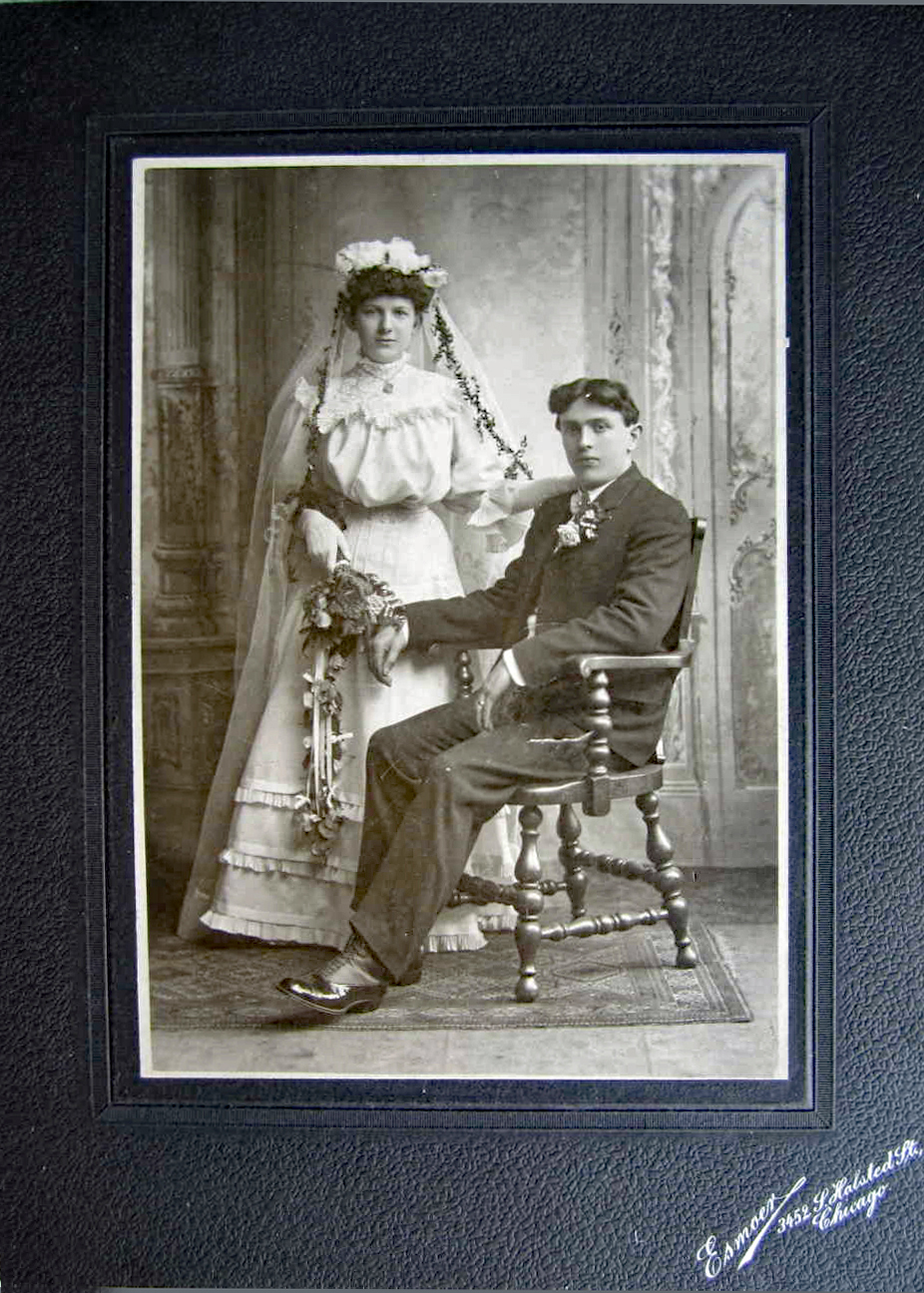
When my great-grandfather Wilhelm Gohr came to America in 1881, he already had an older brother here: Albert Julius Reinhold Gohr, who had settled in Chicago.
“Citation: Digital reproduction of a photograph, collection of hrledebuhr/Ledebuhr Family Tree: Paul Conrad F. Gohr and Franziska Schmude, April 21 1906, Chicago, Illinois, accessed 8 August 2026.
Albert, married to Wilhelmine Mowes or Mews, had six children in Chicago and one of them is pictured here at his wedding. Paul Conrad F. Gohr was twenty-four when he married Franziska (Frances) Ida Adeline Schmude, who had emigrated from Klein Gustow in Pomerania to Chicago. Paul was a first cousin to all Wilhelm Gohr's children. They may have attended this 1906 wedding.
The cardboard frame includes an embossed logo for Esmoer Studios in Chicago, a studio popular with German immigrants in the neighborhood. Franziska wears a white dress of what looks like cotton (good choice, practical for make-overs as an every-day good dress), with a blousy bodice, a lace collar over which she wears a necklace, and three rows of ruffles near the hem. Her flowered cap anchors the floor-length veil and the familiar Germanic-style flower vine provides a decorative touch. Her bouquet includes floral ribbons. Franziska stands next to her bridegroom, the better to display the details of her gown.
Paul, seated in a wooden chair, wears his best dark suit with a corsage in his lapel. He may be wearing spats over his shoes, it's hard to tell. His hairstyle is surprisingly contemporary-looking, and that may be a watch chain peeking out of his right trouser pocket.
Paul and Franziska had two children, Albert (born in 1907) and Valeira, born in 1910. Valeira married Fred Ledebuhr, and it's through their collection that we have photos of their family.
1906: John Alfred Glawe and Anna Gohr, Chicago, Illinois
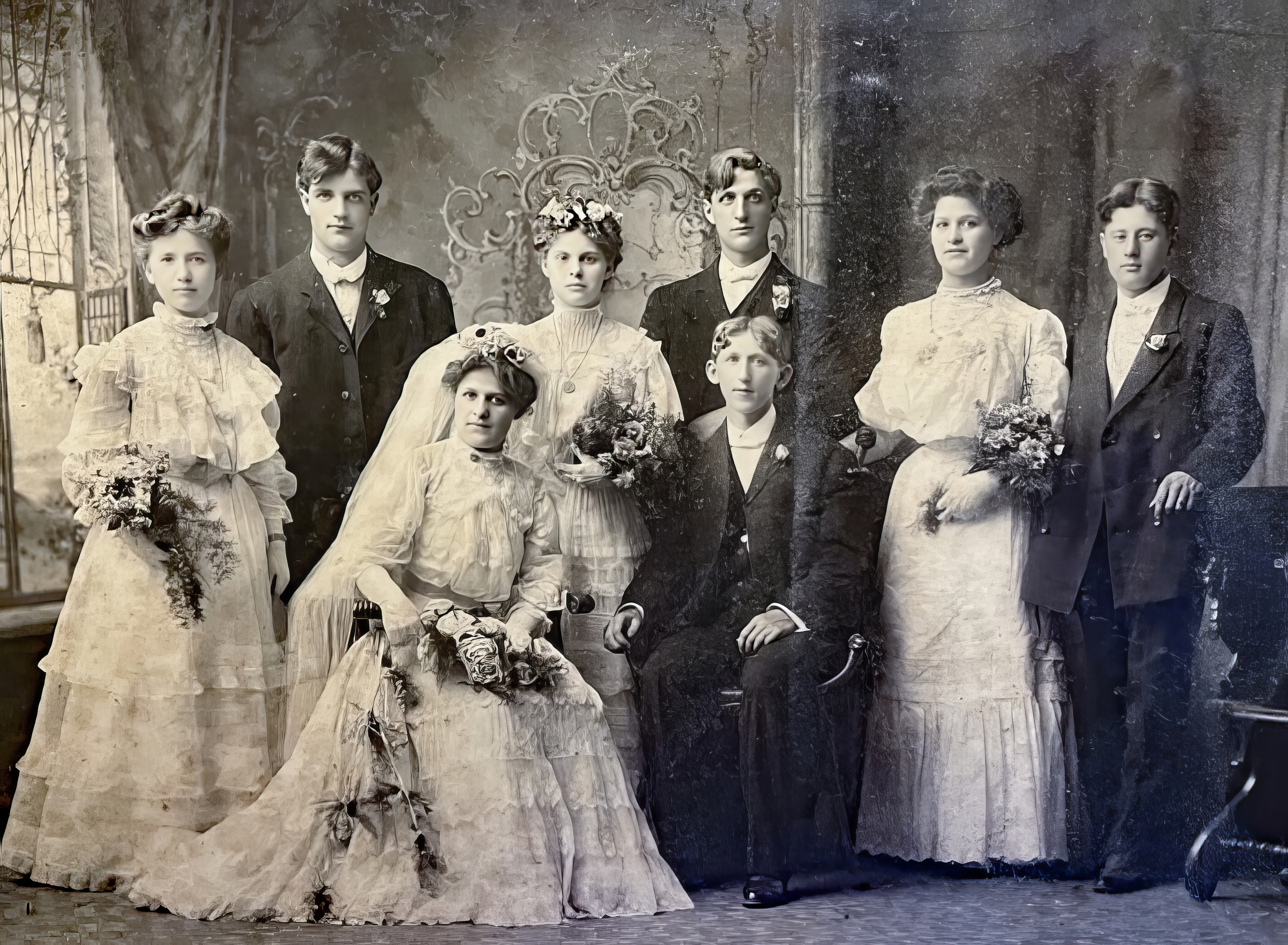
It's our first wedding portrait with attendants and it's well worth a closer look. Anna's younger sister, Caroline, was married in 1904 so she was the fist of the Gohr girls to tie the knot with her bridegroom Edward Collins, but the bride was expecting and it's possible that the situation didn't lend itself to photographic evidence. So Anna's wedding gets the festive treatment.
“Citation: Digital reproduction of a photograph, collection of Anna Glawe and Dorothy Glawe Maynard: marriage of John Walter Glawe and Anna Gohr, Chicago, July 29, 1906, accessed 9 August 2026.
Anna, seated, wears a lace-trimmed white gown with multiple ruffles down to the hemline, a style echoes by the bridesmaid on the left and the maid of honor behind her. Anna's veil is held in place by flowers and she holds a large bouquet on her lap.
The groom, also seated, wears a formal day suit with a white shirt and tie, a small blossom at his lapel, and a hint of a watch chain at his vest.
The wedding party is not identified on the photograph, but the lady on the right bears a strong resemblance to the bride, and it could be her sister Caroline (Carrie) Edwards. Her dress is much simpler than the other bridal gowns, as if it had been repurposed from another event. Is the gentleman in the ill-fitting suit right next to her Edward Collins, her husband? We have no family photos of either one so it's speculation.
The gentleman standing behind the bridegroom looks like other photos we have of Anna's only brother, Rudy Gohr, and it may be him. Anna's father had died the year before and it's logical that she would have wanted her brother in the party to represent the family. But we can only guess.
John and Anna had three daughters and lived in Chicago all their lives. John died in 1950, Anna in 1957.
1911: George Henry Bruns and Bertha Gohr, Chicago, Illinois
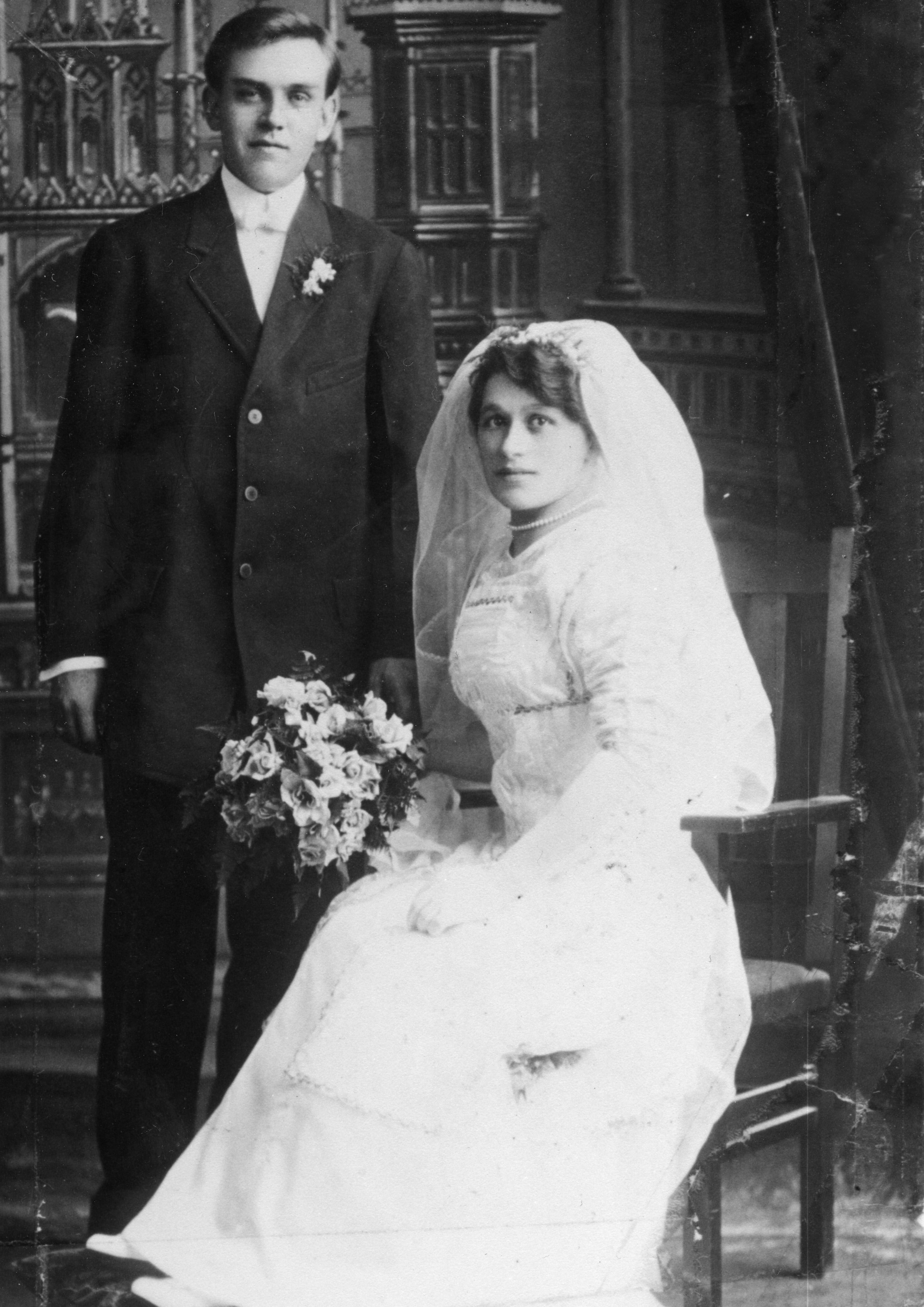
It's a Gohr festival! This time it's Anna Gohr's younger sister, Bertha (born Hertha Alvina Louise) Gohr, daughter of the late William and Laura (Kramp) Gohr, plus her bridegroom George Henry Bruns. George was Cincinnati-born but moved to Chicago with his family.
“Citation: Digital reproduction of a photograph, collection of Lorraine Bruns MacLaughlan: marriage of George Henry Bruns and Bertha Gohr, Chicago, August 3, 1911, accessed 9 August 2026.
Unlike many of our other wedding portraits, in this one the bride is seated and the groom stands. This may have been suggested by the photographer to discreetly hide the bride's figure, which was expanding. George's and Bertha's first son, Bernard, made his appearance three months after the wedding. As a genealogist friend of mine used to say, "The first baby arrives when it wants, the second baby after nine months."
The bride's white gown includes some darker embroidered stripes on the bodice, a shorter than customary veil held in place by a small spray of flowers in her hair, and an elegant pearl necklace. On her feet she wears a pair of white slippers.
George is in his best suit, with white shirt and tie, and a small boutonniere in his lapel. Bertha's parents were no longer living in 1911 but George's were so we assume they were in attendance, and probably the couple's siblings were there too, but unlike Bertha's sister Anna's wedding there was no wedding party portrait.
George and Bertha had four children. George died in 1945, Bertha in 1974 after a long a full life living with her children.
https://sakionline.net/family-folio/img/krack-gersch-modified-full.png
1911: Otto Friedrich Leo Krack and Dorothea Wilhelmina Johanna Gersch, Chicago, Illinois
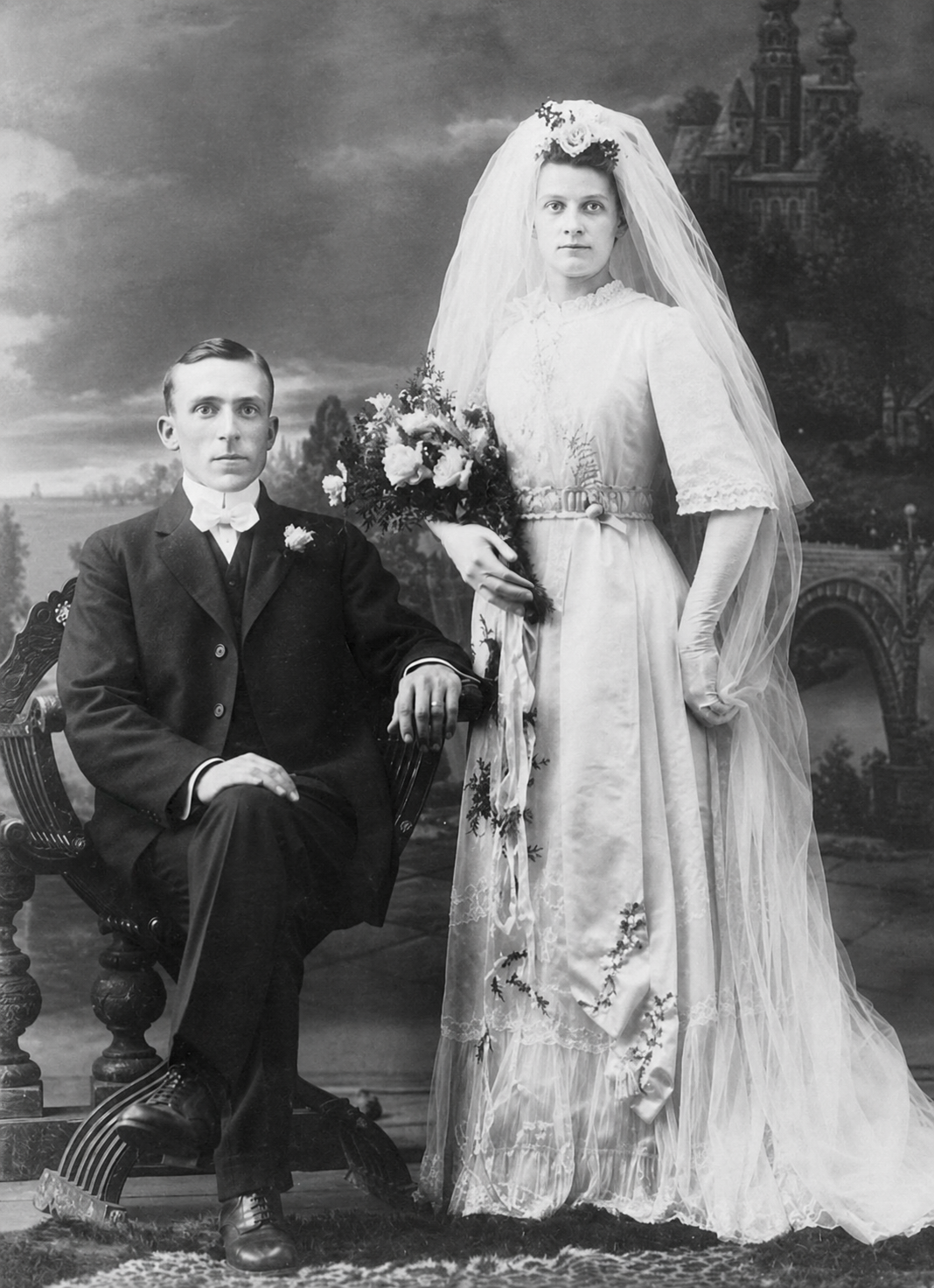
Dorothea Gersch was the Chicago-born daughter of Adeline Dorothea Gohr and her husband Gustav Friedrich Gersch, and a granddaughter of Wilhelm Gohr and Caroline Jaffke, a mystery couple to which we're related by DNA. Records are missing that would tell us just how we're related, but at last DNA is there to prove the connection.
“Citation: Digital reproduction of a photograph, collection of Laurel J. Henrickson: marriage of Otto Friedrich Leo Krack and Dorothea Wilhelmina Johanna Gersch, Chicago, October 11, 1911, accessed 25 August 2026.
The bride stands, the better to show off her elaborately embroidered white wedding gown. The neckline is high and lined with lace, while the sleeves are elbow-length, augmented with wite gloves. A pearl, embroidered cap attaches to her floor-length veil, and she hold her wedding bouquet upright
The groom, seated in an ornate carved wooden chair, wears a dark suit, vest, white shirt and bow tie. His pose is relaxed and his left hand is arranged to display his wedding band.
The marriage took place at the First Bethlehem Lutheran Church in Chicago with witnesses recorded as Minna Gohr, Johanna Birr, and Franz Dombrowsky.
Otto and Dorothea had five children and lived in Chicago all their lives. Otto died in 1955, Dorothea in 1957.
1911: Hedwig Marie Kebschull and Clarence Earl Zumbrun, Bridger, Montana
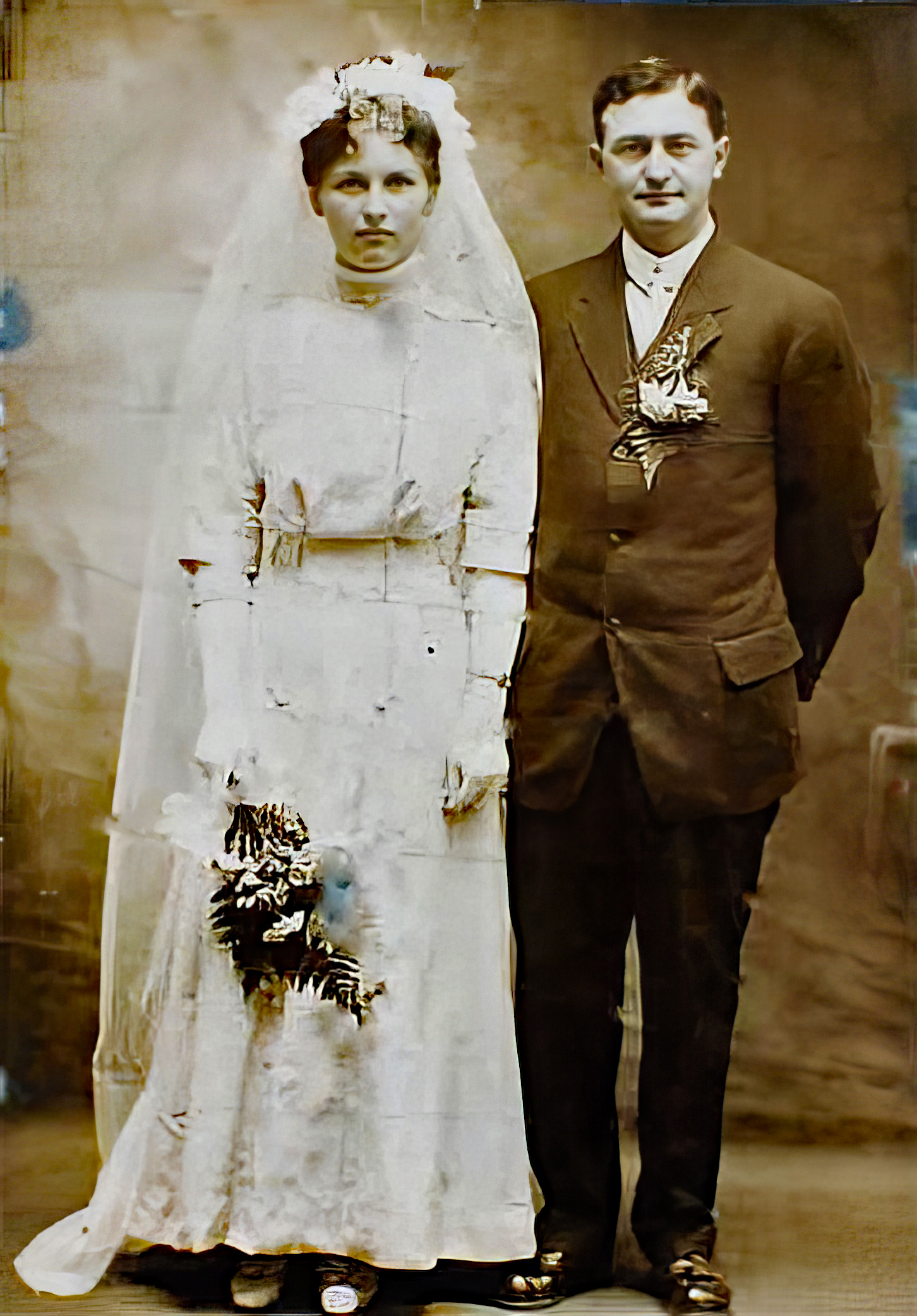
Hedwig Kebschull was the daughter of Otto Carl Kebschull and Ida Scheunemann, born in Klein Nossin, Pomerania, who emigrated to America with her parents. The family settled in Montana where they farmed on a homestead. In Pomerania the Kebschull family married a number of our Lübeck ancestors, so that's our conneciton to the Kebschulls.
“Citation: Digital reproduction of a photograph, media gallery, collection of Dixie Armstrong via Ancestry.com: marriage of Hedwig Marie Kebschull and Clarence Earl Zumbrun, Bridger, Montana, accessed 9 August 2026.
Hedwig was the first of the family's children to marry. Her gown reflects a simple homemade style of fashion and may have been sewn by her mother. It's a minimalist style with a straight skirt and narrow elbow-length sleeves, but the veil is full length and is secured to her hair with ribbons and flowers. An elegant wristwatch completes the look, with a small bouquet of roses and fern leaves held by her side.
Clarence is equally solemn. A native of Ohio, he lived in Kansas with his family before ending up in Bridger, which is probably where he met the Kebschulls. Clarence wears a formal suit with a white shirt clasped at the collar, and a small spray of roses and fern leaves at his lapel (hanging downward, interestingly, like the bride's bouquet). He clasps his hands behind his back. No apparent display of affection between the couple, who appear to be a tad nervous.
Clarence and Hedwig had six children before Clarence died at the early age of forty years old in Billings, Montana. Hedwig died in 1939.
https://sakionline.net/family-folio/img/kolberg-gaul-wedding-1912-full.jpg
1912: Frank "Franz" Gaul and Grace Kolberg, Stevensville, Michigan
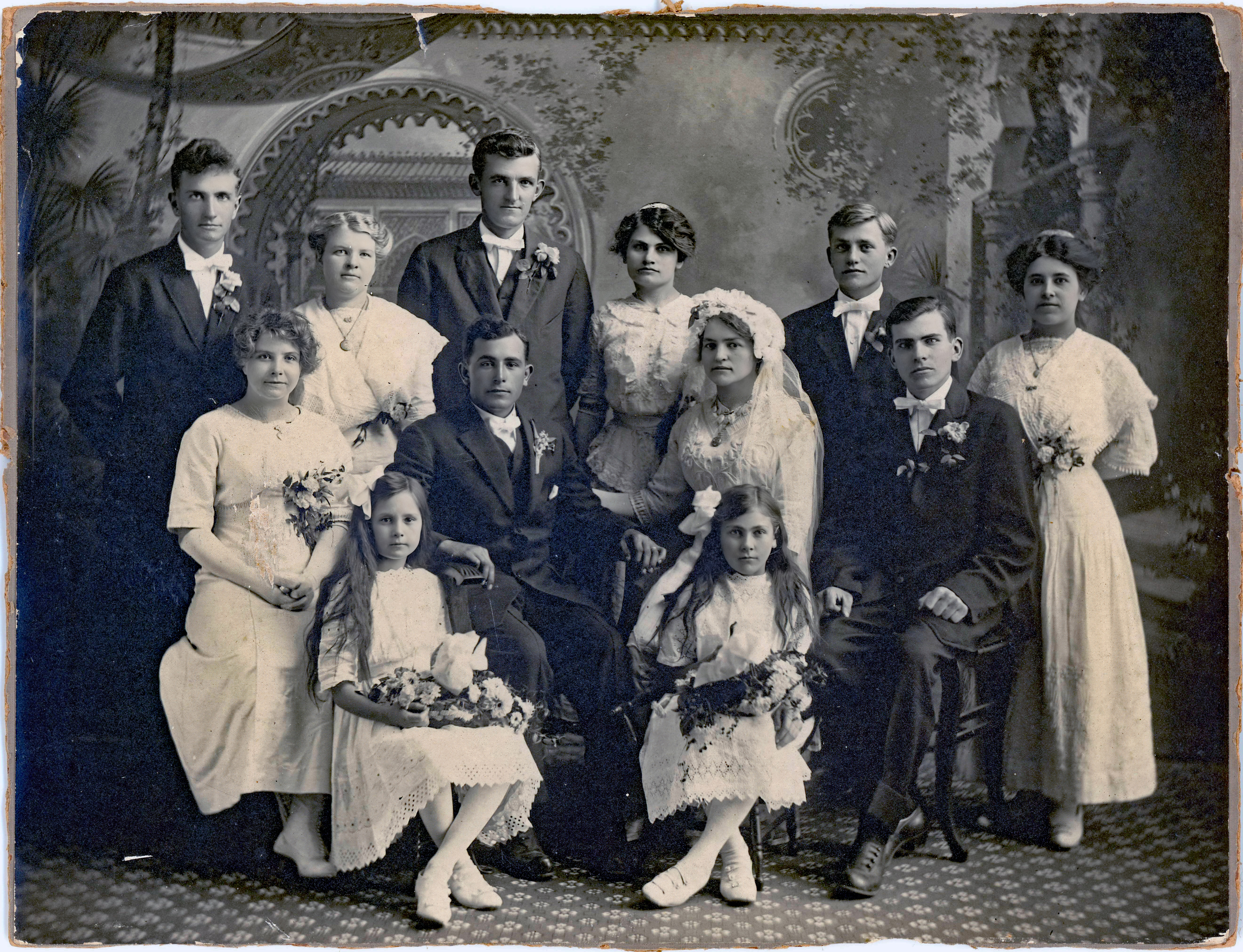
The Gauls of Stevensville probably didn't realize that they had cousins living in Chicago, but we have a mutual ancestor, Johann Christian Gohl (as it was then spelled) who lived in Kreis Bütow, Pomerania from 1767-1830.
“Citation: Digital reproduction of a photograph, media gallery, collection of Cheryl J. Schulte via Ancestry.com: marriage of Frank "Franz" Gaul and Grace Kolberg on September 27, 1912, Stevensville, Berrien County, Michigan, accessed 9 August 2026.
Frank Gaul, born in 1889 in Lincoln Township, was the son of Leo Frederick Gaul, who was originally from Trzebiatkow, Bütow, Pomerania, and Augusta W. Kaufmann. Grace was the daughter of Otto Ferdinand Paul Kolberg and Alvina Laura Truhn.
This explains the selection of the wedding party -- it was replete with Truhn and Kolberg relatives, although interestingly only two Gauls. From left to right standing: Oscar Kolberg, Louise Ludwig, Lawrence Nelson, Carrie Truhn, Fred Kolberg, Reitha Kolberg; and left to right seated: Tillie Gaul, Frank Gaul (groom), Grace Kolberg (bride), Henry Truhn. Flower girls were Ruth Zick and Grace Truhn.
The bridal fashions appear to be a bit anticipatory of styles slightly later in the decade although the Berrien County marriage registry dependably records the date as September 27, 1912. Grace wears a white gown with an elaborate lace and embroidered bodice, and a full floral cap with a veil. She also wears a large locket necklace. Her right hand embraces her husband. Both bride and groom are seated.
Frank wears his best suit, white shirt and bow tie, a jaunty spray of flowers at his lapel, and displays his wedding band on his left hand.
The wedding party, seated and standing, echos the bridal fashions with similar half-sleeved gowns for the ladies and white shirt and tie combinations for the gentlemen. The two flower girls have similarly styled long hair with large bows at the right temple, enormous bouquets, and stylishly crossed legs.
Frank, a farmer, and Grace, a homemaker, had three children. Frank died in 1949 but Grace lived until 1986.
1915: Louisa Wilhelmina Gohr and Fred John Erickson, Kimball MN
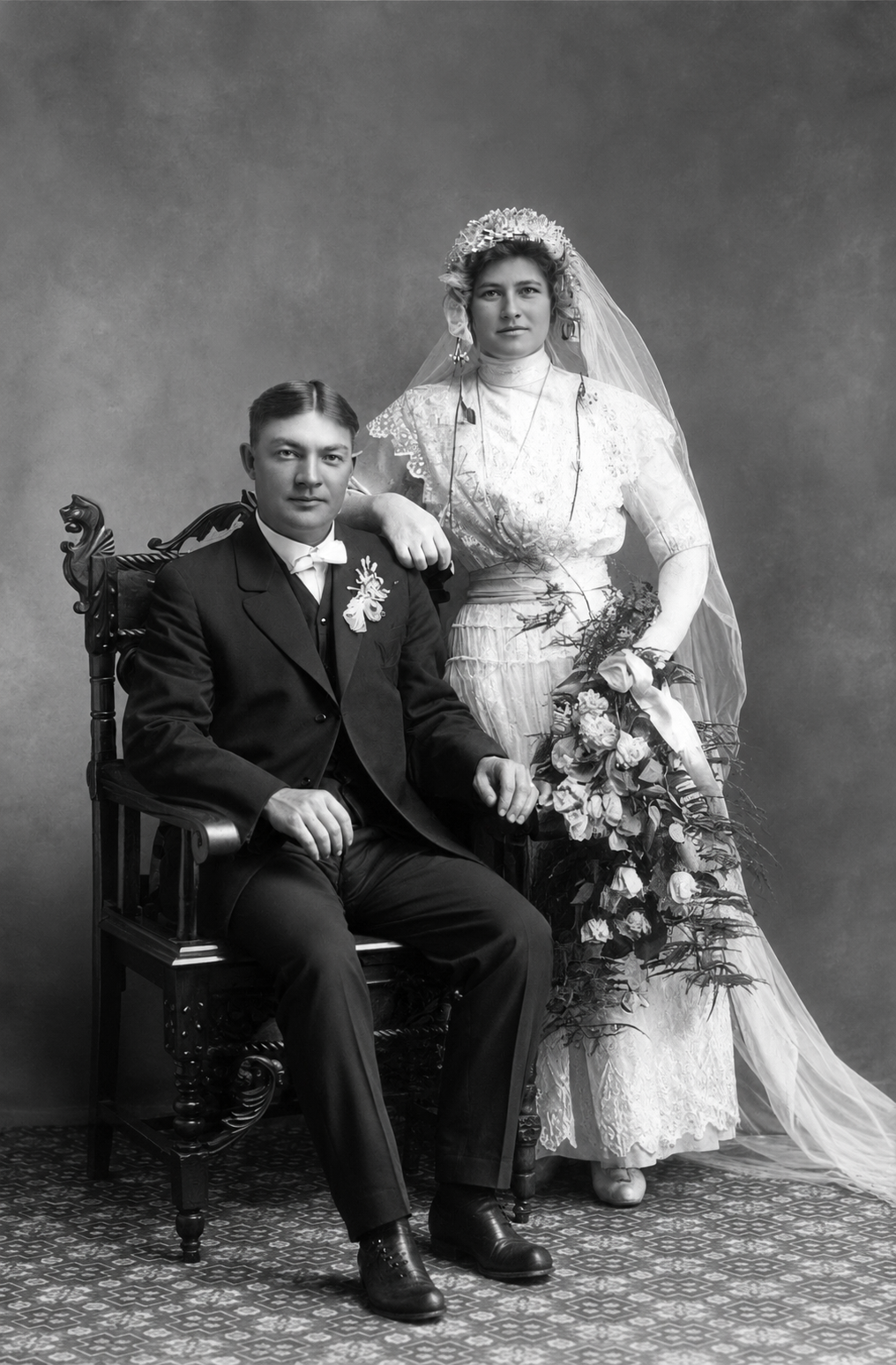
Louisa was the daughter of Johann Ferdinand Gohr (1849-1927), a son of Wilhelm Gohr and Caroline Jaffke of Zezenow, Kreis Stolp. Parish records explaining our connection are missing but DNA indicates that our Gohr clan of Nippoglense nearby is related to this family. Johann Ferdinand had a brother, Albert Wilhelm, who also shows up as a DNA match to our clan.
“Citation: Digital reproduction of a photograph, media gallery, collection of Brandon Hess via Ancestry.com: marriage of Louisa Wilhelmina Gohr and Fred John Erickson, Kimball, Minnesota, accessed 9 August 2026.
Louisa, known as Lizzie, was born in 1894, so she's just twenty-one in this portrait. The photographer has captured a particularly relaxed couple on what must have been a very festive day. Fashions are already starting to evolve and you can see it hinted in Lizzie's elegant gown.
Lizzie, standing, wears a white dress with a v-neck over-blouse and an A-line skirt with elaborate pleats. The skirt length is beginning to shorten, stopping just a couple inches from the floor so you can see her satin slippers. Her veil is extra long but the flowered cap is beginning to reflect the cloche-like style that would be popular just a year or two later. She carries an elaborate bouquet of roses and fern leaves. In a nod to her heritage she has a small vine-like wreath around her shoulders.
Kimball-born Fred was baptized as Godtfred Hans Erikson but in later records he was always referred to as Fred Erickson, Fred J. Erickson, or Fred John Erickson, so we'll note that in the interests of good record-keeping. Fred is seated in a wooden chair wearing a nicely-pressed suit, white shirt and tie. His boutonniere is attached to his lapel.
Fred and Lizzie had four children. Fred died in 1941 but Lizzie lived to the impressive age of ninety and died in 1984.
1917: Celestia Bray and Walter Petersen
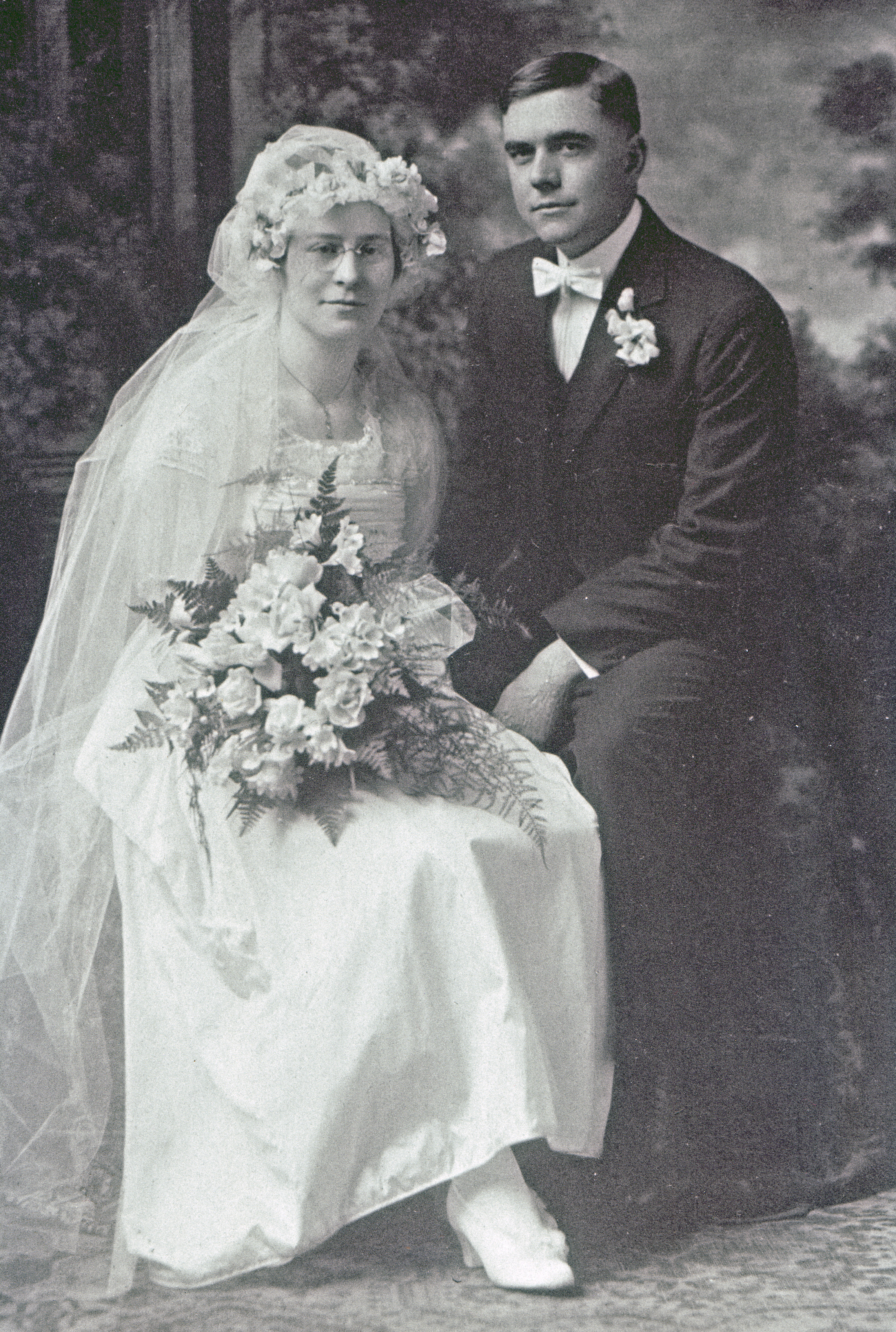
Celestia came from Independence, Iowa from a large family and settled in Kenosha several years before this wedding. Walter was the son of Andrew (Andreas) Petersen and Karen Marie Johansen, our ancestral cousins from Kenosha, Wisconsin.
“Citation: Digital reproduction of a photograph, media gallery, collection of Father Michael Petersen: marriage of Celestia Bray and Walter Petersen, Kenosha, Wisconsin, accessed 9 August 2026.
Both bride and groom are seated in front of a painted backdrop at this studio, presumably in Kenosha. Celestia's headpiece is the most unusual I've seen: basically a lace cap completely covering her hairstyle and trimmed with flowers. Her veil cascades from the cap and is trimmed with flowers. Her white dress includes lace and horizontal fabric folds on the bodice. The plain white full skirt reaches to her ankles and reveals stylish heeled slippers. Celestia is our second bride to wear glasses.
Walter wears a new suit with a nattily-tied bow tie and white shirt front. Like most bridegrooms Walter wears a small rosy corsage at his lapel.
Walter and Celestia were married for forty years and had five children together.
1917: Marie Petersen and George Henry Schmidt, Chicago, Illinois
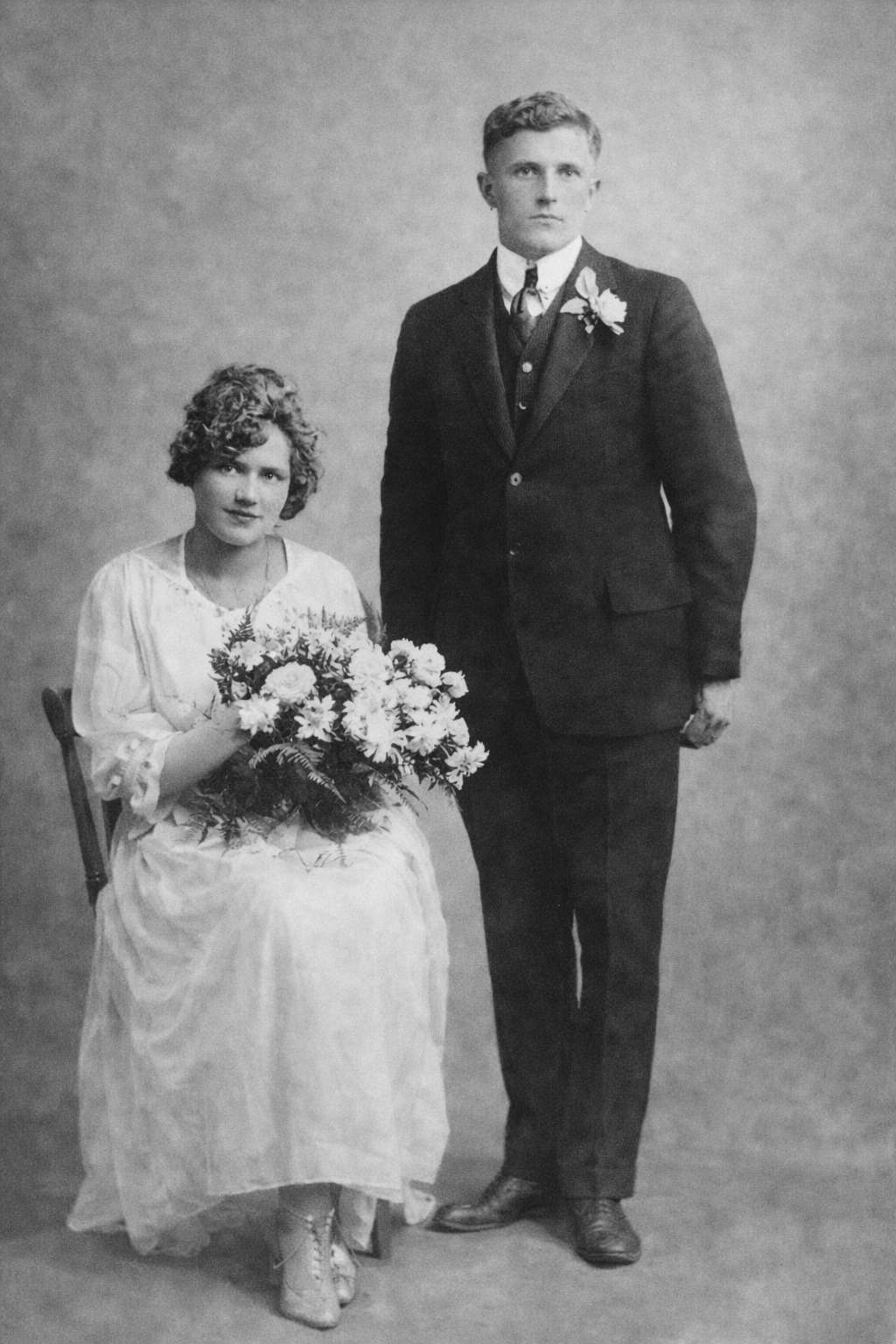
Marie Catherine Petersen was the youngest daughter of Hans and Catherine Petersen, born in 1899 in Chicago. She was just four years old when her older sister Maggie died, so Marie became the only girl in the family.
“Citation: Digital reproduction of a photograph, collection of Cathie Meyer: Marie Petersen and George Henry Schmidt, 1917, digitally restored by Bruce Dumes, accessed 10 August 2026.
Marie was eighteen when she met and married George Henry Schmidt of Chicago. Marie, in this wedding portrait, is seated while her bridegroom stands. This is the beginning of the simplified sartorial Petersen weddings with brides dressed for a civil service rather than a church wedding with all the trimmings.
Marie's dress is white and looks as though it could have been reworked from a confirmation gown. The collar and three-quarter-length sleeves have some elegant embroidery and she wears a simple necklace. There's no veil or flowered cap but her bouquet is a nice collection of white chrysanthemums and dark-green fern leaves. She wears lace-up boots too.
George, a solemn groom, wears a good suit with the jacket buttoned, but you can just see the hint of a watch chain attached to his vest. He has a high-necked white shirt with a white orchid fixed to his lapel.
This was a short marriage, likely just a couple of years. Their daughter Louise Catherine was born in May 1920 but the couple soon divorced and George remarried Wilma Schmeidl in 1921. Unusually for the time he made himself available for parental visits. We have photos of George with Marie and Louise during the early 1920s. Marie reverted to her maiden name, Petersen, and remained in Chicago with her mother Catherine.
1920: Albert Kruschke and Emma Wendt, Eau Claire, Wisconsin
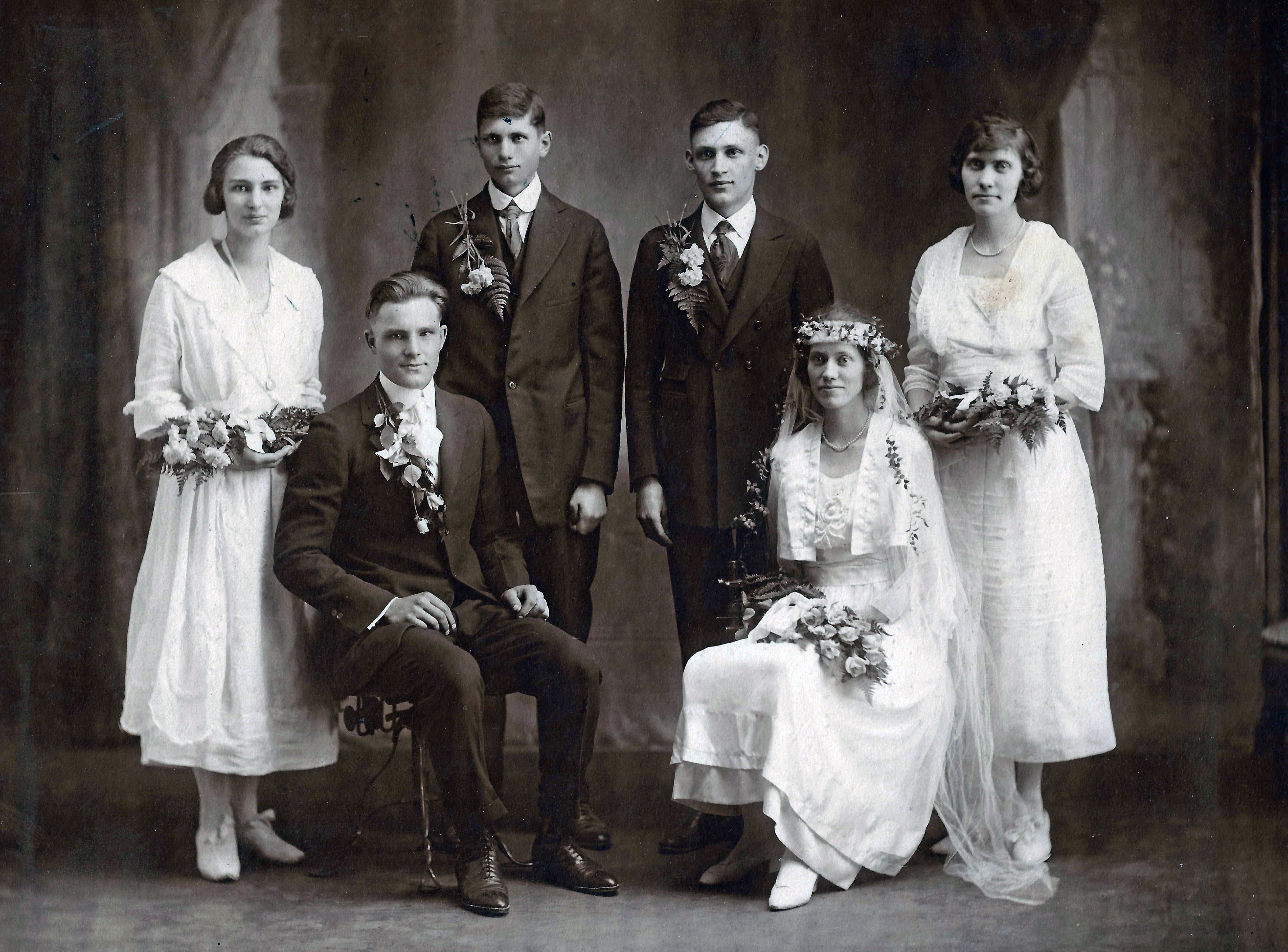
The Kruschke family was excellent at staging a wedding party, and we have several examples in this collection although not one with our cousin Louis Jatho and his bride Martha Kruschke. Martha was the older sibling of Albert. She and Louis were probably guests at the wedding though.
“Citation: Digital reproduction of a photograph, media gallery, collection of hlkruschke, Howard Kruschke Family Tree: Albert Kruschke and Emma Wendt, Eau Claire WI, 1920, accessed 10 August 2026.
Albert was nineteen and Emma twenty-one at the time of their wedding. The wedding party included Dorthy Kruschke, Rudolph Wendt, Dewey Meuli, and Emma Wendt.
Women's fashions were evolving quickly in 1920. Emma, seated, wears a white gown with a hem several inches above the floor, a unique design with a rose embroidered on the bodice and a decorative cape over her shoulders.
Her veil is full length but instead of a flowered cap she has a floral headband with a leafy vine cascading down across her shoulders. She wears a simple pearl necklace and cradles a bouquet of ferns and roses in her lap. Emma's bridesmaids also have shorter skirts and carry rose bouquets of their own, and both wear white shoes with bows across the instep.
Albert and his groomsmen wear formal suits, white shirts, dark ties (Albert's is white though) and small bouquets attached to their lapels, facing downward. I've not been able to discover whether this is supposed to be a sign of something, maybe just the style of the time. The etiquette then and now says that boutonnieres are not to be worn upside-down but perhaps small lapel bouquets require a different protocol.
Albert and Emma had three children. Emma died in 1950, Albert in 1960.
1920: Harry Peterson and Edith Kebschull, Bridger, Montana
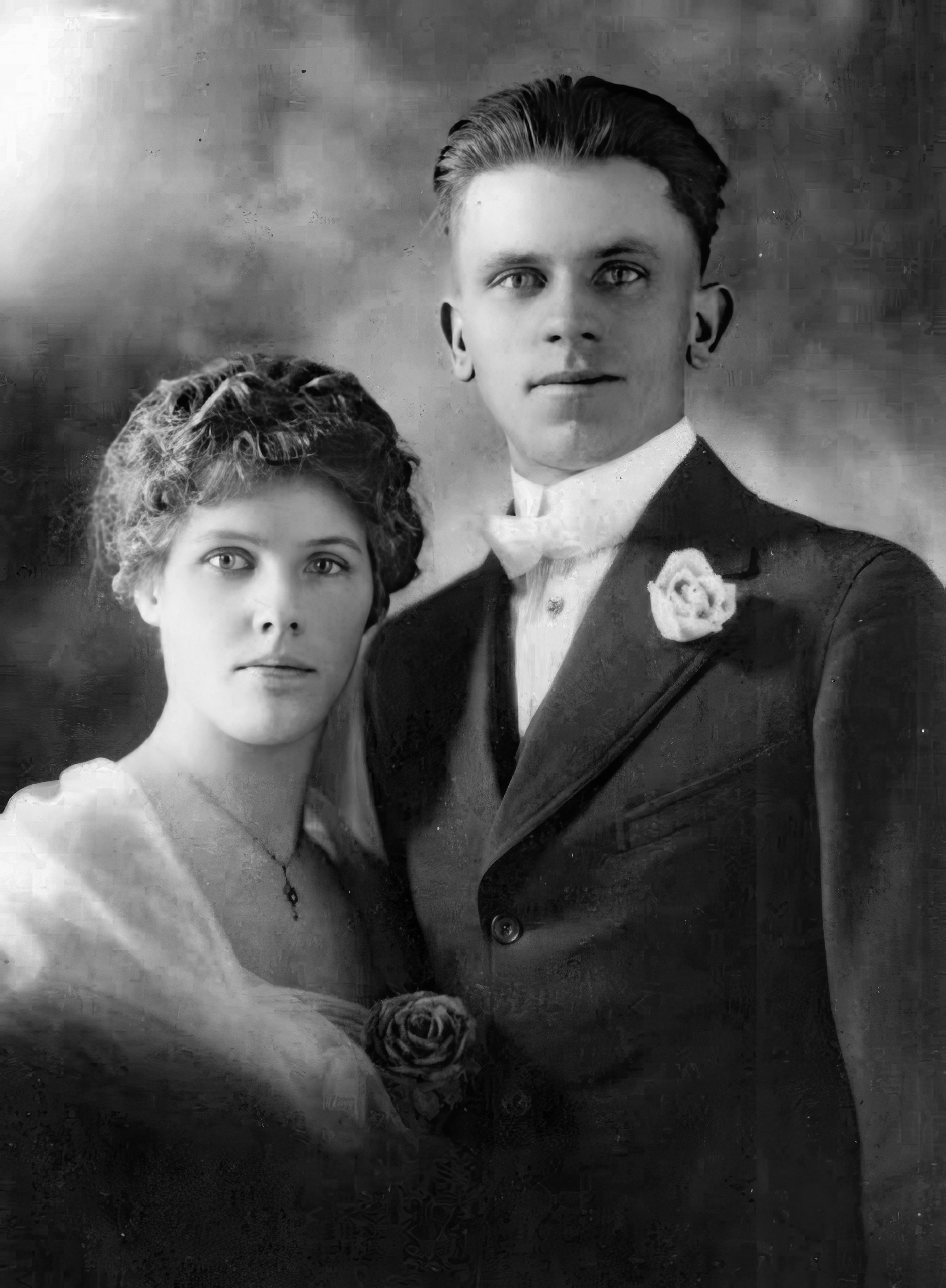
Edith was a Kebschull cousin of ours. Edith's parents were homesteaders in Montana and built their own ranch. Her family line connects with our Lübeck family in Klein Nossin, Kreis Stolp, Pommern with a paternal line traced to Johann Jakob Kebschull (1789-1866). DNA testing confirms the connection.
“Citation: Digital reproduction of a photograph, media gallery, collection of Dixie Armstrong, Wakkuri-Petersen tree, Edith Oleta Kebschull and Harry Peterson, Bridger, Montana 1920, accessed 10 August 2026.
The Bridger Times newspaper (The Bridger Times, Bridger, Montana, Thursday, October 28, 1920) described Harry (Richard Harrington) Peterson, twenty-four years old, and Edith Kebschull, just nineteen, as a "brilliant couple" who were apparently much admired in their community. They had an intimate wedding at the bride's home, which included the bride's parents, the minister, and two attendants, plus a passel of friends.
The portrait includes just Edith and Harry. Edith appears to be wearing a white gown of modest design, perhaps of silk or tulle, with a real or fabric white rose at the bodice, and a necklace of intricate design. She wears no veil and no other flowers.
Harry (not related to our Petersen clan, so far as I know) wears a well-tailored suit, white shirt and immaculately tied bow tie, and a white rose in his lapel.
The newspaper article indicated that there was a reception for seventy-five people, no honeymoon, and that the bride and groom would make their home at Harry's ranch near the town of Golden immediately following the ceremony.
The Petersons had eight children and eventually took over the Kebschull homestead for seventeen years before buying their own land and farming for twenty-seven more years. Edith died in 1985, Harry in 1987.
1921: Henry Albert Petersen and Marie Malatinka, Chicago, Illinois
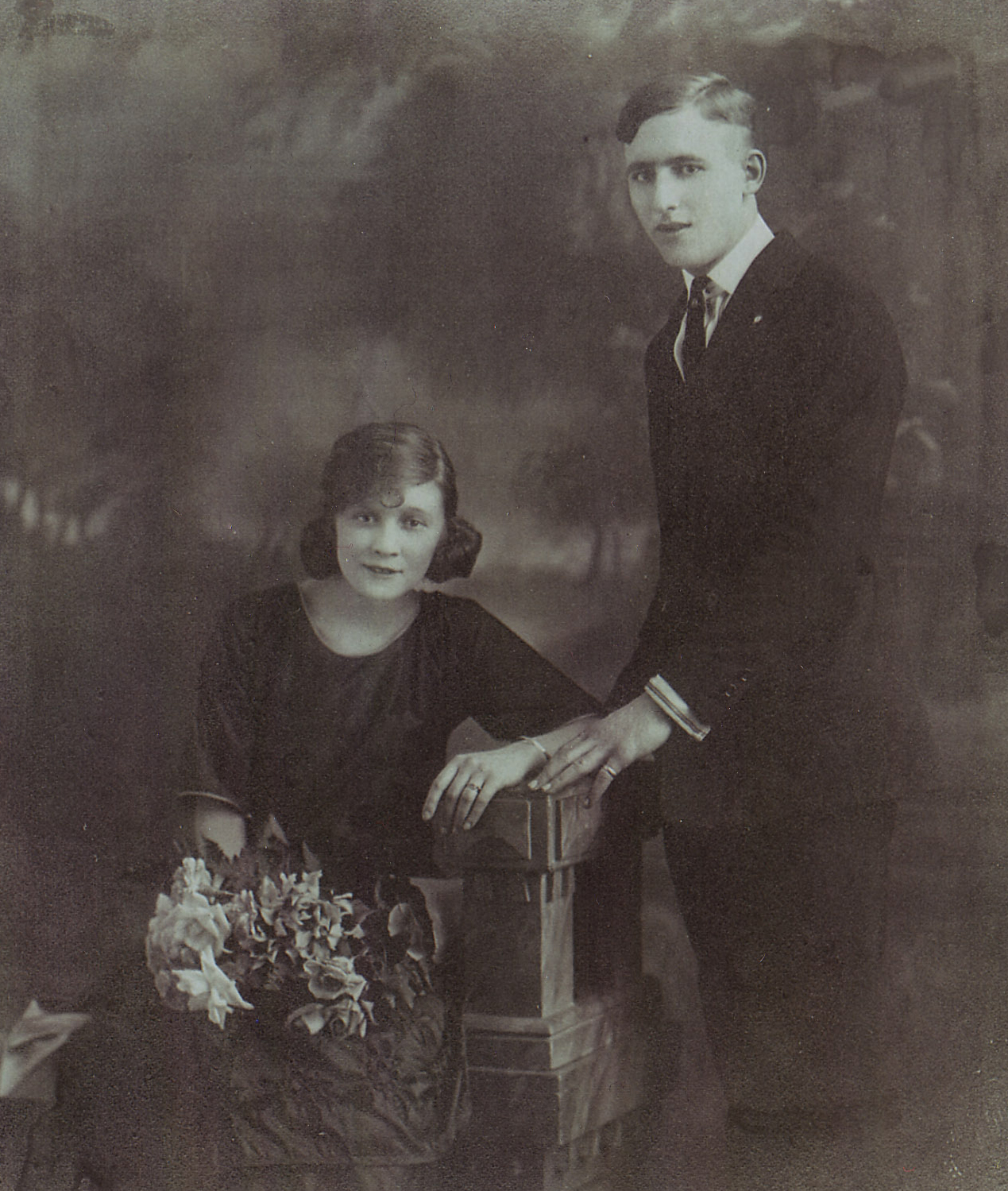
Henry Albert Petersen was the oldest child of Louis and Anna (Majoros) Petersen. His bride Marie was the daughter of Joseph and Anna Malatinka or Malatinko, Slovak immigrants from Austria who had eight children in Chicago. Marie was the second oldest, born in Blue Island, Illinois, which put her in proximity to Henry, whose Petersen family lived in Blue Island.
“Citation: Digital reproduction of a photograph, collection of Cathie Meyer: Henry Albert Petersen and Marie Malatinka, 1921, accessed 11 August 2026.
This is the first grandchild of Hans and Catherine Petersen to marry, and it appears that it was not a white wedding. Fashions were more relaxed and women (at least in our Petersen families) wore dresses that would be practical for formal dinner occasions after their marriage. This makes good economic sense, and we'll see it again in the 1940s when we get there.
Marie wears a dark, scoop-neck dress with ruffles on the skirt, and she's seated in a heavy wooden chair next to Henry, who stands next to her. Marie wears a bangle bracelet and proudly displays her left-hand wedding band.
Henry wears a dark suit, a striped shirt, and a dark tie. He also displays a ring on the little finger of his left hand, so probably not a wedding band.
Henry and Marie had one child, Leonard Alfred, who was born in 1922, and then the marriage apparently ended. Marie remarried a Charles Twombly. We have no further information about Henry Albert Petersen, not even his death year.
1923: Albert Petersen and Maria (Mae) Thelen, Chicago, Illinois
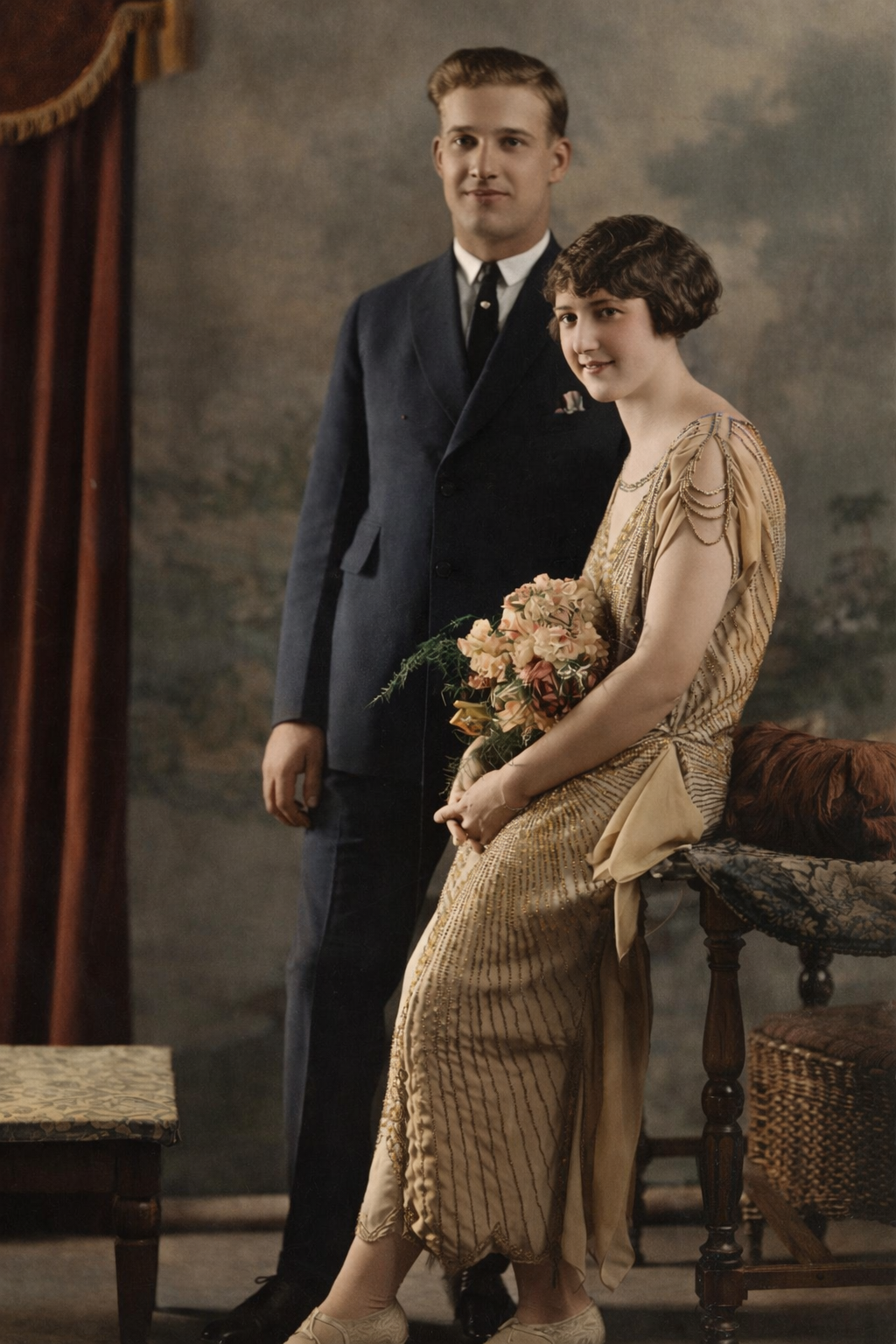
Albert was the second son of Louis and Annie Petersen, while Mae was the daughter of Theodore and Elizabeth Labonde Thelen.
“Citation: Digital reproduction of a photograph, collection of Cathie Meyer: Alfred Petersen and Maria (Mae) Thelen, 1923, accessed 11 August 2026.
The bride wears one of the most elegant wedding dresses I've ever seen, with elaborate folds and pleats along the front and back, plus delicate pleated cap sleeves. There's no veil, no floral cap, and no jewelry to be seen, but Mae carries a bouquet full of a variety of roses, with fern leaves acting as second botanical design element. Mae's hairstyle displays the popular Marcel wave that was seen in fashionable circles.
Albert wears a well-tailored suit, white shirt with a modern collar, a dark tie with a simple tie pin, and a coiffure that displays his lush hair. Petersens generally had great hair.
Albert and Mae had six children. Albert made his living as a truck driver in the Chicago area. The couple enjoyed forty-six years of marriage before Albert died in 1969, Mae in 1981.
1924: Adolph Olson and Dorothea Kruschke, Eau Clairie, Wisconsin
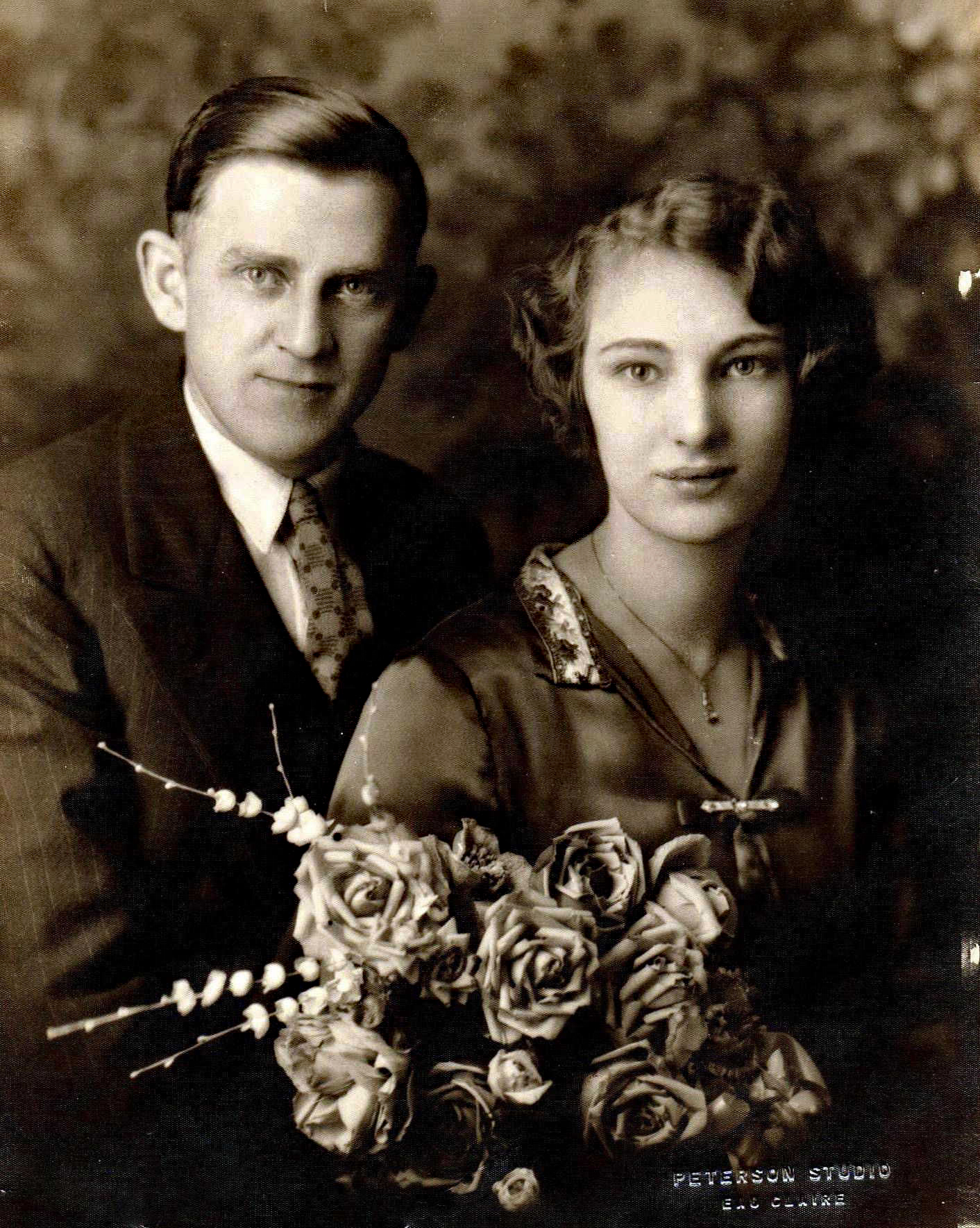
Dorothea Kruschke was the youngest daughter of Fred and Elizabeth (Wienand) Kruschke and a sister of Martha Kruschke Jatho, who married Louis Jatho. This glamorous portrait shows her with her new husband Adolph Barney Olson, son of Evan and Elizabwth (Johnson) Olson, both of Eau Claire, Wisconsin. This portrait was taken at the Peterson Studio in Eau Claire.
“Citation: Digital reproduction of a photograph, collection of Savannah Brogden, Brogden Family Tree: Adolph Barney Olson and Dorothea Elizabeth Kruschke, 1924, accessed 11 August 2026.
According to the local press Dorothea had several wedding showers before her actual marriage, one of them including a mock-wedding service -- good for rehearsals, I expect, although it was a modest wedding at the home of the bride's parents, with no attendants involved. Dorothea apparently did wear a different dress and a veil for the ceremony but then changed to this evening dress for her formal portrait.
Dorothea's post-wedding outfit is dark with delicate embroidery around the collar and sleeves. She wears a horizontal collar pin and a lavalier necklace. Her wedding bouquet of roses is part of the portrait.
Adolph wears a dark suit, a white shirt, and a patterned tie. He probably wore this outfit for his departure on the couple's honeymoon, which the Eau Claire Leader-Telegram reported was to be in St. Paul, Minnesota.
Aming the attendees at the wedding were two folks from St. Paul: Martha Kruschke Jatho, the bide's older sister, and Martha's husband Louis Jatho.
Dorothea and Adolph lived in Eau Claire all their lives and had two children there. Adolph died in 1961, Dorothea in 1992 at the age of ninety.
1924: Hans Petersen and Marie Siebels, Dithmarschen, Schleswig-Holstein
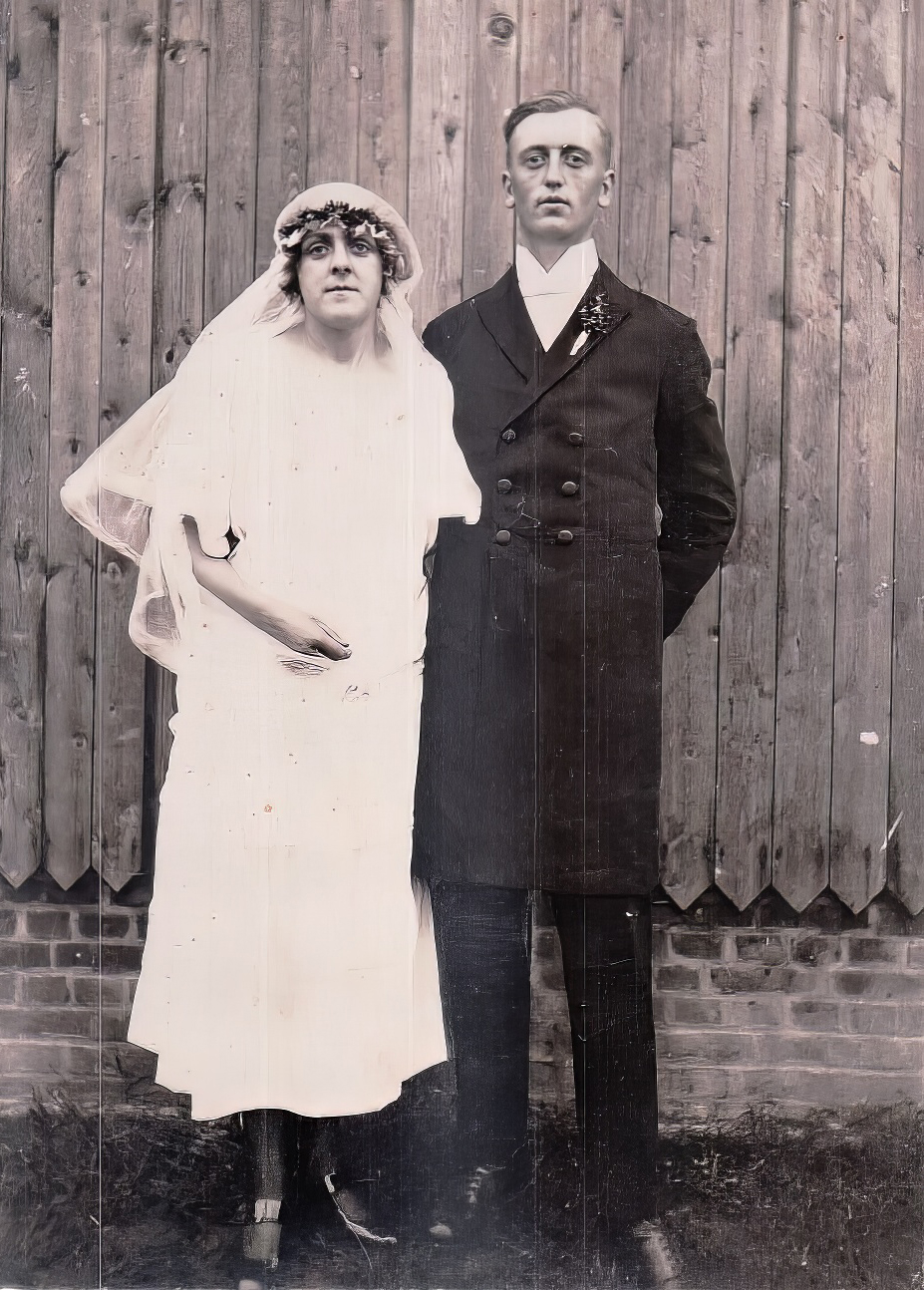
White weddings were popular in the Old Country by the time the 1920s rolled around. Our Schleswig cousins celebrated their wedding with the bride, Marie Siebels, all in white for her marriage to Hans Petersen, who was the grandson of our cousin Helena Marie Petersen.
“Citation: Digital reproduction of a photograph, front side, collection of Mario Petersen: Hans Petersen and Marie Margarethe Siebels, Dithmarschen, Schleswig-Holstein, 1924, original photograph scanned from the album of the owner, accessed 12 August 2026.
The marriage took place on August 15, 1924 in Dithmarschen, the bride's home town. Marie wears a white gown with a drop waist, very popular at that time, with a half-length veil held in place by a lace cap wreathed with flowers. It must have been the fashion at the time for the bride to wear dark stockings and shoes, because several of our brides do this, Marie included.
Hans wears a double-breasted frock coat with wide lapels, a white high-necked collar, and a jaunty boutonniere at his lapel.
Hans and Marie had four children and lived in Dithmarschen all their lives. Hans died in 1946, Marie in 1990.
1925: Celia Gratz and William Henry Gatz, Chicago, Illinois
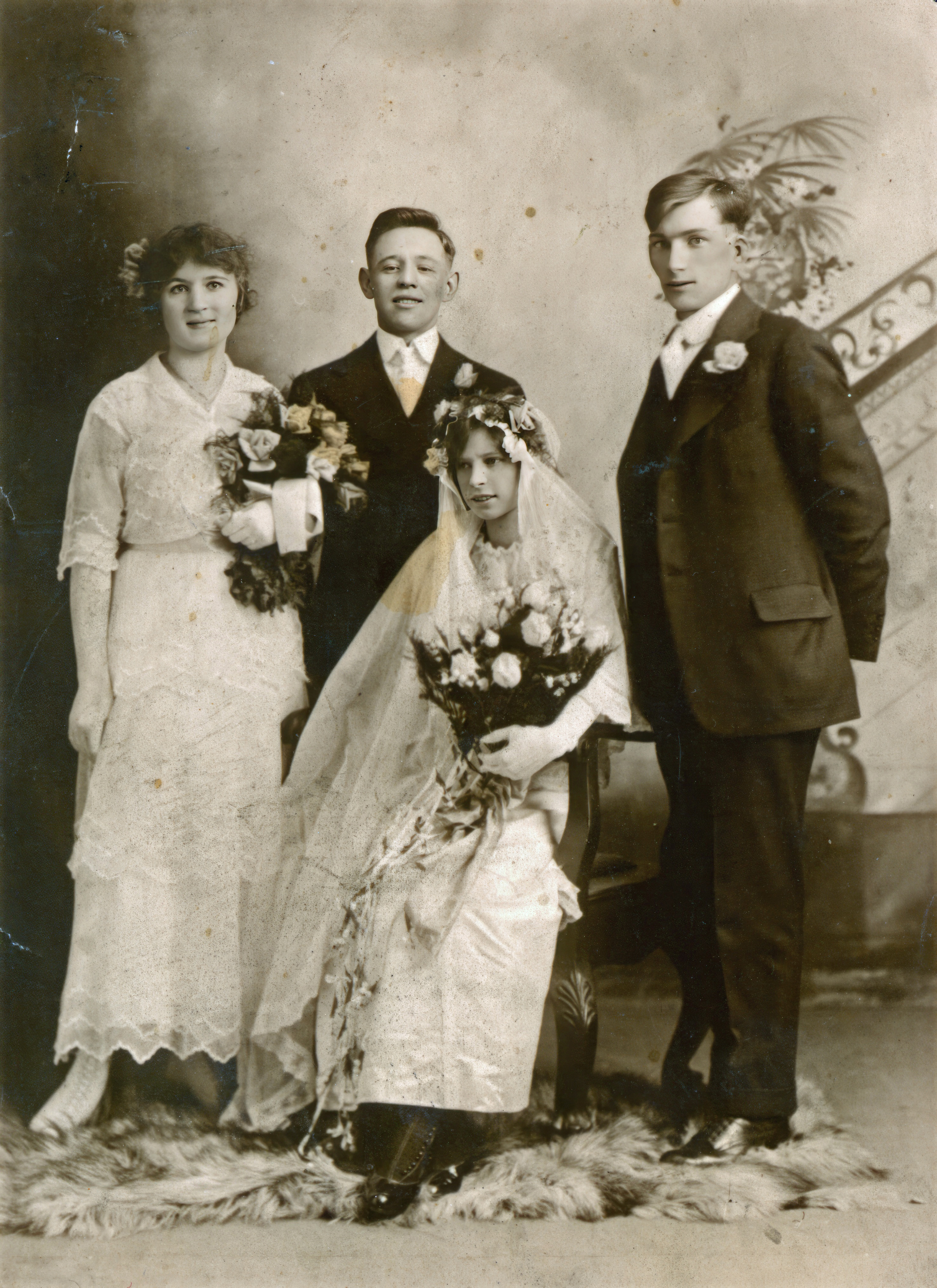
The Gratz family was related to our Chicago Jatho family. Celia's father was the cigar maker John Gratz. She came from a family of thirteen children.
“Citation: Digital reproduction of a photograph, collection of Judi Jatho Weber: Celia Gratz and William Henry Gatz, Chicago, Illinois, 1925, original photograph scanned by the owner, accessed 12 August 2026.
Celia is seated and wears a mid-calf-length white gown with a flowered lace cap holding her floor-length veil in place. She cradles an impressive bouquet of roses and ferns. Celia was visually impaired so it was difficult for her to look into the camera lens, but her far-away appearance is nevertheless captivating.
William Henry stands at her side, hands grasped behind his back, immaculately dressed in a tailored suit, white shirt and tie, and a small rose at his lapel.
The attendants were the bride's brother Peter Gratz and his wife Sadie.
William and Celia lived on Bell Street in Chicago where he was a truck driver for a coal company. They had two children William died in 1969, Celia in 1995.
1925: Emma Gohr and Harry Emanuel Olson, Jackson, Minnesota
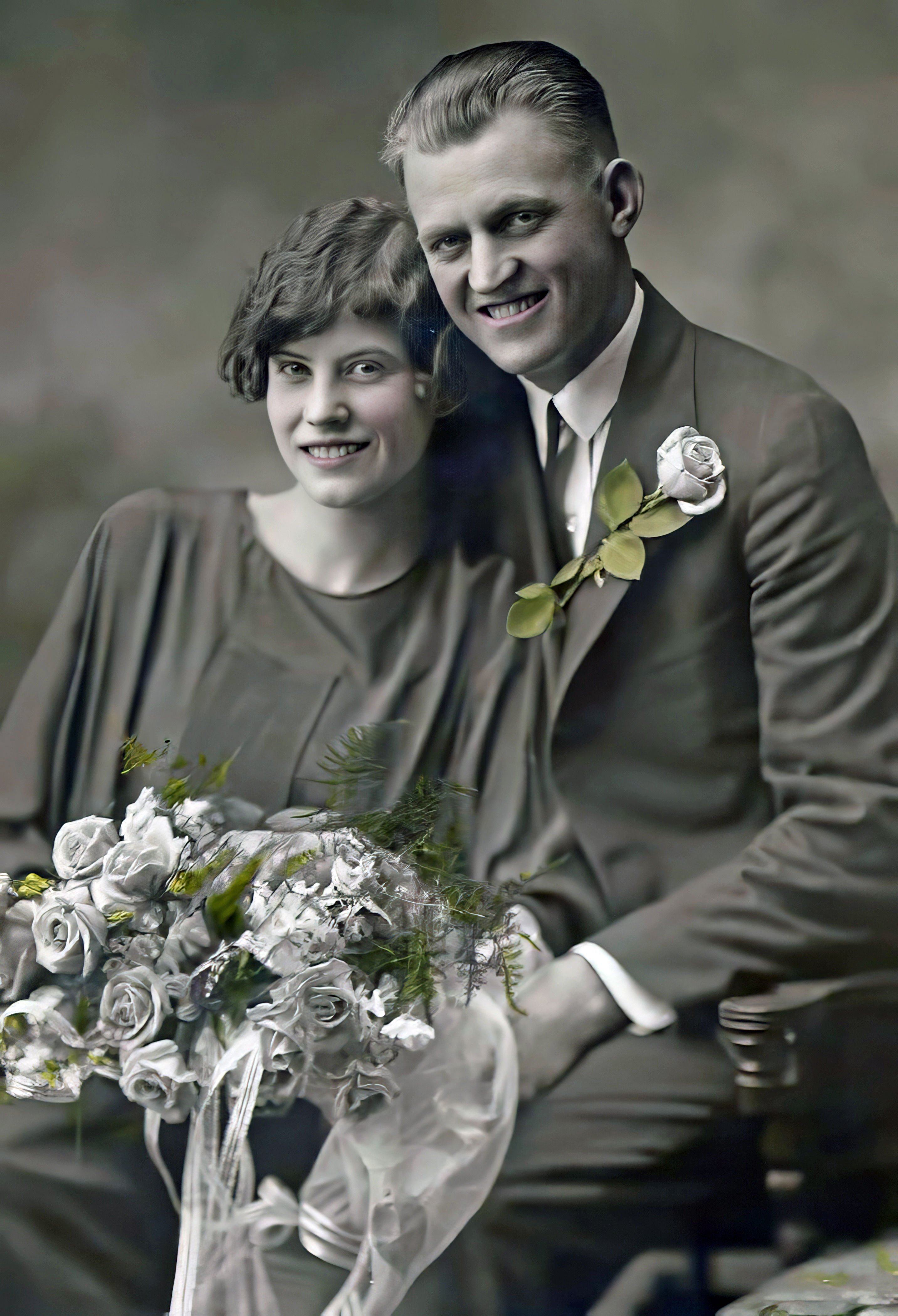
This charming wedding portrait shows traces of hand-tinting. Emma was the granddaughter of Albert Wilhelm Gohr and his wife Wilhelmine Stenke. They were cousins of our Chicago Gohr family, which we know from DNA matches with Gohr descendants.
“Citation: Digital reproduction of a photograph, collection of Carmen Jass, Gustav Emil Olson tree: Emma Wilhelmina Augusta Gohr and Harry Emanuel Olson, Jackson, Minnesota, 1925, original photograph from the collection of the owner, accessed 12 August 2026.
Emma wears a flowing day dress and leans affectionately agains her groom, Harry Olson. She wears no flowers or veil but embraces an opulent wedding bouquet of roses and ferns.
Harry Olson, a World War I veteran, is seated beside Emma. He wears a neatly tailored suit, a white shirt and dark tie, and has a single rose pinned to his lapel.
The couple lived in and around Jackson for most of their lives managing their farm. They had six children. Harry died in 1979, Emma in 1988.
1926: Fritz Peter Petersen and Anna Goohs, Belum, Lower Saxony
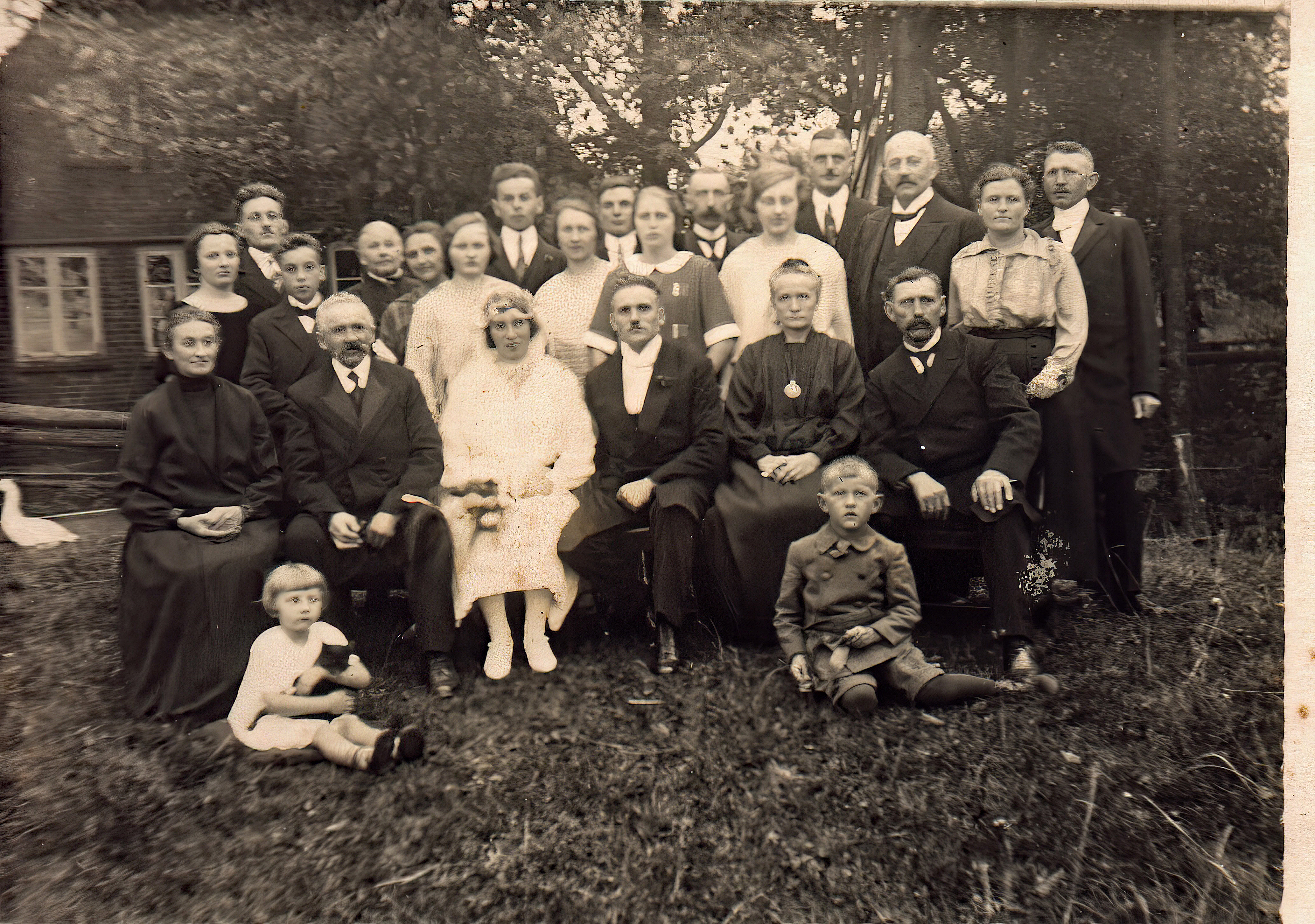
Belum is a small town on the north coast of Lower Saxony near Cuxhaven. Fritz Peter Petersen was the son of Matthias Petersen of Leck and Esther Møller of Medelbye, Schleswig-Holstein, grandson of Helena Maria Petersen Burmeister. Unusually this isn't a studio portrait but rather a semi-informal snapshot taken outdoors, with the full wedding party in attendance.
“Citation: Digital reproduction of a photograph, collection of Mario Petersen: Fritz Peter Petersen and Anna Goohs, Belum, Lower Saxony, 1926, original photograph scanned by the owner , accessed 13 August 2026.
As a result the image is slightly out of focus in places. The bride, Anna, wears a long-sleeve white wedding dress with a three-quarter length skirt, a lace cap and short veil, and a small bouquet of local flowers.
The groom, Fritz, wears his good suit with a high white shirtfront and no discernable tie with a dark-blossomed boutonniere in his lapel.
The wedding party included Fritz' parents, Matthias and Esther Petersen, seated at right. As a bonus we have a young girl on the lawn with her black cat, as well as a visiting white goose who photobombs the festivities to the left of the picture.
1927: Elsie Lehrmann and Myrton Hackert, Milwaukee, Wisconsin
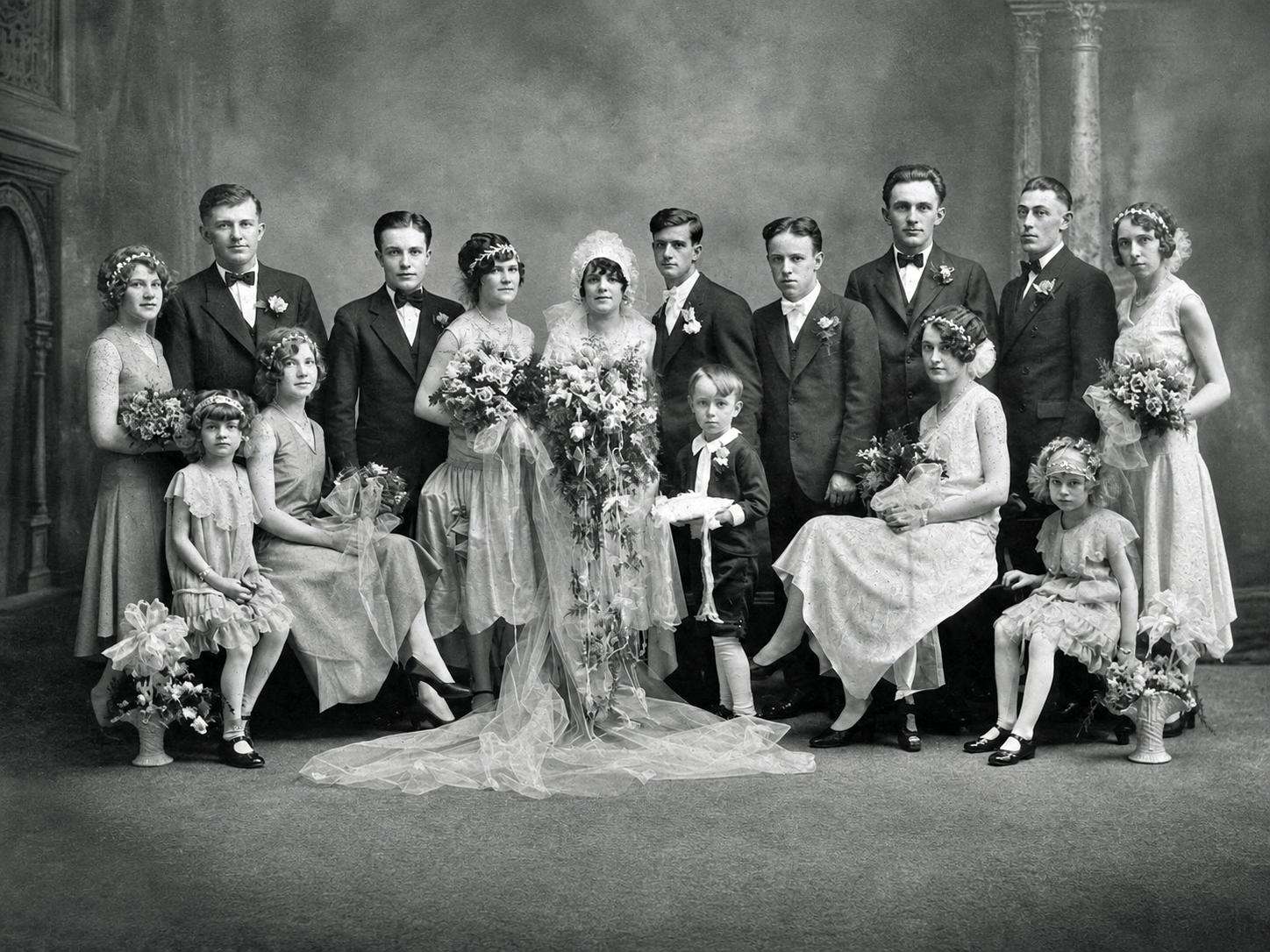
Not only was this an opulent wedding party but it suggests that our Milwaukee Petersen cousins were already part of the Lehrmann circle of friends, well before Marge Petersen married Arthur Lehrmann in 1930. The two Petersen twins, Marge and Myrtle, are at left, serving as bridal attendants. Is this where the romance blossomed?
“Citation: Digital scan of a photograph, collection of Patrick Lehrmann, wedding of Elsie Lehrmann and Myrton Hackert, June 18, 1927, Milwaukee, Wisconsin, restored by Bruce Dumes, accessed 13 August 2026.
Elsie Lehrmann was the sister of Art Lehrmann who later married Marge, but this is Elsie's day and she's dressed to the nines. She's standing at the center of the portrait surrounded by the groom, ten attendants, two flower girls, and a ring bearer.wears a three-quarter length white wedding dress, a spectacular upright headdress from which her floor-length veil cascades to the studio floor, and a monumental bouquet of roses, daisies, ferns, and vines.
Myrton stands beside her, arms behind him, dressed in a formal suit with a white shirt and bow tie, and a rose at his lapel. The other groomsmen wear dark bow ties, maybe to make it easier to tell who was the groom.
The flower girls wear matching dresses, but one wears a flowered cloche cap, the other a floral headband. And the ring bearer looks like he'd rather be anywhere else!
The Hackerts lived in Cudahy, a suburb of Milwaukee and the traditional home of the Lehrmann family. They had eight children. Myrton died in 1973, Elsie in 1976.
1928: Elizabeth Petersen and Stephen (Stepan) Zahar, Chicago, Illinois
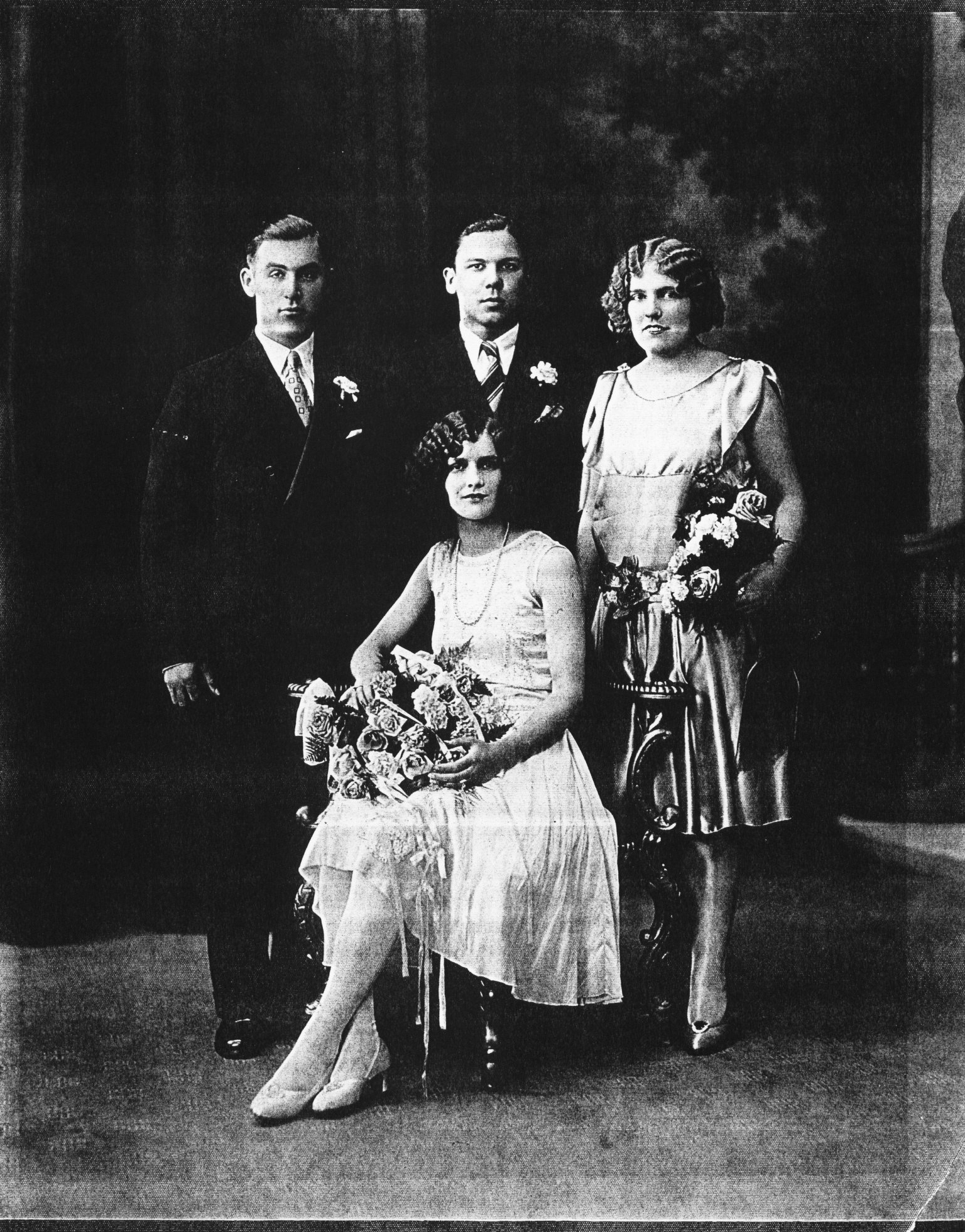
Elizabeth Petersen was a daughter of Louis and Anna Majoros Petersen. We don't know the name of the best man on the left, but the maid of honor was Florence Mikkelsen, technically Elizabeth's aunt, although Florence was one year older than Elizabeth.
“Citation: Digital reproduction of a photograph, collection of Cathie Meyer: Elizabeth Anne "Betty" Petersen and Stephen Zahar, Chicago, Illinois, 1928 accessed 13 August 2026.
Stephen emigrated with his mother and siblings in 1911 to join their father in Chicago where he was already working. Borders change over time so Stephen updated his country of origin depending on the political events of the day: Croatia, Yugoslavia, Austria.
This looks like a small wedding but everyone is nicely dressed. The bride is seated, wearing a white sleeveless dress near knee-length with a long strand of pearls and a beribboned bouquet of roses. Her stockings and shoes are also white, keeping with the bridal theme.
Stephen, standing behind her, wears a dark dress suit, white shirt and striped tie. He has a single blossom at his lapel (a rose? a carnation?) as does his best man. Florence Mikkelsen wears a satin dress of a neutral color, perhaps beige or gold, and carries a substantial bouquet herself. The ladies both wear their hair in the fashionable Marcel wave style that was so popular in the late 1920s. Florence was the half-sister of Louis Petersen, Elizabeth's late father.
Stephen was a laundry worker and Elizabeth was a food handler for the Chicago Cubs and White Sox, which probably gave her special access to their games. The couple lived in Chicago through the 1950s and had two children, Elizabeth (known as Betty like her mother), and Alfred. They eventually moved to Mesa, Arizona and lived there in happy retirement. Elizabeth died in 1993, Stephen in 1998.
1929: Walter William Paul Gohr and Emily Kruck, Sioux City, Iowa
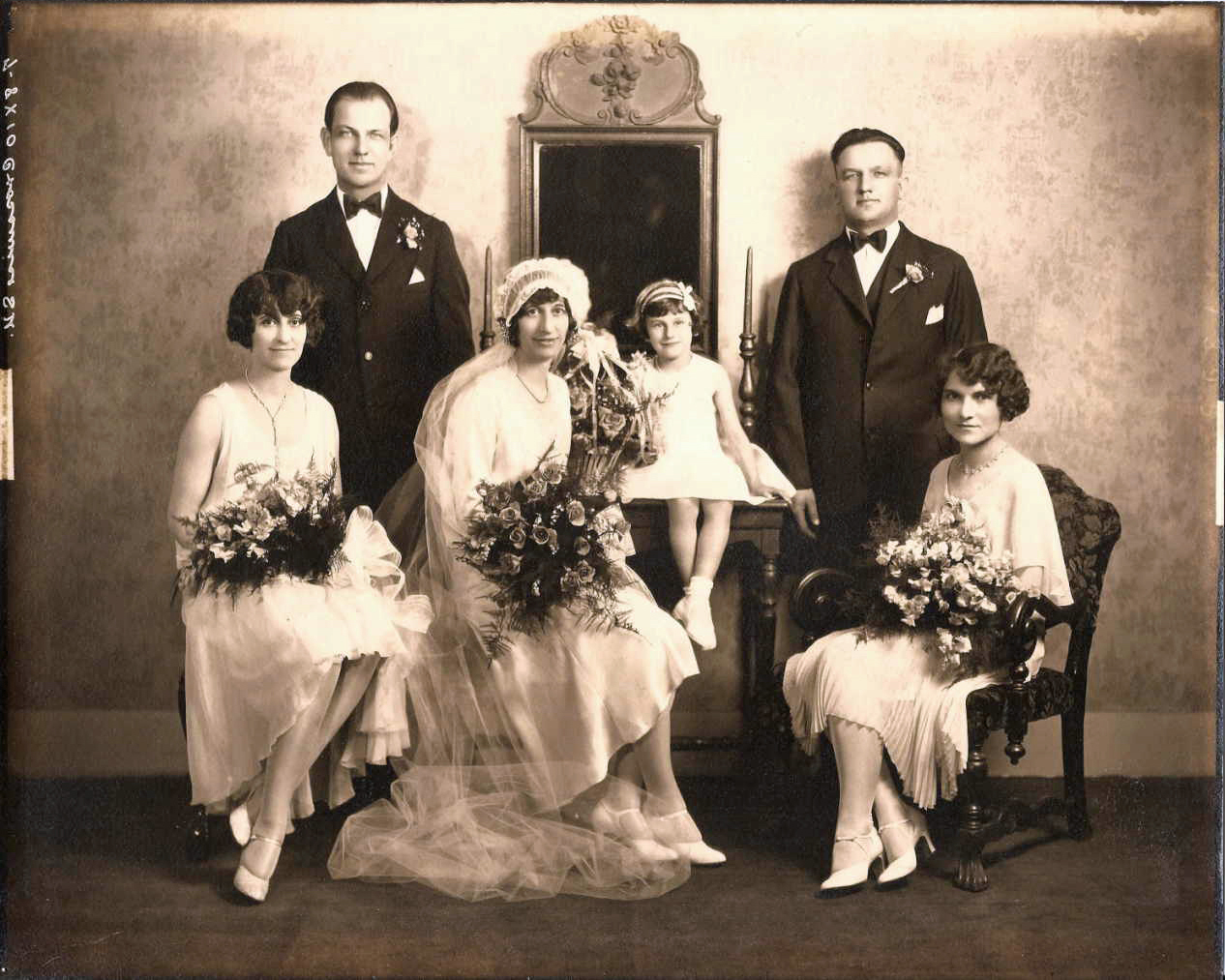
Walter Gohr, born in 1897, was the son of Albert Gohr and Amelia Kersine of Oconto County, Wisconsin. Emily, born in 1901, was the daughter of Wilhelm Kruck and Anna Clay. Walter's Gohr family was connected to our Chicago Gohr clan via a DNA match, although available records don't tell us the details.
“Citation: Digital reproduction of a photograph, collection of Rochelle Gentele: Walter William Paul Gohr and Emily Kruck, Siouz City, Iowa, 1929, accessed 25 October 2026.
The marriage was held on June 12, 1929 in Sioux City. Emily Kruck, seated, is dressed in a three-quarter length white satin gown with a full floral cap and full-length veil, curled around her stylish shoes. She wears a single strand of pearls and carries a large bouquet full of roses, lilies of the valley, and fern leaves.
Her maids of honor, also seated, are dressed similarly in white below-the-knee dresses with smaller bouquets and delicate necklaces, with stylish Marcel-waved hair styles.
The groom and his best man, standing, are dressed in dark suits with dark bow ties, pocket squares, and small boutonnieres.
Members of the wedding party included Walter's brother Edward. Maid of honor was the bride's sister Margaret Kruck and Helene Sulzbach was a bridesmaid. Perched on the dressing table behind the wedding party is Virginia Johnson, a charming flower girl. Interestingly the mirror behind Virginia appears to have been draped in black for some reason (or has been treated photograhically), perhaps to remove any reflection.
Walter and Emily had two children and lived in Sioux City after their marriage. Emily died in 1980, Walter in 1994.
1930: Martha Krohn Petersen and Herbert LeRoy Allen, Milwaukee
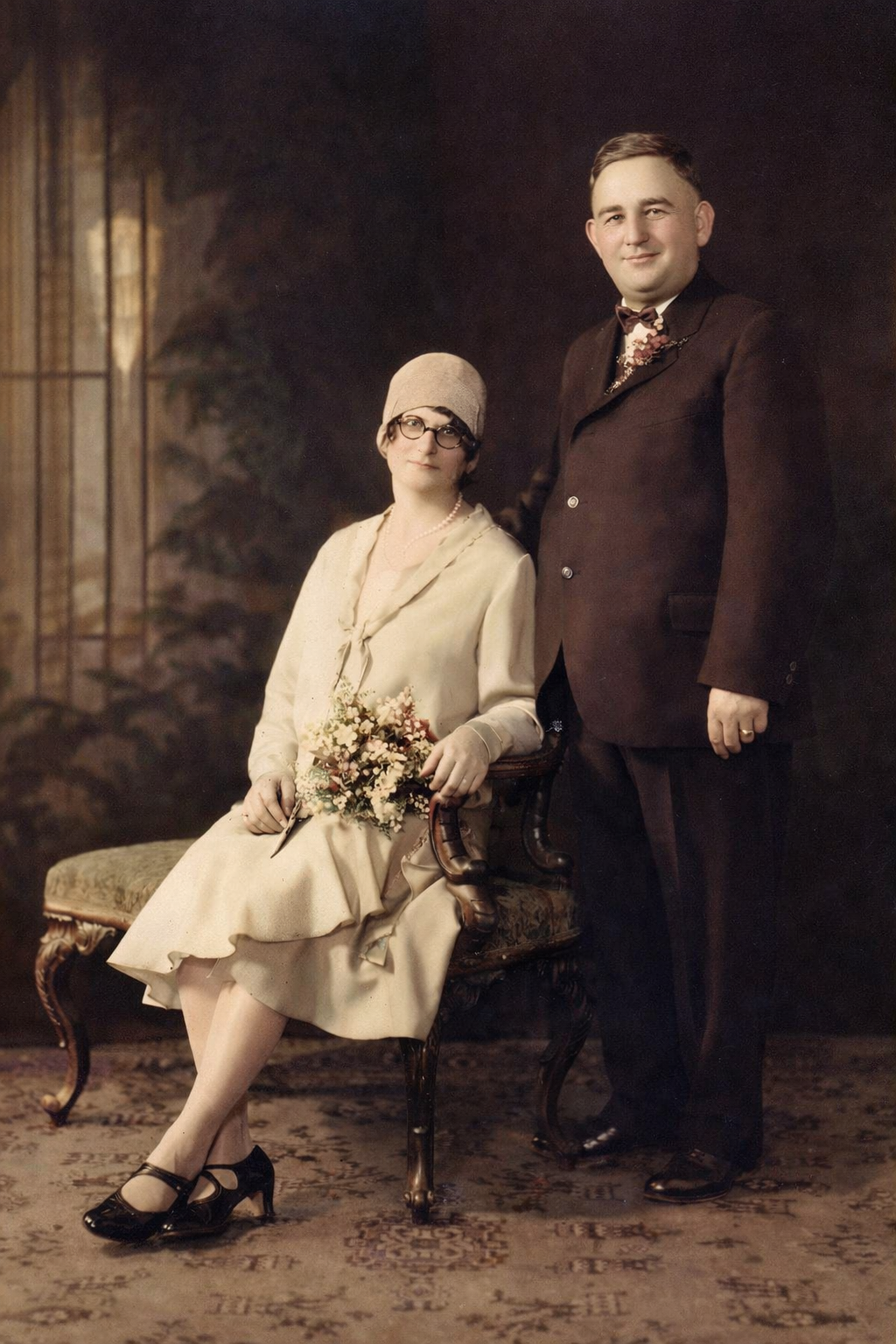
Martha Krohn and Peter Heinrich Petersen had married in 1906 and had six children before Peter's untimely death in 1916 of nephritis. Their youngest child, a son called Alvin or Allie, was born after his father's death.
“Citation: Digital reproduction of a photograph, collection of Cathie Meyer: Martha Krohn Petersen and Herbert LeRoy Allen, Milwaukee, Wisconsin, 1930, accessed 15 August 2026.
Martha and her family were based in Milwaukee during the 1920s although she had frequent visits from her Petersen and Krohn relatives, which must have helped immensely with child care. Eventually Martha met Massachussetts-born Herbert LeRoy Allen, a truck driver, and they decided to marry in 1930. Thus Herbert acquired a ready-made family.
In this studio wedding portrait Martha is seated, wearing a light-colored day dress of contemporary design, with a ribbon accent at her collar and a wrap skirt. She also wears a fashionable cloche hat and dark heeled shoes with a small wedding bouquet of mixed flowers.
Herbert wears a well-tailored single-breasted dress suit with a white shirt and dark bow tie, plus a small boutonniere of flowers that match Martha's bouquet.
Herbert, Martha, and her children lived with her sister Anna's family and her own mother, Augusta Krohn, with frequent exchanges of photos among family members, especially the Petersens in Chicago and the Lehrmanns in Milwaukee. Herbert died in 1942, Martha in 1951.
https://sakionline.net/family-folio/img/franz-petersen-anna-politz-wedding-full.jpg
1930: Fritz Politz and Anna Petersen, Schleswig-Holstein
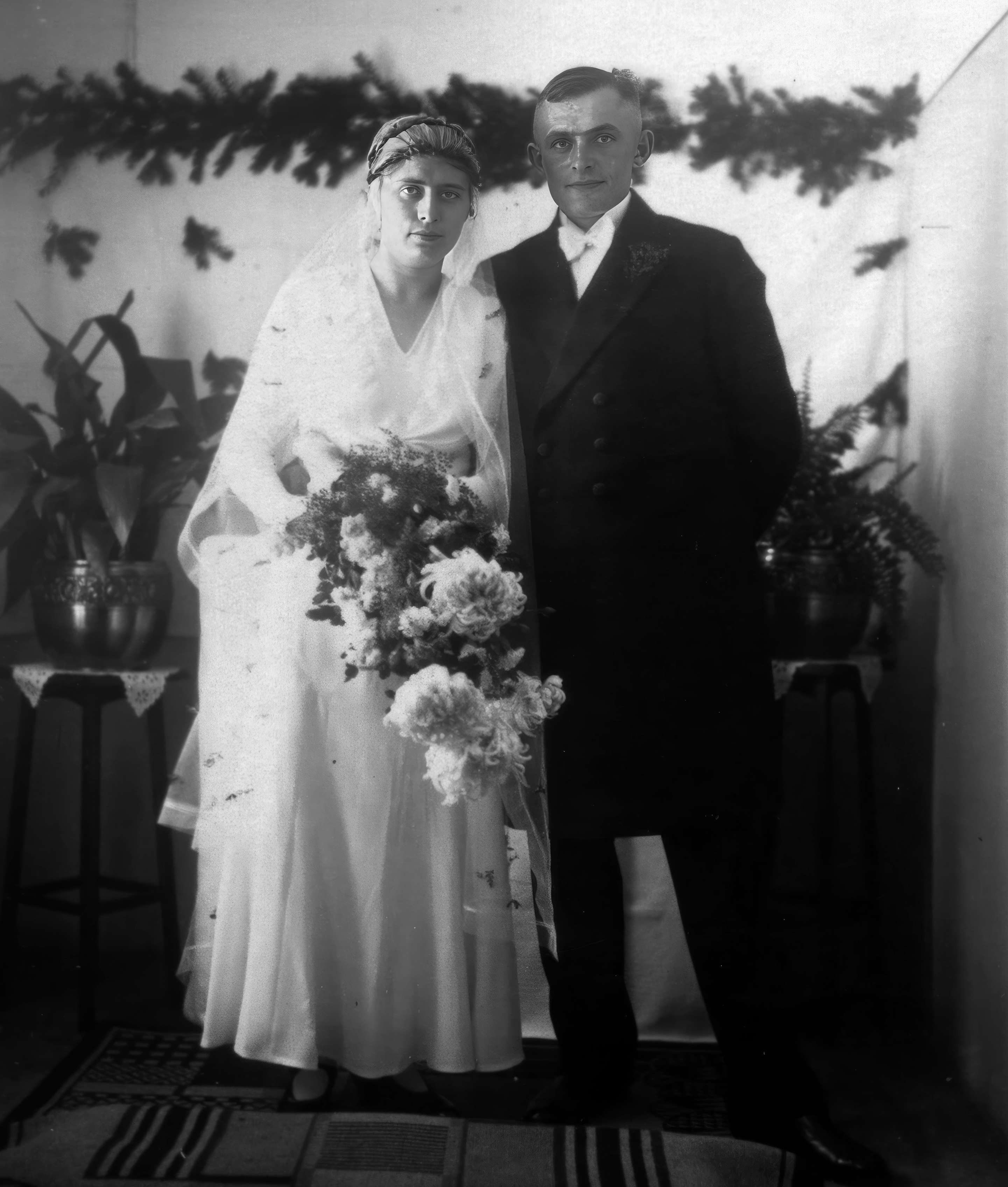
Anna Petersen, born in 1911, was the youngest daughter of our cousins Matthias Petersen and Esther Luise Möller, and a granddaughter of Helena Petersen Burmeister. She was one of seven children.
“Citation: Digital reproduction of a photograph, collection of Mario petersen: Anna Petersen and Franz (Fritz) Politz, Dithmarschen, Schleswig-Holstein, 1930, scanned by the owner, accessed 16 August 2026.
Anna and Fritz pose together, standing in front of a decorated wall presumably in the church hall where they were married. Anna's gown is full-length and white, with a delicate three-quarter-length veil fixed to her hair by a fabric cap. Her bouquet is a large one, dominated by white chrysanthemums and green fern leaves.
Fritz wears a frock coat, which was a popular choice for bridegrooms in the region, with a white shirt and white bow tie. Interestingly he doesn't wear any floral arrangement at his lapel.
Fritz and Anna lived in the town of Marne and raised a family there. Fritz died in 1961, Anna in 2004.
1930: Marge Petersen and Arthur Lehrmann, Milwaukee, Wisconsin

The year 1930 was a big one for Petersen weddings, and to prove a point this is another one. Margaret Petersen, known as Marge in her family, was a twin sister to Myrtle. They had been bridesmaids in 1927 to the Lehrmann-Hackert wedding but here it's Marge's day as she joins the Lehrmann clan officially.
“Citation: Digital scan of a photograph, collection of Patrick Lehrmann: Margaret (Marge) Petersen and Arthur Lehrmann, Milwaukee, Wisconsin, 1930, scanned by the owner, accessed 16 August 2026.
The Milwaukee Petersens seemed to go for larger wedding party portraits, and that's just fine. It gives us more to admire. Marge wears a sleeveless floor-length white gown with a long veil anchored to a lace cap -- it may be the same veil worn by her older sister Germaine who married and posed prettily for her own wedding in 1926. Marge's bouquet is the largest in the photo with trailing ribbons of flowers down to the floor. Her bridesmaids wear three-quarter-length dresses with floral headbands and bouquets of their own. The flower girl admirably hefts her basket of flowers and her dress and headband echo the older ladies' fashions.
Arthur wears a nicely-fitting formal suit with a white shirt and bow tie, plus a natty pocket square and boutonniere. His groomsmen are similarly attired but with dark bow ties.
Marge and Art had a son, James Arthur. They lived in Milwaukee and divorced in 1960. Art died in 1969, Marge in 1988.
1935: Evelyn Petersen and Horton Leverenz, and Myrtle Petersen and Harvey Doerr, Milwaukee, Wisconsin
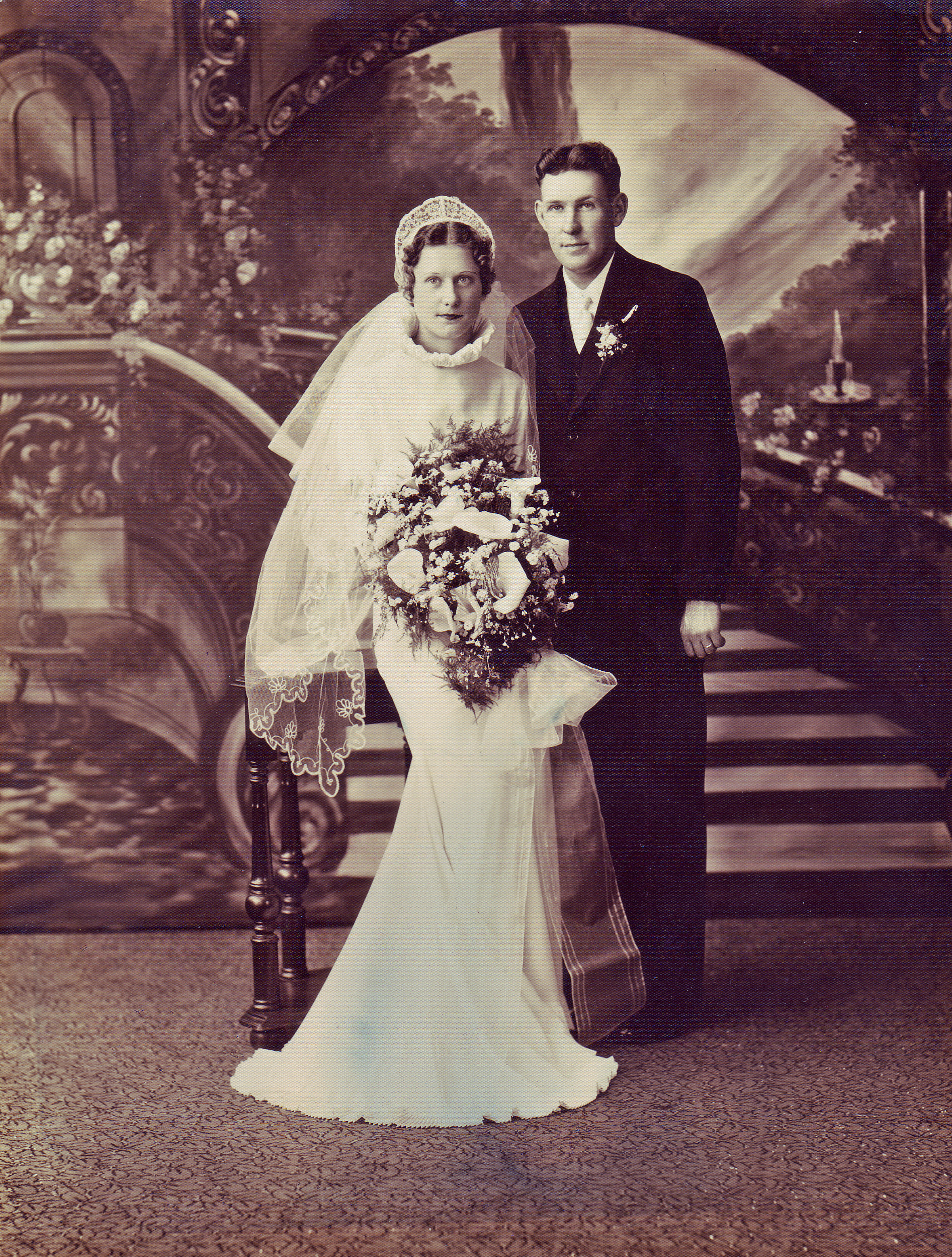
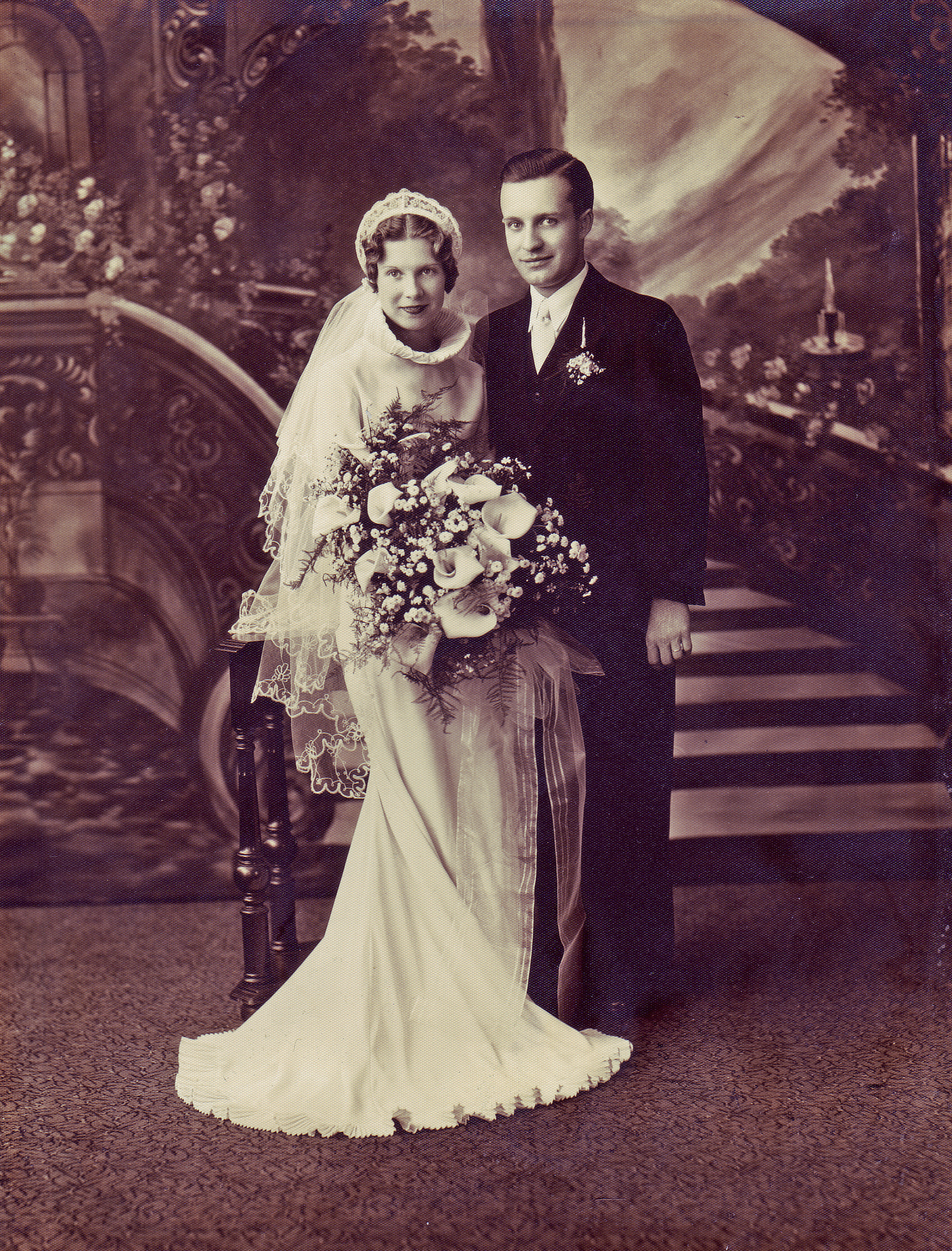
Seeing double? Not exactly. Evelyn and her sister Myrtle (not twins, interestingly) decided to get married on the same day in Milwaukee. The Milwaukee News for June 4, 1935 highlighted the event as a double wedding and the girls dressed accordingly to show off their fashion sense.
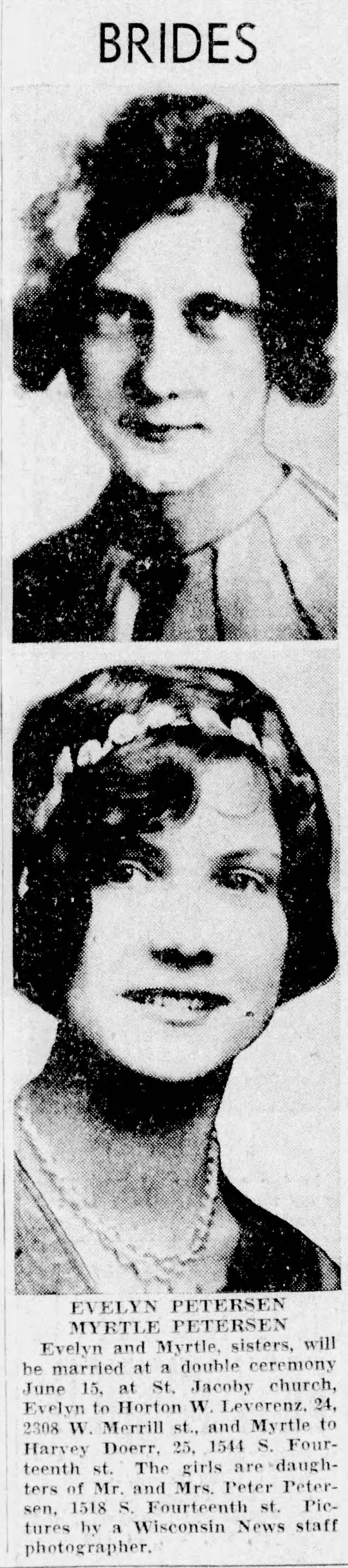
“Citation: Digital scan of a photograph, collection of Cathie Meyer: Evelyn Petersen and Horton Leverenz, and Myrtle Petersen and Harvey Doerr, Milwaukee, Wisconsin, June 15, 1935, accessed 17 August 2026.
Both Evelyn and Myrtle pose in front of identical studio backdrops and wear identical dresses: floor-length white gowns with a distinctive circular high collar and ruffled hems, half-length veils trimmed with lace embroidery at the edge, Russian-style "kokoshnik" lace tiaras, and substantial bouquets with calla lilies, button chrysanthemums, and fern leaves.
The grooms -- Horton Leverenz with Evelyn, Harvey Doerr with Myrtle -- both wear dark suits, white shirts and bow ties, and have small boutonnieres fixed upside down to their lapels. Harvey Doerr was literally the boy next door, living just a few houses down from the Petersens on 14th Street in Milwaukee.
Evelyn and Horton had one daughter, while Myrtle and Harvey had two. All lived in Milwaukee.
https://sakionline.net/family-folio/img/anna-emil-wuske-full.jpg
1936: Anna Majoros Petersen and Emil Wuske, Chicago, Illinois
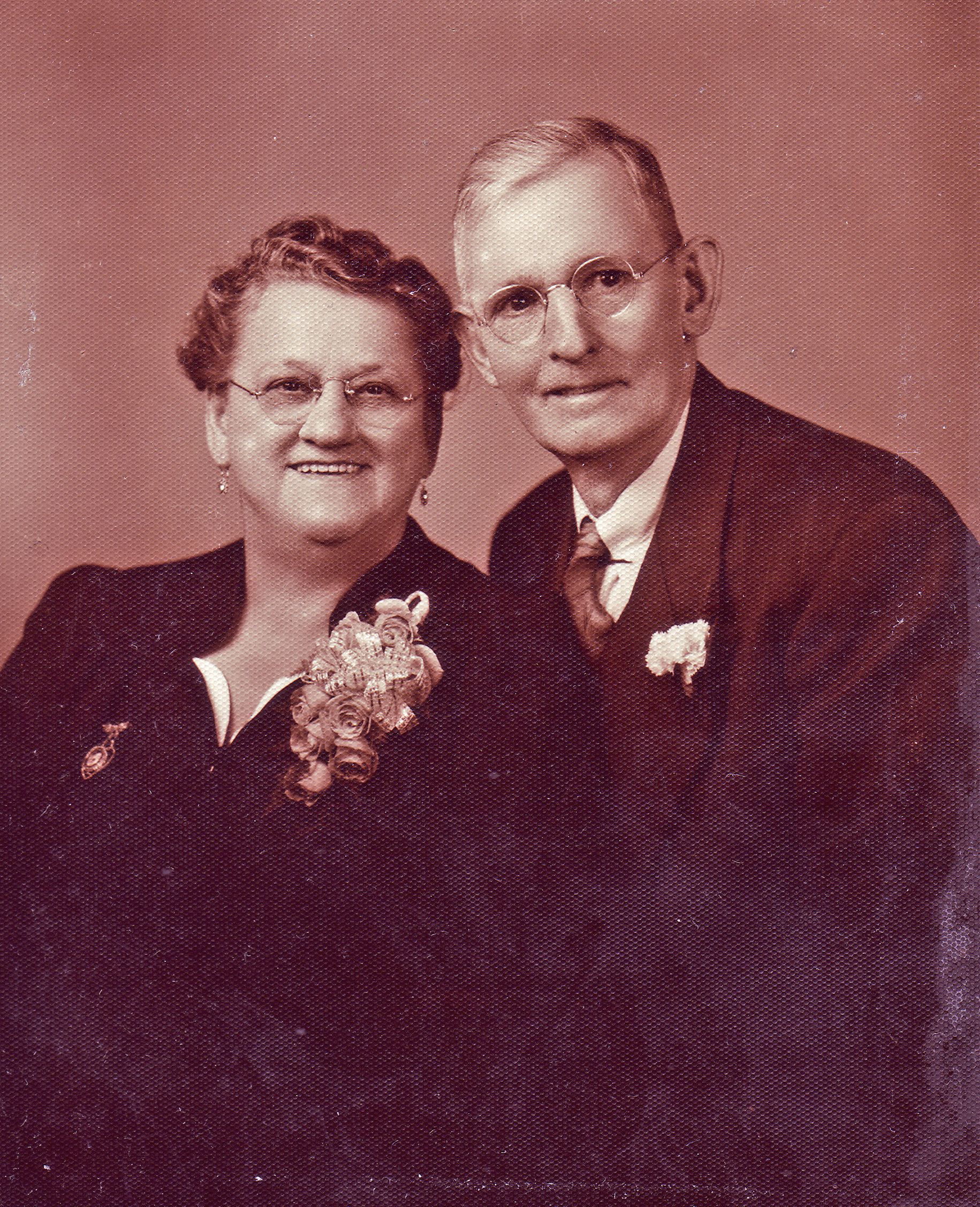
Emil Wuske was a windower of four years when he married Anna Petersen, Louis Petersen's window. It must have been a little confusing for Emil: his first wife, Anna Thelen, had the same first name as his second wife. And Anna Petersen's son Albert married a Mae Thelen. A relative? Could be!
“Citation: Digital scan of a photograph, collection of Cathie Meyer: Anna Majoros Petersen and Emil Wuske, 1936, accessed 17 August 2026.
Annie Petersen had been alone since 1926 when Louis Petersen died, and Emil Wuske's wife Anna died in 1932, so the timing was right for the couple to join forces in matrimony.
Annie wore a dark suit dress for her second wedding with a white blouse, petite earrings, and a ribbon corsage.
Emil wore a dark suit, white shirt, dark tie, and had a carnation fastened to his lapel. The couple had their wedding portrait taken at a local photography studio. Annie's mother-in-law from her previous marriage was still living so this portrait made it into Catherine Petersen Mikkelsen's collection and was eventually inherited by her granddaughter Cathie Meyer.
Annie died in 1956, Emil in 1960.
1940: Violet Petersen and James Avery MacEntee, Chicago, Illinois
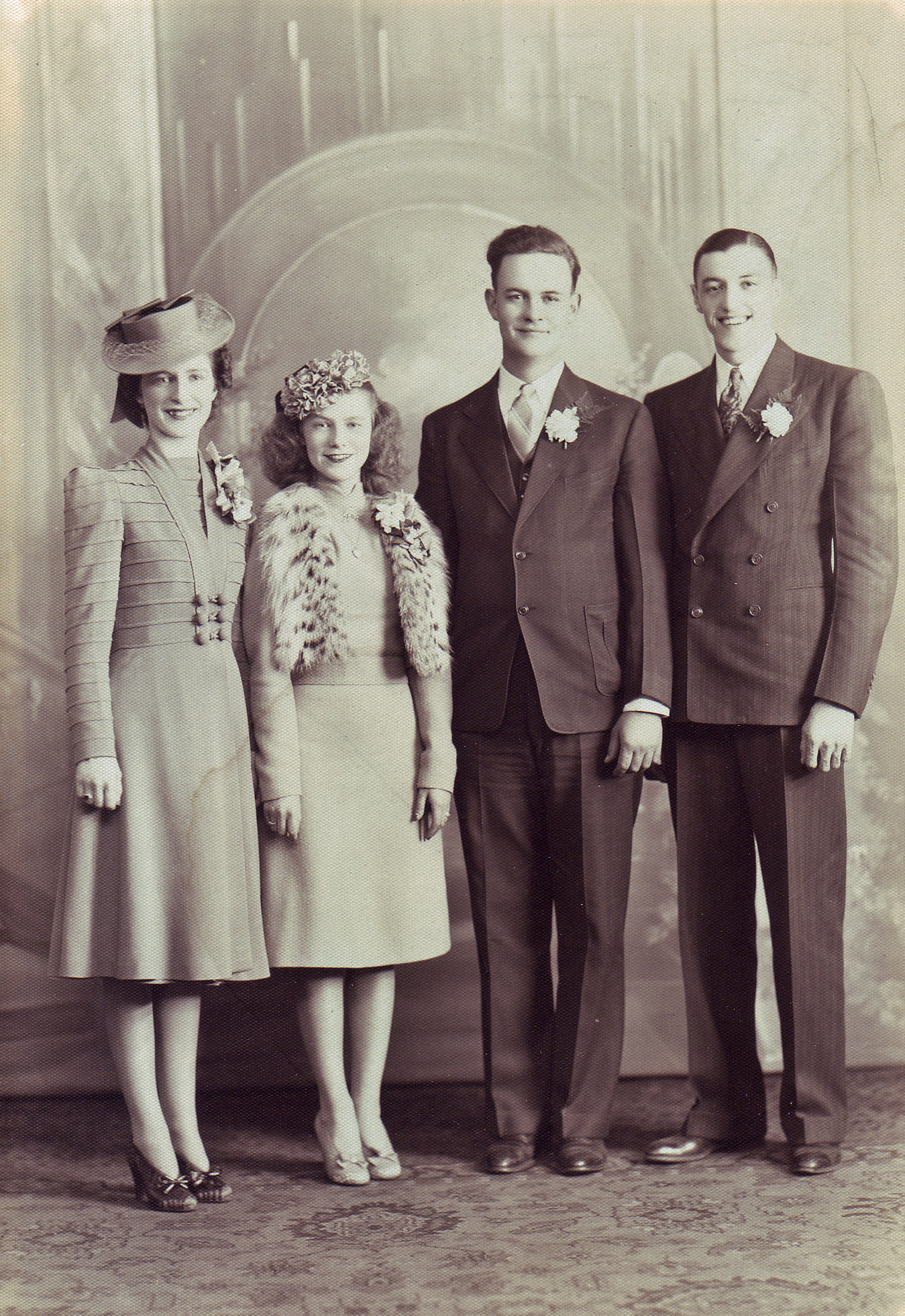
Violet Petersen was the daughter of George Christian Petersen and Agnes Majoros, born in 1919. her wedding portrait shows a distinct evolution in style. Rather than dress formally in white lace and veils, brides were choosing a more sedate look, one that valued practicality over pomp.
“Citation: Digital scan of a photograph, collection of Cathie Meyer: Violet Petersen and James Avery MacEntee, 1940, accessed 18 August 2026.
This might have been a civil wedding rather than one held in a church, in which case Violet's style of dress is entirely appropriate. She wears a short day dress with an elegant fur wrap. her hat is entirely floral. She wears a heart-shaped necklace and asmall corsage pinned to the fur wrap. Her bridesmaid is similarly dressed in a contemporary knee-length outfit with a corsage.
James wears a dark single-breasted suit, white shirt and faintly-striped tie with a carnation at his lapel. His best man is in a double-breasted suit with an identical flower at his lapel.
Violet was married three times. Her marriage to James ended in 1953 and she remarried Edward James McGraw in Monrovia, California, which lasted until Edward's death in 1976. She then married Richard Fickling in Sacramento, California. Richard died in 1995, Violet in 2001.
1940: William Petersen and Virginia Mae Nory, Chicago, Illinois
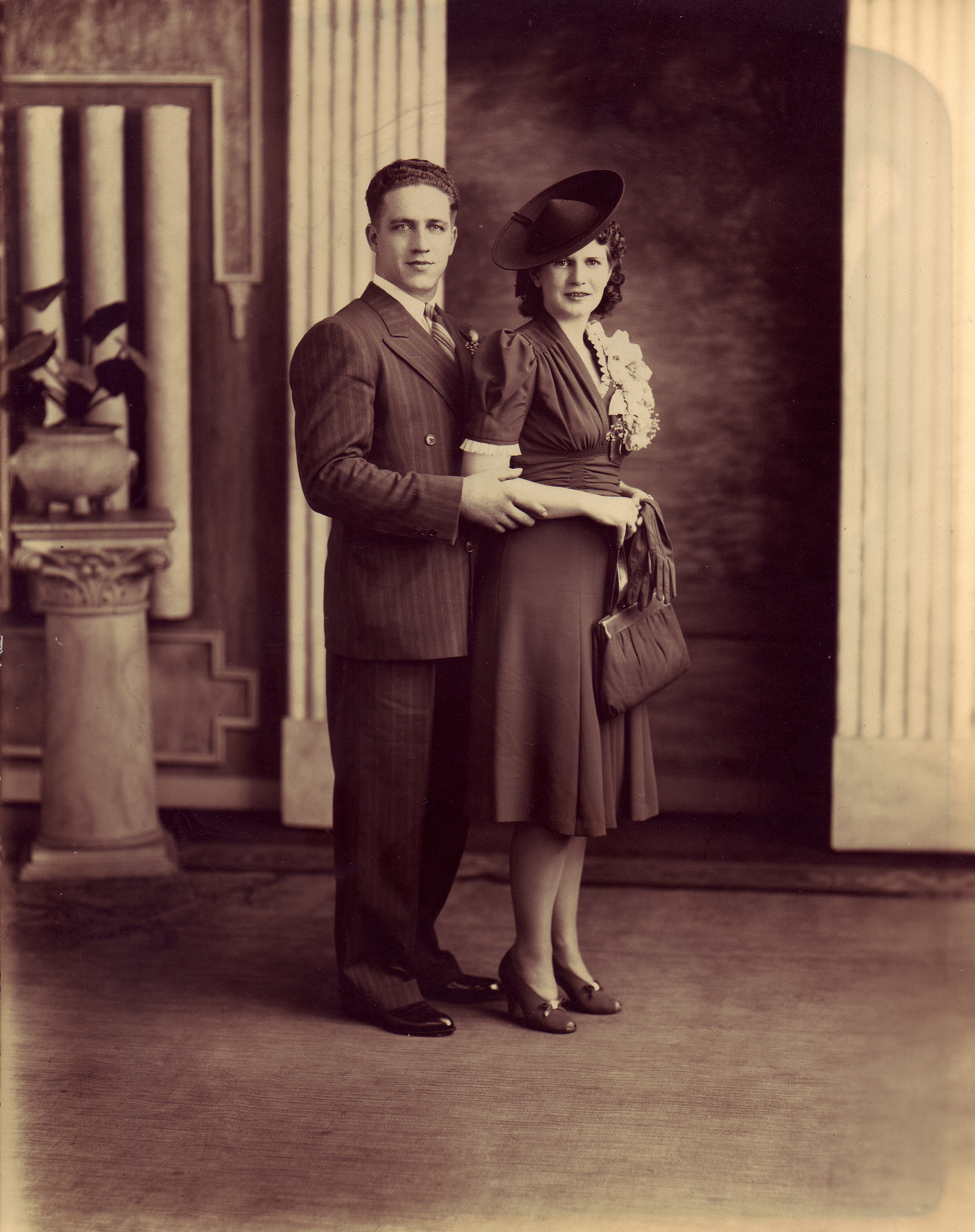
The youngest son of Louis Petersen and Annie Majoros Petersen, William was born in 1917 and lived with family members until his marriage to Virginia Nory in 1940.
“Citation: Digital scan of a photograph, collection of Cathie Meyer: William Petersen and Virginia Mae Nory, 1940, accessed 18 August 2026.
The wedding was held in Chicago on August 15, 1940 in Chicago and it looks like the same kind of civil affair enjoyed by William's first cousin Violet Petersen.
William and Virigina chose to have their wedding portrait done in a local photography studio with a fanciful pseud-classical backdrop. William wears a nice double-breasted pinstripe suit, white shirt and striped tie, and a small boutonniere in his right lapel, visible just over the bride's shoulder.
Virginia wears a dark day dress with white trim around the short sleeves and the collar, with a stylish hat at a jaunty angle and a large corsage on her left shoulder. Matching purse, gloves, and shoes are a nice sartorial touch.
William and Virginia had three children and at some point moved to Northern California, a popular destination for several of our Petersens. William died in 1987, Virginia in 1989 after 46 years of marriage.
1941: Marie MacLaughlan and Walter Miller, Chicago, Illinois
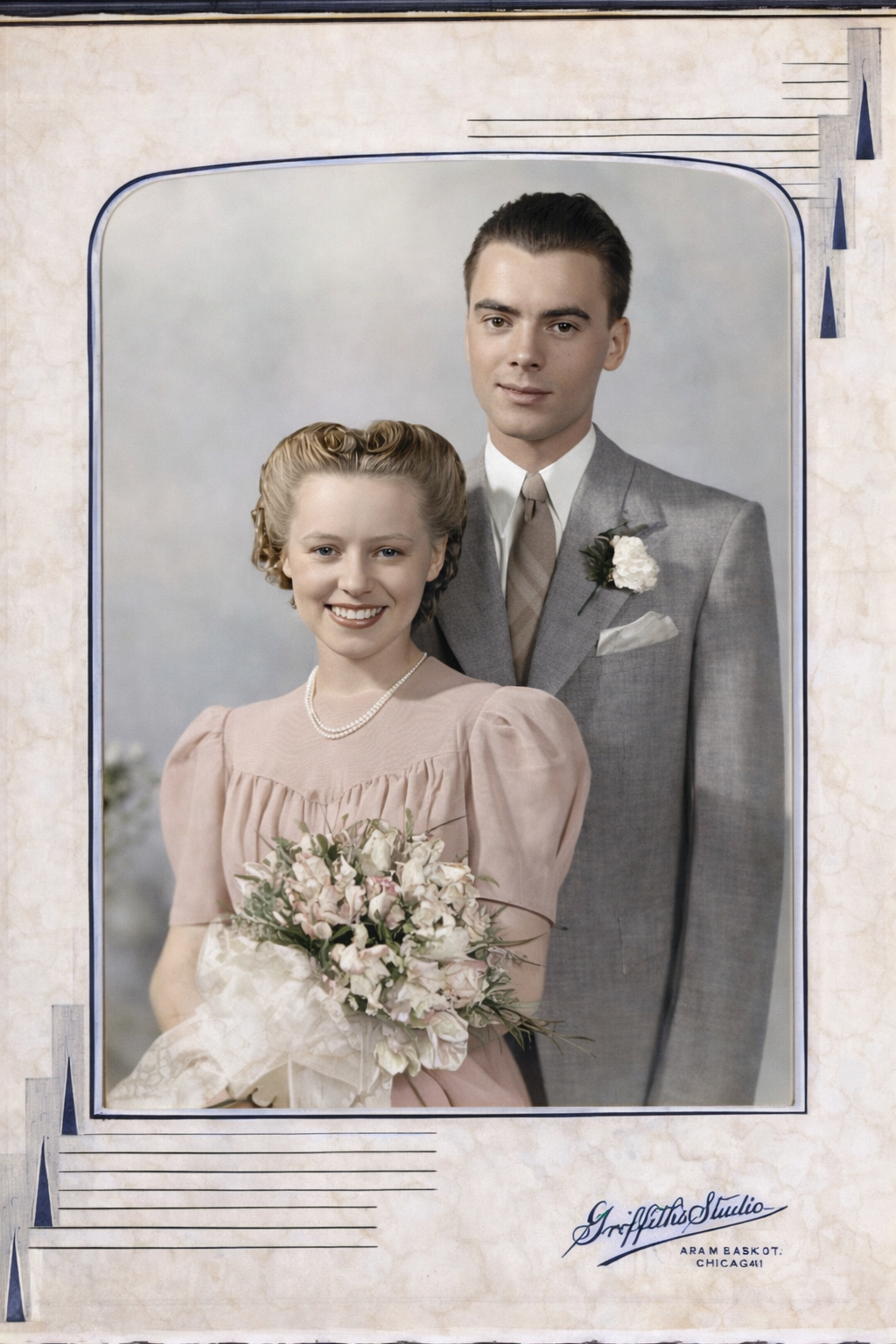
Technically we have two people whose surnames were originally something different, but folks are allowed to change their names, especially if their parents choose to do it for them.
“Citation: Digital scan of a photograph, collection of Jean Miller Lisk: Marie MacLaughlan and Walter Miller, 1941, accessed 18 August 2026.
Marie, born in 1915, had a father whose name was still in flux. Alfred Emil Petersen, as he was born, was still using McLaughlin-Petersen a year after Marie's birth but he soon settled on Alva Elwood MacLaughlan as his official name, and that's how Marie MacLaughlan was known.
Scottish-born Walter Miller was actually Walter Miller Ronchitte, the name having evolved from Ronchette in Ireland and England, with a hint of an Italian origin at some point. But he became Miller, taking his grandmother's surname, once he emigrated to America.
Marie and Walter were married in Chicago at the Drexel Park Presbyterian Church but from the appearance of the bridal couple it was a casual affair with a few relatives and friends. The bride wore a light-colored short-sleeved dress with a pleated bodice, a double strand of pearls, and a stunning upswept hairstyle. She's seated in this portrait holding a beribboned bouquet of roses and ferns and smiles broadly for the camera.
Walter stands next to Marie, dressed in a neat tan-colored suit with a white shirt and plaid-styled tie with a rose and a gardenia in his lapel. The Chicago Suburbanite Economist for Sunday, July 27, 1941 listed two attendants, the groom's brother Robert Miller and Robert's wife Juanita Moore Miller. Interestingly, none of the bride's family were listed in the bridal party.
Walter and Marie remained in Chicago for a time and had three children but eventually moved to Omaha, Nebraska where they lived for the rest of their lives. Walter and Marie enjoyed 55 years of marriage before Marie's death in 1996 and Walter's in 2004.
1942: Everett Alva Zumbrun and Alice Burris, Red Lodge, Montana
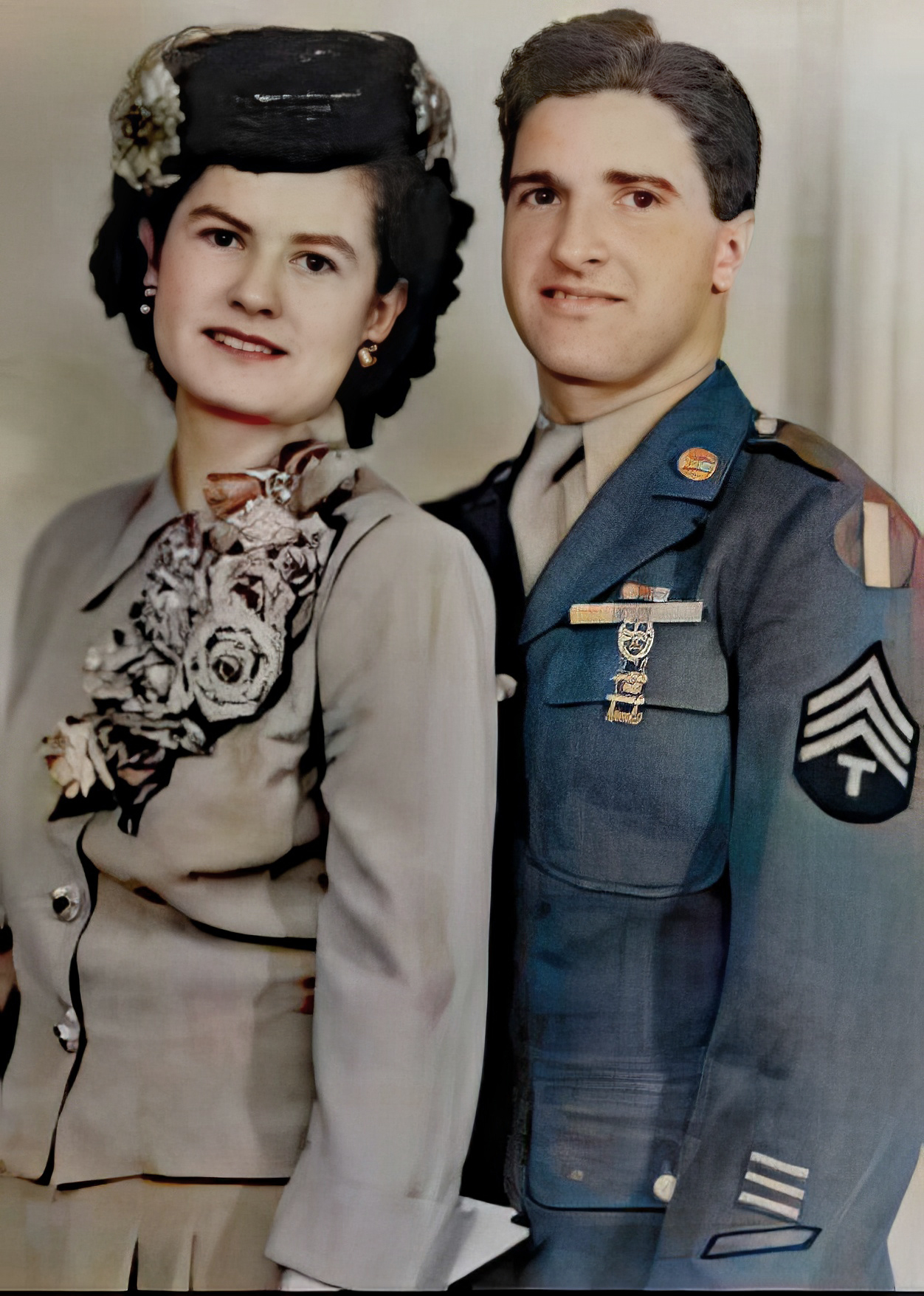
Everett Zumbrun was the son of Hedwig Kebschull, related to us from our Kebschull-Lübeck line, and her husband Clarence E. Zumbrun. Everett was so enamored of his parents' homestead that he took it over when it became too much for them and lived in Red Lodge, Montana for the rest of his life.
“Citation: Digital scan of a photograph, collection of Dixie Armstrong, Wakkuri-Peterson Family Tree: Everett Alva Zumbrun and Alice Lucille Burris, July 2, 1942, accessed 19 August 2026.
Everett, a laborer on his parents' farm, was also in the U.S. Army during WWII as a Technician fourth grade, a class of technician that could include medics, radio operators and repairmen, mail clerks, mechanics, cooks, musicians, and tank drivers. It doesn't appear that Everett saw combat but he was proud enough of his rank to be married in his uniform, the first example we have in our collection.
Alice wore a beautifully tailored light grey suit with grey fabric roses arranged as a corsage at her left lapel, with a matching flower on her dark pillbox hat. Her earrings are delicate and her hair arranged in cascading curls.
Everett wears his blue uniform with his service badges and has a light brown shirt and tie. Both stand next to each other for this studio portrait.
Everett and Alice had four children together and enjoyed 61 years of marriage. His 2003 obituary mentioned that "he treated his cows with nearly as much love as he showed his dog and companion, Pepper."
1944: Carl Julius Jatho and unknown lady, Rye, New York
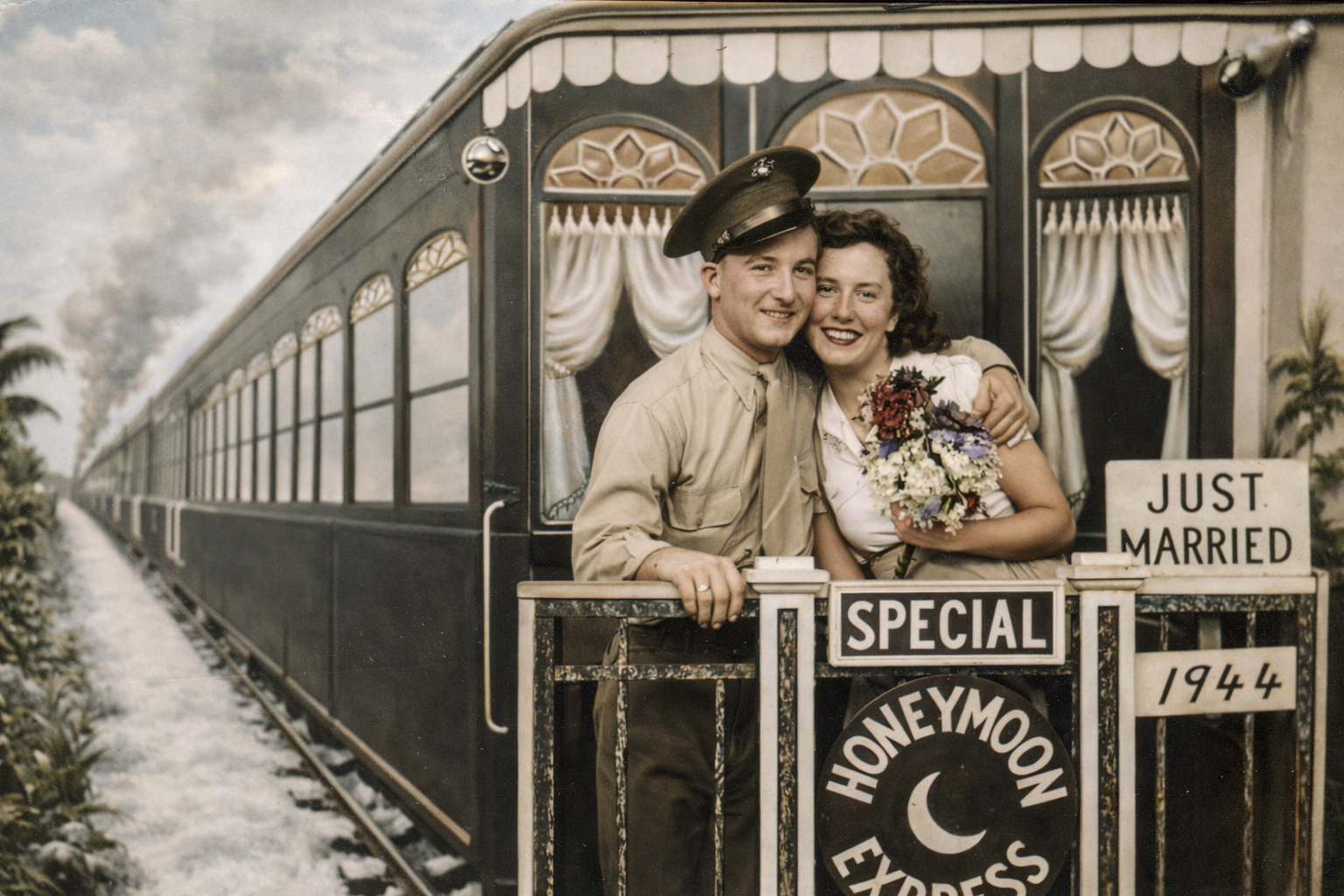
This is a real conundrum. Our cousin Carl Julius Jatho poses with an unknown lady for what looks like a commemorative wedding photo. But we can't find any evidence that he was married in 1944.
“Citation: Digital scan of a photograph, collection of Susan Jatho Reed: Carl Julius Jatho and unknown lady, 1944, accessed 19 August 2026.
Carl was the son of Carl Julius Jatho Senior and Mary Smoot. Carl Junior was only six years old when his father died in Florida in 1929 and he was left living with his mother and two sisters. He enlisted in the U.S. Marines after completing high school in Winter Haven, Florida, was wounded in late 1943 while in action near the Solomon Islands, and was hospitalized in San Diego, California during the early part of 1944.
C.J., as he was known, was variously in California hospitals during the early part of 1944 and by 1945 was back in Winter Haven, single, living with his mother, his occupation listed on the 1945 Florida state census as "med[ical] discharge," presumably from the Marines. No marriage record in California, Florida, or anywhere else has been found for this period.
Did a marriage really occur? Was it annulled? And most importantly, who is the lady?
It's possible that this was a gag photo or that the couple intended to get married but never did. The lady's dress is white and that's an opulent corsage she wears -- some expense was involved. C.J. wears a khaki-brown shirt and trousers plus his dress cap but there are no insignias on the shirt indicating rank (he was a private first class at the time of his medical discharge). It's a puzzlement!
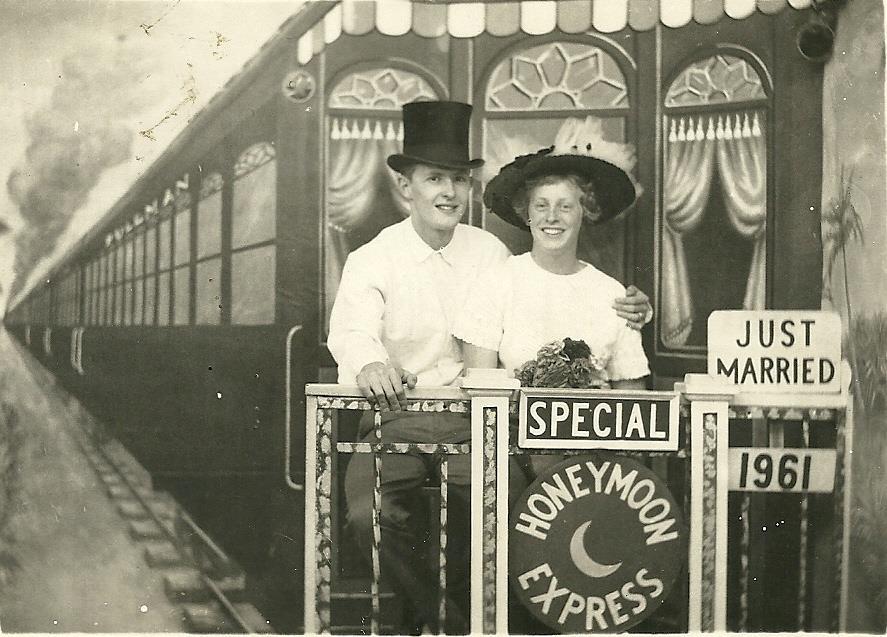
By uploading this photo via Google's image match option I found several similar photos, this one taken in 1961 commemorating the honeymoon of Howard Targonsky and Patricia Betty Moore, both from Connecticut. Several other similar photos online point to an amusement park called Playland in Rye, Westchester County, New York State. The photo booth area offered a variety of backdrops where folks could have pictures taken. An actual marriage was not required, so perhaps Carl was on holiday there, met up with a lady friend, and decided to capture the moment on film.
C.J. did marry several times, first to Dolores Gomez on February 21, 1948 in Yuma, Arizona, where no three-day wait or blood test was required. Then C.J. married Colleen Outland in Las Vegas in September 1949, although he didn't divorce Dolores in order to form this alliance. A charge of bigamy ensued.
Dolores and C.J. had a son, Paul, born in 1950 and Dolores officially divorced C.J. in 1952. His marriage to Colleen Overland had been quietly annulled. So C.J. was free to marry Mary Catherine Chaney in Los Angeles in 1957.
We're still left wondering what was really going on in this picture, whether it was real or fanciful. What a pity. It's our first Jatho marriage photo too.
1945: Leo Skiba and Lolus Bruns, Chicago, Illinois
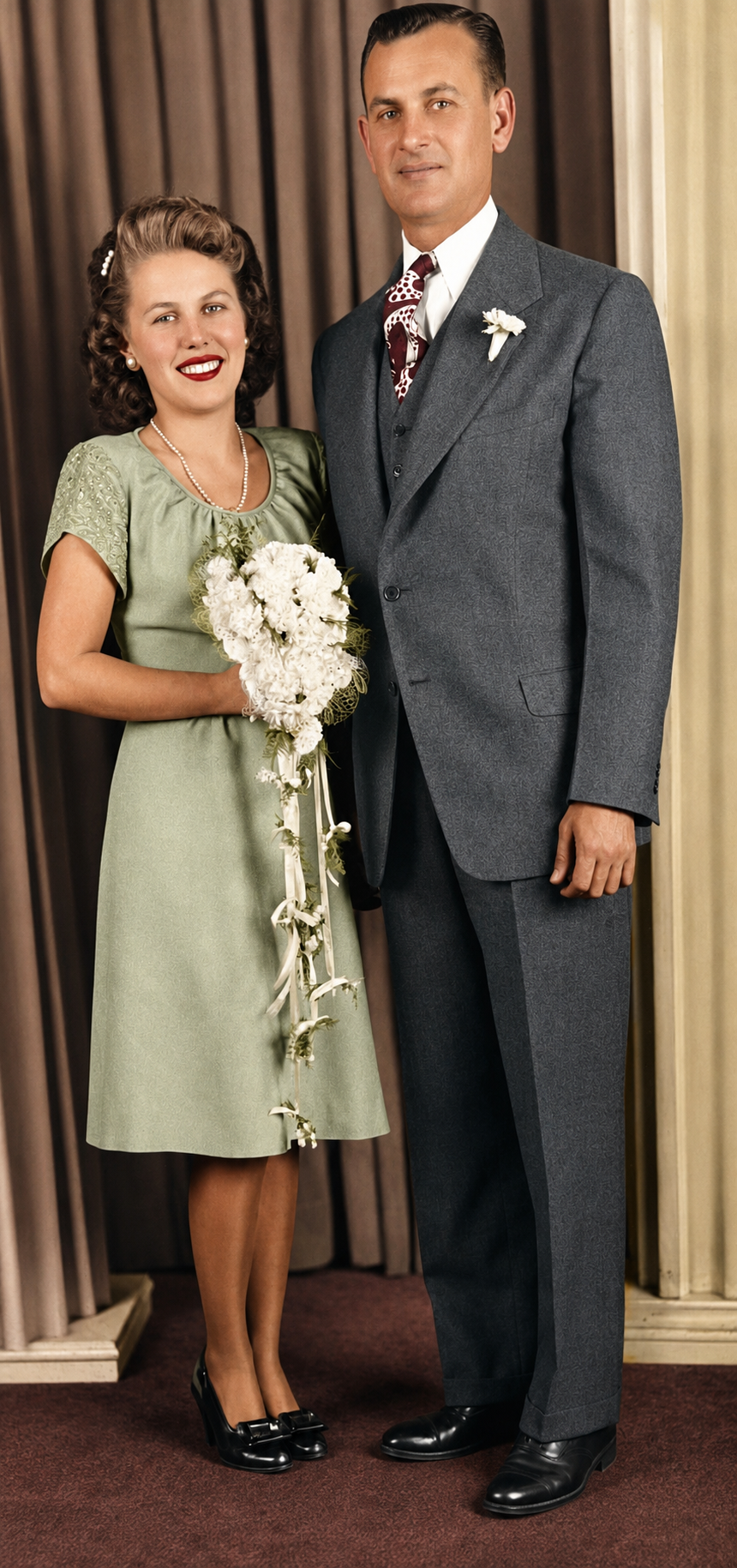
The Bruns family lived on Winchester Street in Chicago near numerous relatives, but Leo Skiba was a newcomer from McKeesport, Pennsylvania and was a former U.S. Navy man, now pursuing romance with the younger Bruns daughter, Lolus.
“Citation: Digital scan of a photograph, collection of Lorraine MacLaughlan: Leo Skiba and Lolus Bruns, 1945, accessed 20 August 2026.
Leo was the son of Polish immigrants, Lolus the daughter of a first-generation family of German ancestry. Their wedding was planned for October 13, 1945, with a trip the following week to California, where Lolus had relatives and where Leo would begin a new job.
This was an era of low-key wedding fashions and Leo and Lolus were dressed in their best. Lolus wears a light colored scoop-neck knee-length dress with short lace sleeves. Her dark hat is decorated with pearl accents, and she wears a single strand of pearls with pearl earrings. Her bouquet is trimmed with fern leaves and lace.
Leo wears a well-tailored suit, white shirt, and patterned tie. He has a single rose in his lapel. In another family photo we can see that Lolus and Leo had her brother George and sister Lorraine as attendants.
Two days after the wedding Lolus' father George H. Bruns suffered a heart attack and died while on a business trip to Boston. Despite the family tragedy Leo and Lolus kept to their travel plans and boarded a train for Los Angeles, where they were met by family and friends.
The couple never had children of their own but were loving aunt and uncle to their two nieces. Lolus adopted her father's antique diary, updated entries occasionally with her own observations and sketches. She lived and worked in Southern California until 1964, when she was killed in a car crash in town. Leo mourned her loss. He remarried twice and died in 2005.
1947: Thomas MacLaughlan and Lorraine Bruns, Temple City, California
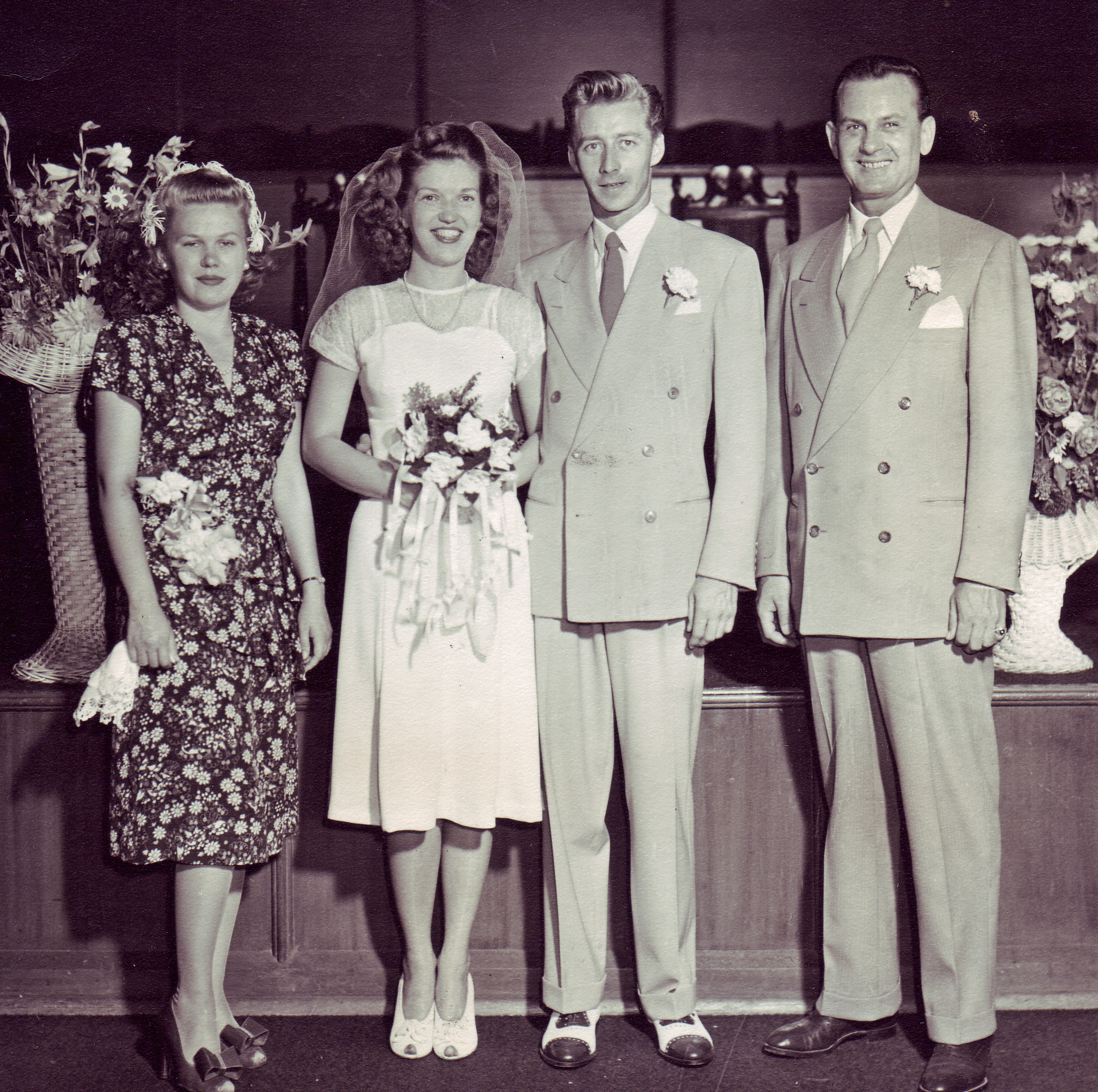
Next up: another Bruns girl, Lolus' older sister Lorraine. In 1946 Lorraine and her mother Bertha Bruns had followed Leo and Lolus to Southern California for better post-war job opportunities and warmer weather. At a party held by friends, Lorraine was introduced to an ex-pat Chicagoan, Tom MacLaughlan, and the couple (each of whom had resigned themselves to the single life) found an instant attraction.
“Citation: Digital scan of a photograph, collection of Lorraine MacLaughlan: Lolus Skiba, Lorraine Bruns, Thomas MacLaughlan, Leo Skiba, Temple City, California, 1947, accessed 20 August 2026.
The wedding was held on August 3, 1947, the same month and day that Lorraine's parents had been married in Chicago in 1911. But this was quite a different universe: palm trees, orange blossoms, and a blending of two Chicago families.
Lorraine chose a chic white dress with see-through lace sleeves and shoulders. She had a short veil, white high-heel shoes, and a ribboned bouquet of roses and other blossoms.
Tom wears a tan double-breasted stuit with a white shirt and dark tie, a pocket square, and a small boutonniere with what looks like a white gardenia. His dashing two-toned shoes were very popular in that era.
Their attendants included Lorraine's sister Lolus in a stylish blossom-decorated dress with a white hat and a small bouquet fixed to her belt. Lorraine's brother-in-law Leo was best man, also attired in a tan double-breasted suit, white shirt, lightly colored tie, and boutonniere.
Tom and Lorraine settled in several Southern California communities, eventually moving to Claremont where the college atmosphere was conducive to raising two daughters. Tom may never have realized it but his continuing reluctance to talk about his grandparents Hans and Catharina Petersen (whose portrait we've seen at the beginning of this page) resulted in his older daughter becoming a determined family historian.
https://sakionline.net/family-folio/photo-detail.html?idx=328
1949: James Jatho and Jacqueline Gratz, Chicago, Illinois
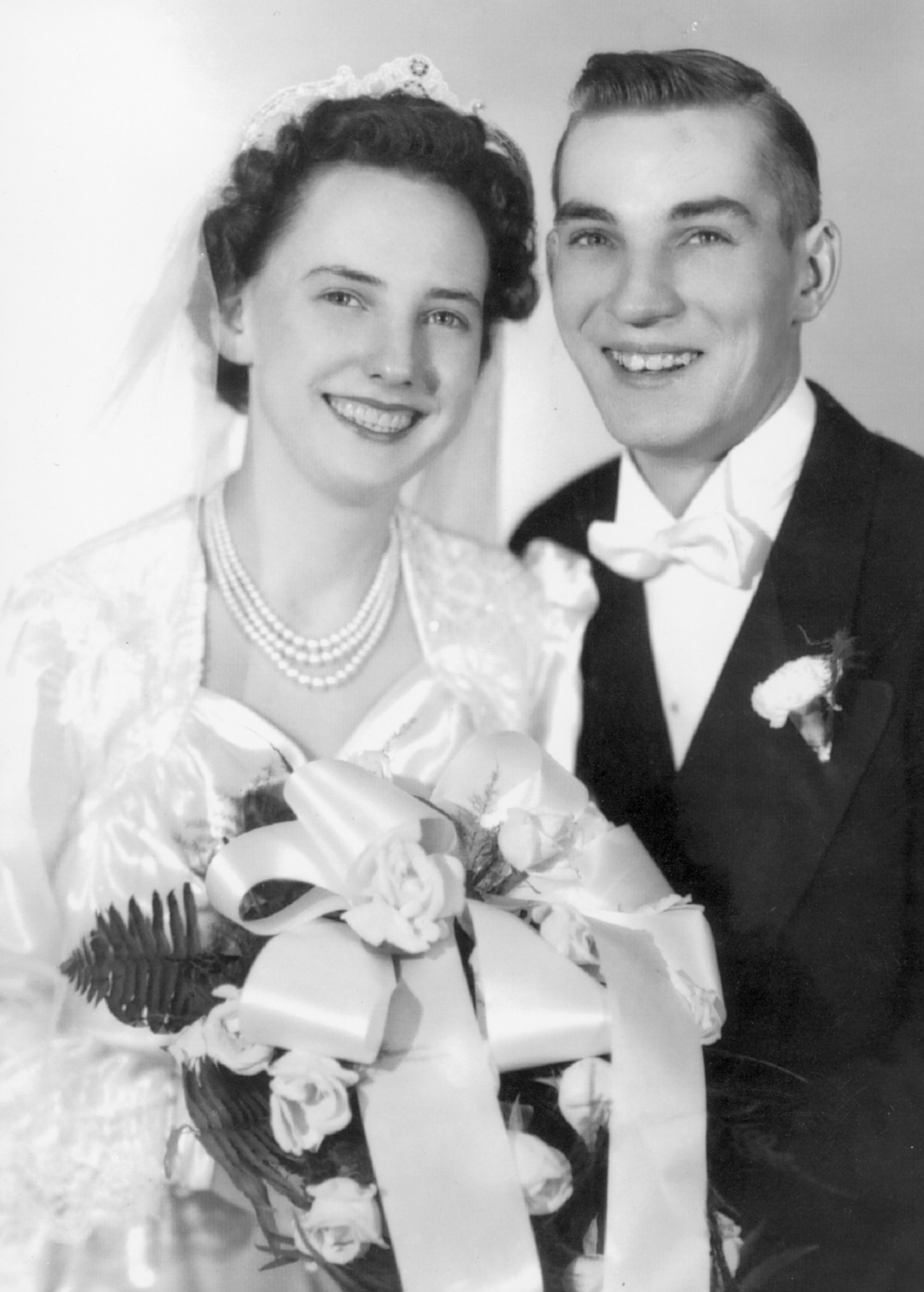
Our first official photo of a Jatho wedding was a long time coming. For some reason any earlier photos of Jatho unions in Charleston, South Carolina and New Orleans, Louisiana are missing from our collection.
“Citation: Digital scan of a photograph, collection of Judi Jatho Weber: Jacqueline Gratz and James Clarence Jatho, Chicago, Illinois, 1949, accessed 21 August 2026.
Jim Jatho was the son of George Jatho and Ruth Shallanberger. He's had a brief marriage to Marie Theresa Isaksen of Arkansas but it was over within a couple of years, and his marriage to Jacqueline Gratz, daughter of John Walter Gratz and Rosetta Frances Larsen, was a success.
Eighteen-year-old Jacqueline wears a satin patterned floor-length white wedding gown with a small tiara-style cap securing her veil to her hair. She also wore a three-strand pearl necklace and carried a bouquet of roses and ferns tied with broad ribbons.
Twenty-to-year-old Jim wore a dark suit with a white shirt and bow tie, and a carnation blossom adorns his lapel.
Jim was a truck driver for a pharmaceutical company. He and Jackie had eight children together. The couple enjoyed 53 years of marriage. Jim died in 2002, Jackie in 2025.
1950: Shirley Petersen, John Petraitis, Chicago, Illinois
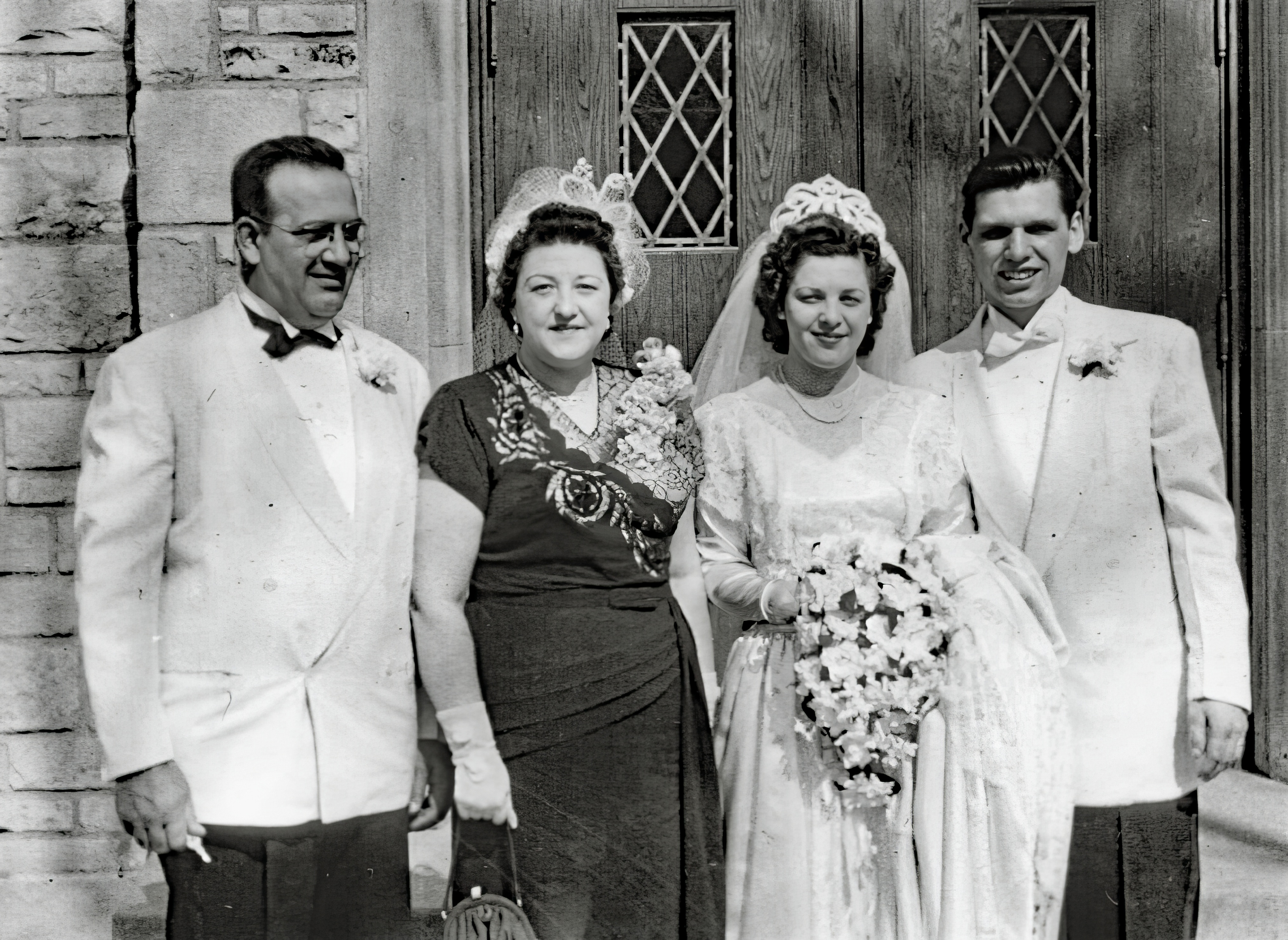
Al and Mae Petersen had six children and Shirley was their middle child. She married John Petraitis, the son of Lithuanian immigrants Nicolas (Nikodimas) Petraitis and Anna Stonis.
“Citation: Digital scan of a photograph, collection of Cathie Meyer: Al Petersen, Mae Thelen Petersen, Shirley Petersen, John Petraitis, Chicago, Illinois, 1949, accessed 21 August 2026.
Parents Al and Mae pose with daughter Shirley and her new husband outside the church door. Shirley's full-length wedding gown includes a V-neck bodice with a lace overlay, a tiara headdress with veil attached, and a single strand of pearls around ehr neck. Her bouquet includes lilies and gardenias.
Groom John Petraitis wears dark trousers, a white jacket, shirt, and bow tie, and a flower arrangement at his lapel.
Mae wears a dark dress with elaborate embroidery at the collar and bodice, white gloves, a large corsage, a lacy hat, and a small purse. Al is dressed like the groom in dark trousers and white jacket with a black accent tie and a small boutonniere.
John and Shirley Petraitis had three children and made the migration to the west coast, where they settled in Glendale, California with John's father. They were married for 30 years until John's death in 1980. Shirley Petraitis died in 2014.
https://sakionline.net/family-folio/img/mary-elizabeth-paul-malek-wedding-full.jpg
1951: Paul Malek and Mary Elizabeth Jatho, Winter Haven, Florida
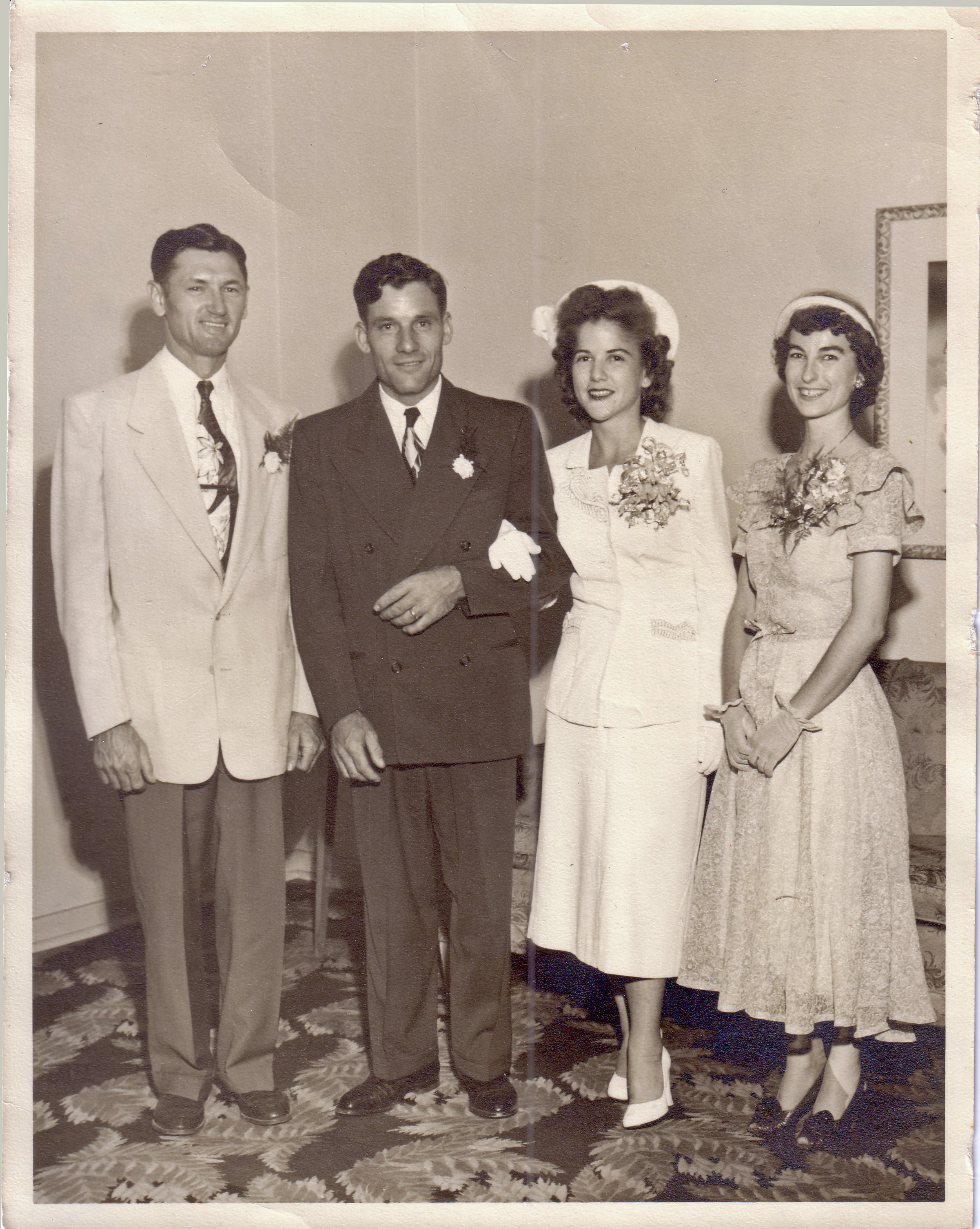
Winter Haven was the home town of widowed mary Smoot Jatho and her children Dorothy, Carl Julius, and Mary Elizabeth. This time it was Mary Elizabeth's chance to shine at her own modest wedding.
“Citation: Digital scan of a photograph, collection of Susan Jatho Reed: Paul Bernard Malek, Mary Elizabeth Jatho, Emily Lorraine Prior, and Benjamin A. Boraiko, Winter Haven, Florida, June 3, 1951, accessed 22 August 2026.
This was probably a civil wedding with fashions appropriate for a daytime ceremony, and you'll note how non-studio snapshots have become more popular than posed, formal, and professional portraits. They're more economical too.
Mary Elizabeth wears a nicely tailored white suit, a stylish white hat, and white shoes, with a large corsage pinned to the jacket. Her maid of honor was Emily Lorraine Prior and she wears a ruffle-shouldered dress with a lace-like design on the pleated skirt, a demure hat, and an equally large corsage for the occasion.
Nebraska-born Paul Bernard Malek wears a dark suit with a white shirt and patterned tie, a small rose blossom appended to his lapel. His best man, Benjamin A. Boraiko, wears a light-colored jacket and dark trousers, and his hand-painted tie looks like a twin of the groom's.
Mary Elizabeth and Paul had nine children and were married for 46 years. Paul died in 1998, Mary in 1999.
1953: Henry Petersen and Mary C. Dorsey, Kenosha, Wisconsin
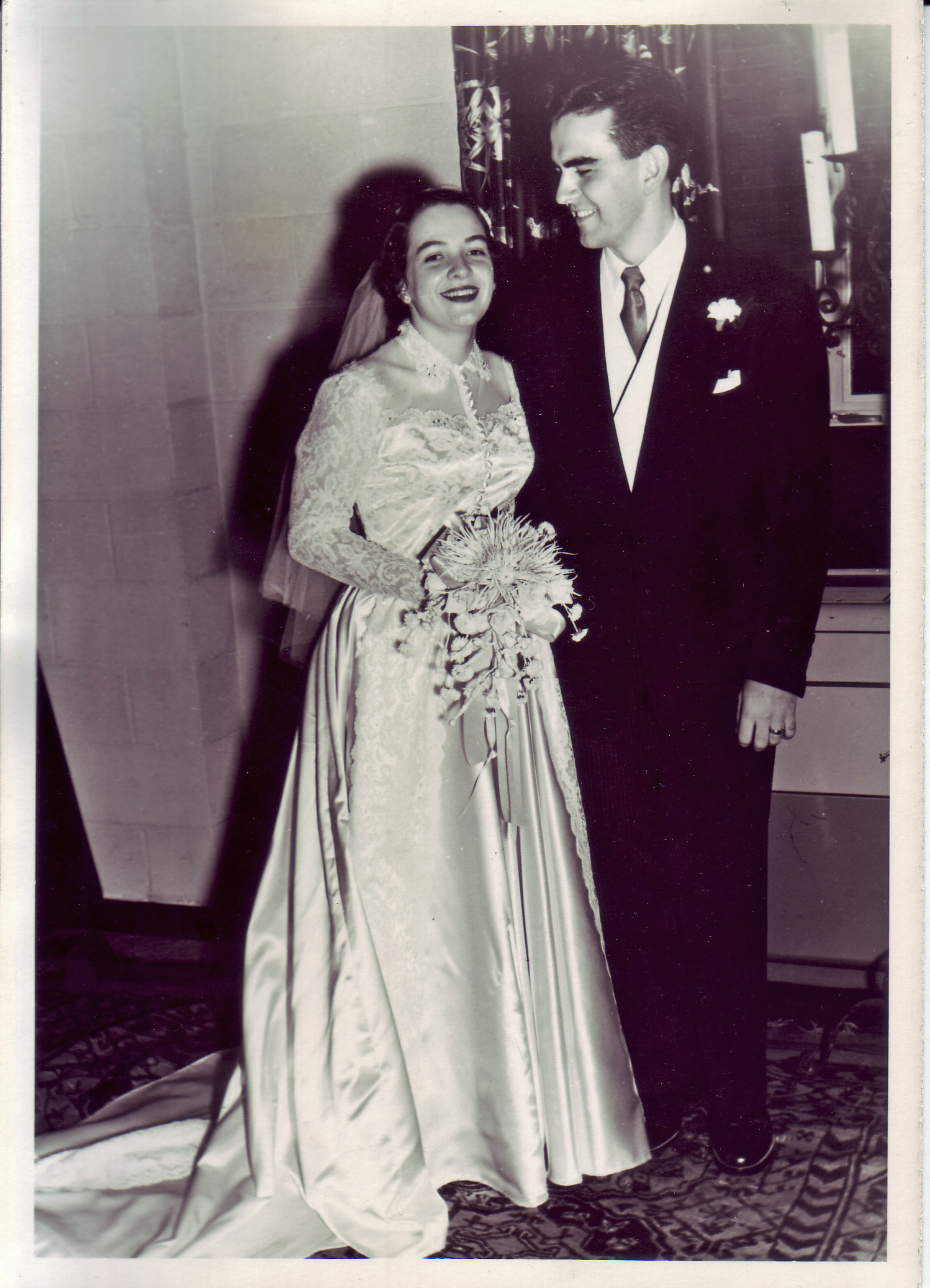
Henry Petersen was a son of Walter and Celestia Petersen, and grandson of Andrew Petersen and Karen Marie Petersen, so he has a long Petersen pedigree.
“Citation: Digital reproduction of a photograph, collection of Rev. Michael Petersen: marriage of Henry Francis Petersen and Mary Catherine Dorsey, Kenosha, Wisconsin, 1953, accessed 23 August 2026.
Their Kenosha wedding appears to have been a joyous affair and the reception involved 200 people. The bride's cousin, Rev. James J. Brady of Wauwatosa, officiated at the ceremony.
Family snapshots show us the details. Mary Catherine is dressed in a traditional wedding gown of white Chantilly lace over the bodice and a satin gown, with a beaded cap holding her lace veil. Her bouquet included chrysanthemums, carnations, and stephanotis lilies.
Henry wears a dark suit with a wrap-around light colored vest, a white shirt and dark tie, and a small carnation blossom pinned just above his pocket square.
Henry and Mary Catherine had seven children before divorcing. Mary Catherine later married John William Rohde. Henry died in 2009, Mary Catherine in 2023.
1957: Carl Julius Jatho and Mary Chaney, Los Angeles, California
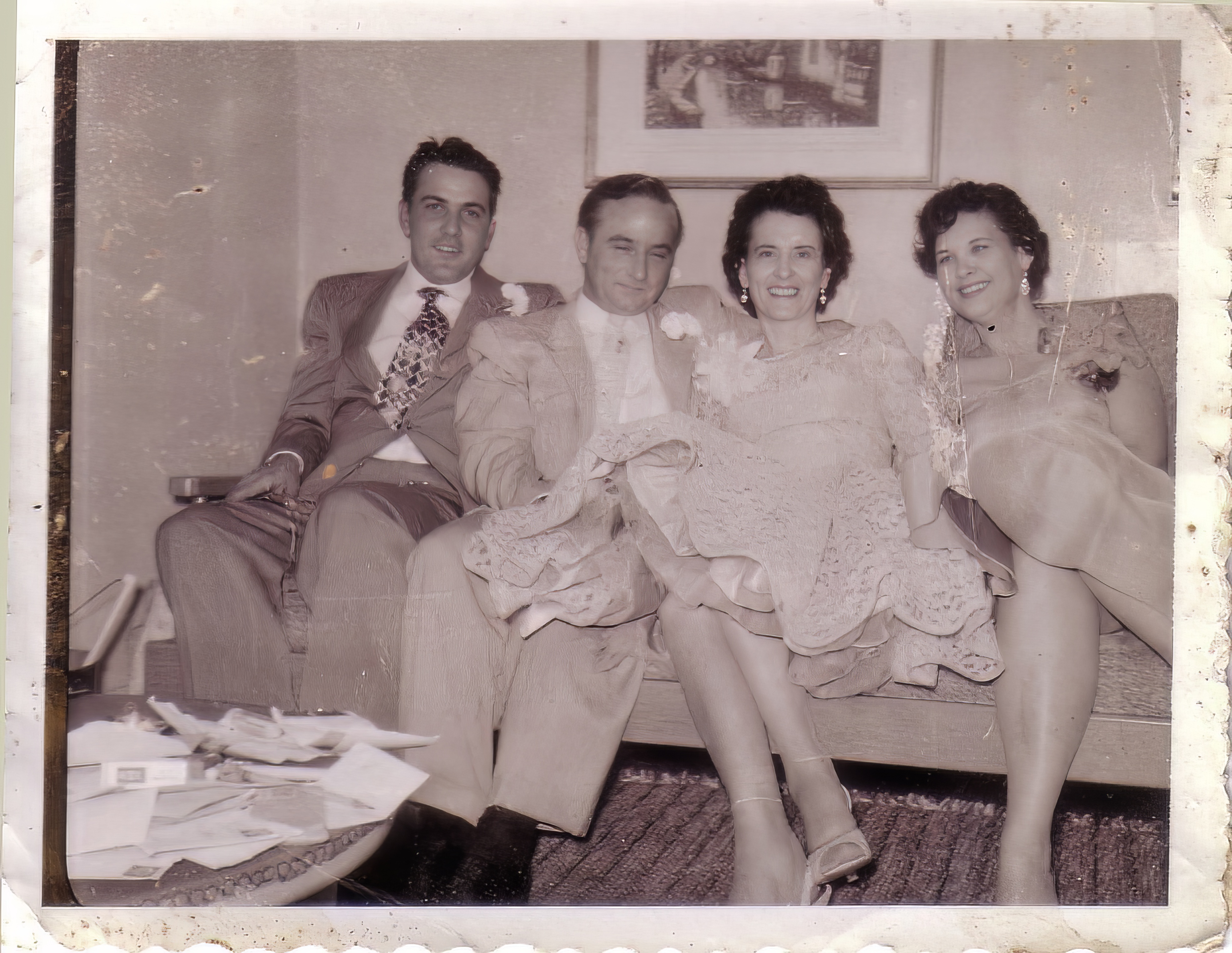
We've hit the peak of relaxed weddings photos. This snapshot shows the happy couple and their attendants post-ceremony, relaxing and possibly opening letters and cards of congratulations, which are spread out on the table in front of them.
“Citation: Digital reproduction of a photograph, collection of Susan Jatho Reed: marriage of Carl Julius Jatho and Mary Catherine Chaney, Los Angeles, California, 1957, accessed 23 August 2026.
Carl Julius Jatho had been married twice already and so had Mary Catherine Chaney. In fact the California, U.S. Marriage Index via Ancestry.com shows that Carl and Mary took out marriage licenses under both her names, Chaney and Carlile, but only one license was required. Perhaps they were just covering all the bases.
Mary wears a white fluffy lace dress for her special day, a large corsage pinned to her right shoulder, and delicate dangle earrings.
Carl wears a tan suit, white shirt and light-colored tie with a floral blossom at his lapel.
Their unnamed attendants flank them on the sofa, both dressed suitably for a daytime but festive wedding celebration.
Carl and Mary had a daughter and made their home in Southern California. Carl died in 1993, Mary in 2005.
1958: Gene Bruns and Cherlyn Hughes, Salt Lake City, Utah
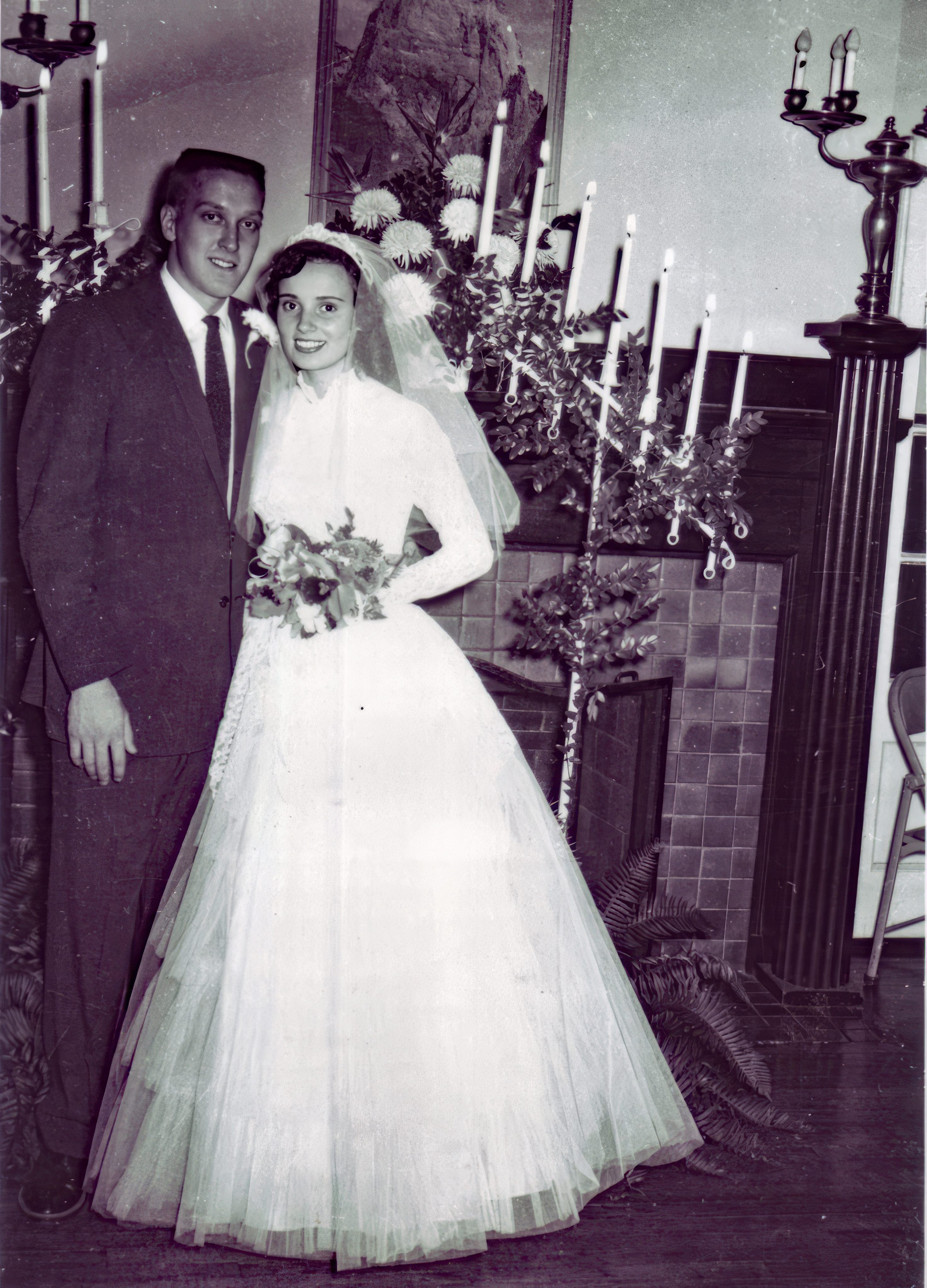
Gene was the son of Bernard A. Bruns and Catherine Parish of Chicago, grandson of George H. Bruns and Bertha Gohr Bruns. Like his father and grandfather he was a journeyman plate maker in a printing firm.
“Citation: Digital reproduction of a photograph, collection of Cherlyn Hughes, Hughes Family Tree: marriage of Gene Parish Bruns and Cherlyn Hughes, Salt Lake City, Utah, November 3, 1958, accessed 23 August 2026.
He met Cherlyn Hughes when his parents moved to North Kansas City, Missouri for better job opportunities, and a romance ensued. The couple were married in November 1958 in Salt Lake City.
Cherlyn poses in front of a church candleabra in her full chiffon wedding gown with its high-necked bodice and long sleeves. A lace cap secures her half-length veil, and she carries a verdant bouquet of flowers.
Gene wears a gard dress suit, white shirt, and dark tie, with a white chrysanthemum at his lapel.
The couple had five children and lived in North Kansas City where Gene was active in local politics. He was mayor for twelve years and a city councilman for fourteen years, an active volunteer for charities such as Meals On Wheels, and a devoted member of the Mormon Church.
The couple enjoyed an idyllic marriage for 63 years until Gene's passing in 2022.
1960: John Murphy and Carol Ann Ostrom, Chicago, Illinois
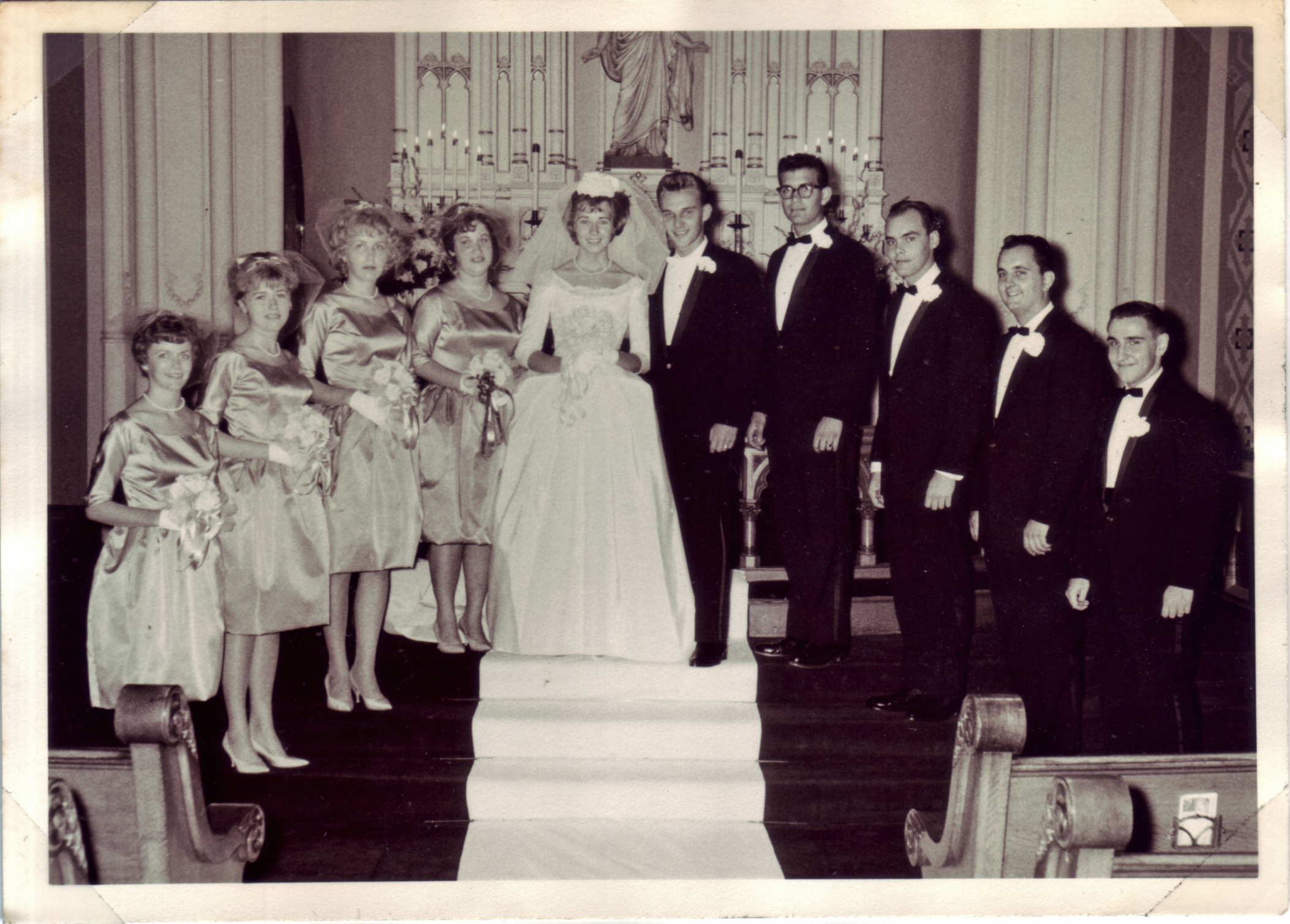
Large, formal weddings were still seen in the early 1960s and this is one of them. John Murphy had German and Irish ancestry and was used to traveling back and forth between Chicago where his father lived and Los Angeles where his mother was located. In Chicago John met Carol Ann Ostrom, whose ancestry was Swedish. Their wedding involved a large party of attendants.
“Citation: Digital reproduction of a photograph, collection of Lorraine MacLaughlan and Bertha Bruns: marriage of John Murphy and Carol Ann Ostrom, Chicago, Illinois,1960, accessed 24 August 2026.
Carol and John pose at the top of the church stairs. Carol wears a floor-length white gown with a scoop-neck bodice, a full cap for her veil, and a bouquet of white flowers. her four attendants wear matching satin knee-length dresses with nell-shaped skirts and mini-veils. The groom's first cousin, Susan Meyers, is the bridesmaid at the far left of the photo.
John wears a dark suit, white shirt and tie, and a white blossom at his lapel.
Gene wears a gard dress suit, white shirt, and dark tie, with a white chrysanthemum at his lapel. The groomsmen are all dressed in identical suits but with dark ties instead of white. Quite a wedding party!
John and Carol had two sons and today spend their time between Illinois and Arizona.
1965: Clifford Jack Bruns and Nancy Lorraine Taff, Jackson, Missouri
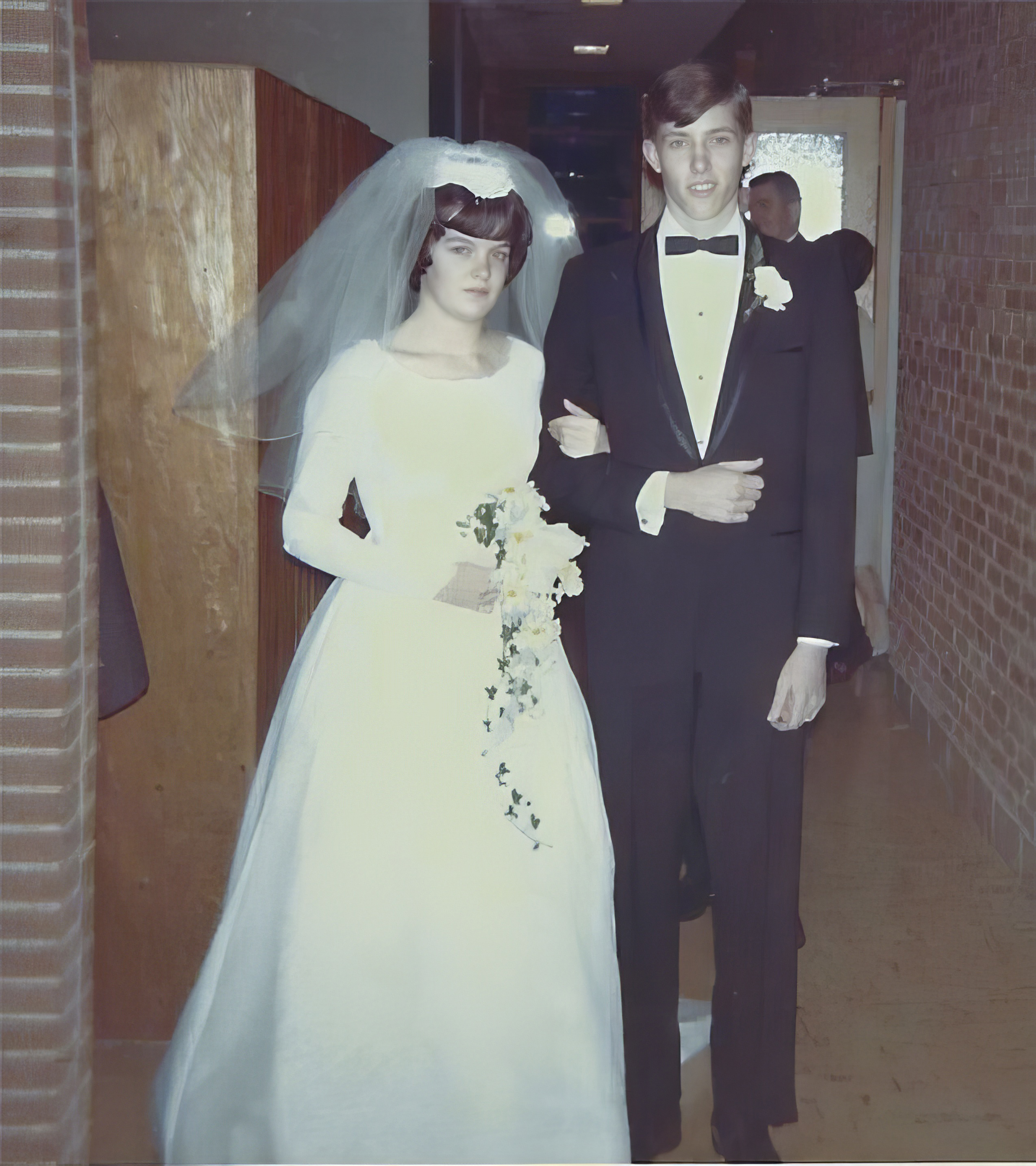
Caught in a snapshot at their wedding, Clifford Jack Bruns and Nancy Lorraine Taff strike a pose. They were still teenagers but determined to let romance be their guide.
“Citation: Digital reproduction of a photograph, collection of Nancy Taff Bruns: marriage of Clifford Jack Bruns and Nancy Lorraine Taff, Jackson, Missouri, April 16, 1965, accessed 24 August 2026.
Clifford Jack was the younger son of Bernard A. Bruns and Catherine Parish, grandson of George H. and Bertha (Gohr) Bruns. Nancy Taff was from Independence, Missouri and was an active participant in William Chrisman High School, particularly in the Future Homemakers of America.
Nancy wears a full-length white gown with a scoop neck and long sleeves. A full cap attaches to her elbow-length veil. Her white-flowered bouquet includes an elegant vine dropping away from the blossoms.
Clifford Jack wears a nicely-fitted tuxedo suit with a white shirt and dark tie, plus a full-blossom flower at his lapel.
Because Clifford Jack was still under age his father Bernard kindly signed the marriage certificate giving his permission for the ceremony.
The couple still live in Missouri and enjoy the company of their children and grandchildren. Nancy is an ardent genealogist.
1965: Louise Zettel and James Stackpole, Chicago, Illinois
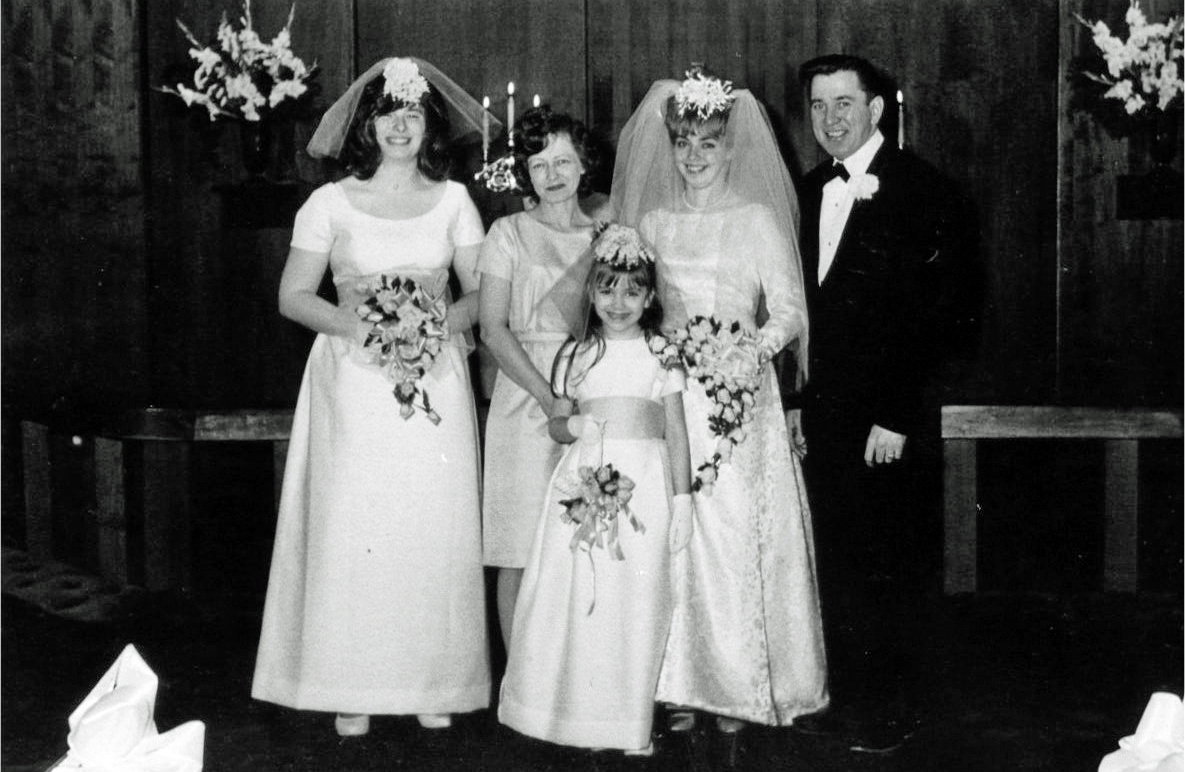
It's an unusual portrait considering that the groom is missing from it. Instead the bride, Louise Zettel, poses with her immediate family at her wedding.
“Citation: Digital reproduction of a photograph, collection of Louise Zettel: marriage of Louise Zettel and James Alton Stackpole, Chicago, Illinois, 1966, accessed 24 August 2026.
The bride, Louise Zettel, was the eldest daughter of Louise Catherine Schmidt and Floyd Zettel. She was also the granddaughter of Marie Petersen from our Chicago Petersen clan. Louise, affectionately known in her family as Honey, married James A. Stackpole in 1966.
The bride wears a floor-length, long sleeve lace and satin gown with a floral headdress and half-length veil. Her attendants, sisters Linda and Laura, wear similar long gowns with small veils and their bouquets mirror that of the bride.
Bridal parents Louise and Floyd Zettel flank the bride, Louise in a knee-length day dress, Floyd ina dark suit with a flower at his lapel.
It was not a long marriage. Louise Zettel Stackpole divorced James in 1971 but they did have two dauaghters.
1973: Theodore Maynard and Diane Fellmer, Grand Rapids, Michigan
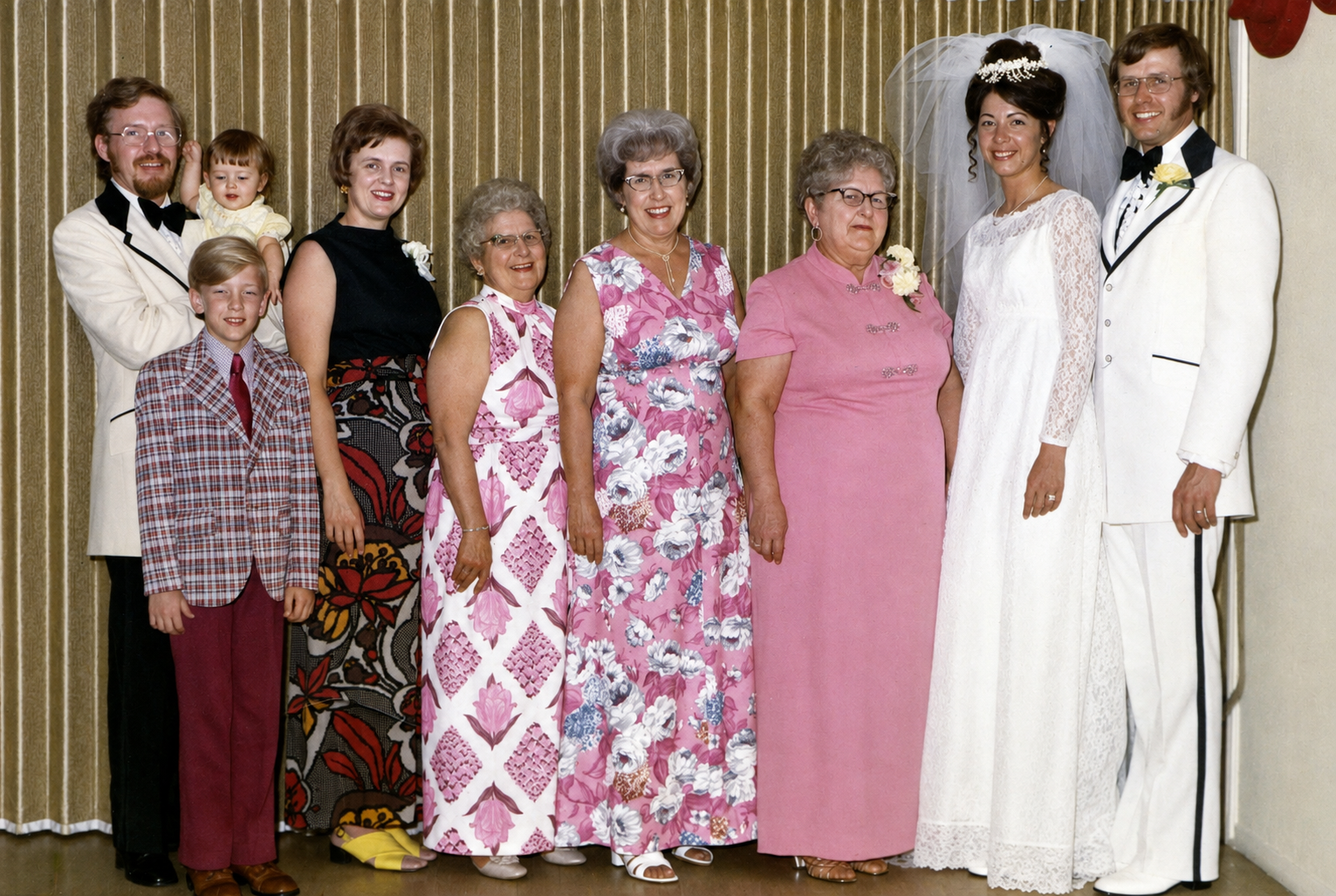
The only son of Dorothy Glawe and the ephemeral Theodore Aloysius Zeltes, Ted Maynard was adopted by his mother's second husband Andrew Maynard. Theodore Zeltes can't be found in any online records although he was described as a U.S. Army captain in family records. Whatever the circumstances of his birth, Ted was much loved by his grandparents (John Walter Glawe and Anna Gohr Glawe) and his aunts, Mildred and Jeanette Glawe.
“Citation: Digital reproduction of a photograph, collection of Diane Fellmer Maynard: marriage of Theodore Maynard and Diane Fellmer with family, Grand Rapids, Michigan, July 21, 1973, accessed 25 August 2026.
Ted Maynard had a predilection for the military as well and enlisted in the U.S. Navy, where he served with distinction. He had an earlier marriage in 1966 which ended in divorce. This was a celebration of his second marriage.
The bride wears an empire-waist white gown with lace sleeves and neckline, a floral circlet holding her sheer veil. This pose shows off her wedding ring on her left hand.
The groom wears a white tuxedo with black trim and a black bow tie. Ted wears a white blossom at his lapel, while Diane has either thrown her bouquet or placed it elsewhere for this portrait.
The lady at the center is Ted's mother, Dorothy Glawe Maynard. The lady just left of her may be her sister Jeanette. The other folks in the photo aren't identified although the lady at left with the children could have been either the matron of honor, June Fellmer Gorman (the bride's sister), or the bridesmaid (Mrs. Jerry VandenBrink), both of whom were married women.
Ted and Diane enjoyed 48 years of marriage before Ted's passing in 2022.
1974: Gary S. Simmons and Sandra Dumes, Vincennes, Indiana
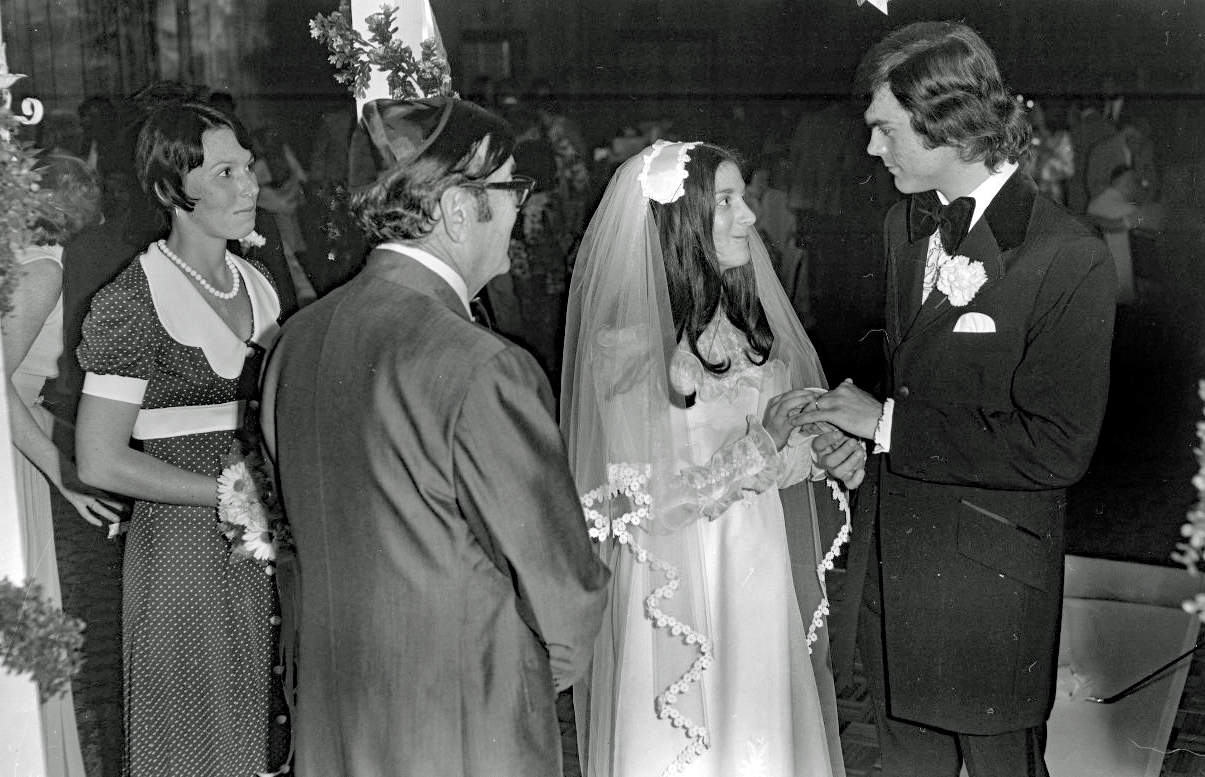
Gary Simmons and Sandi Dumes were both students at the University of Hawaii when they married in July 1974, but her parents arranged for a religious blessing of their marriage in her home town of Vincennes, Indiana. Sandi's family had been well-known there for three generations, ever since her immigrant grandfather settled in Vincennes from Latvia and became a prominent businessman in town.
“Citation: Digital reproduction of a photograph, collection of Bruce Dumes: religious ceremony of Gary S. Simmons and Sandra Dumes, Vincennes, Indiana, August 24, 1974, accessed 25 August 2026.
Sandi wears a traditional full-length white gown with lace sleeves and bodice, and a close-fitting cap with attached veil trimmed with delicate embroidery. The unique pose captured in this photo includes the rabbi officiating at the ceremony under the traditional chuppah, with Sandi's first cousin Adrien Dansker as bridesmaid.
Gary wears a black tuxedo with a velvet collar and dark bow tie, lapel blossom, and a white pocket square. The bride and groom exchange vows in front of a rapt crowd prior to a hosted reception for the couple.
Sandi and Gary had four children and enjoyed their lives in Vincennes until Sandi's untimely passing in 2017.