Myths and mysteries
One of the persistent components of genealogy is the unverified story of our past, no matter how improbable it may be. Vanquishing such tales takes persistence and scholarly skill.
“One can never be sure of one's ancestors. -- Godfrey Park, "My Man Godfrey" (1936)
And the fact is that some of our relatives are more in love with the myth than reality. They cling to the narrative they've been told by family members who readily believe it themselves. Who wouldn't want to be related to Charlemagne?
But facts are facts, lacking the bright sparkle of family mythology. Learning to build a personal history on reality rather than imagination takes courage. That's one of the things we're here to explore.
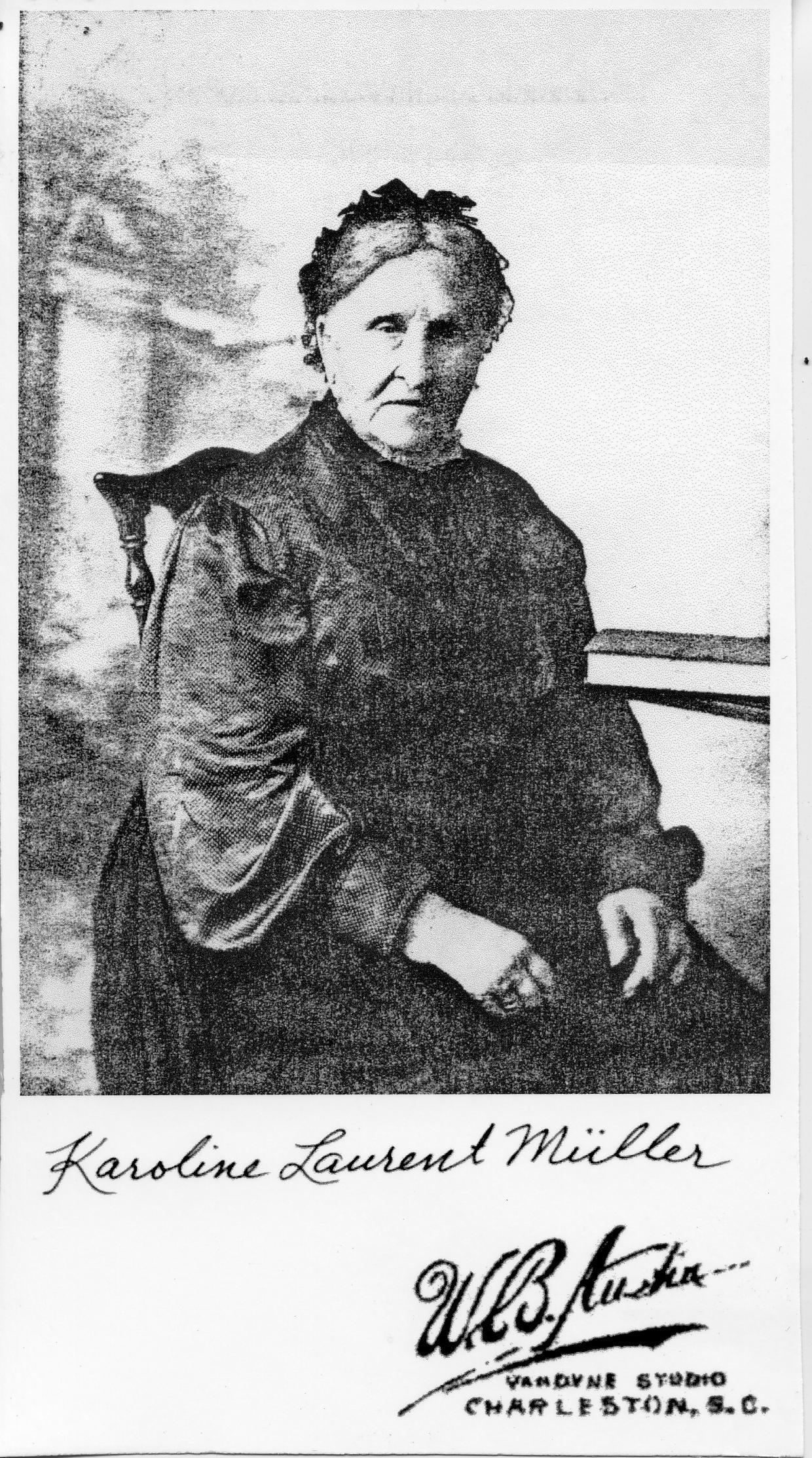
"Her mother was a de Vigny"
Probably my favorite (and most elaborate) myth in the family is the ancestry of Philippina Carolina Laurent, about whom some of her descendants painted an elaborate picture. Caroline was born in 1922 in Zweibrücken, supposedly the daughter of a woman whose surname was de Vigny and who escaped Paris during the French Revolution in 1789 by hiding herself in a barrel in a hay cart and making her way to Rheinland-Pfalz. There she gave birth to Caroline, who grew to womanhood and married the pious student of religion, Louis Müller.
But vital records in Zweibrücken tell a different story. Apparently earlier family researchers were too afraid to consult them because that's not what they would reveal. It's absolutely true that Caroline married Louis Müller, a student of religion, which may be the reason for the subterfuge.
Caroline's mother was Philippina Jungblut, born in 1799 in Zweibrücken a town popular with both German and French inhabitants and where the official German/French border swung back and forth depending on who was in charge. Philippina was thus born a good ten years after the French Revolution. She was an unmarried laundress.
Philippina's mother Eva Magdalena Jungblut was also unmarried and lived in nearby Baumholder. There's no record of Philippina's father. In 1820 Philippina and a local bookbinder, Philipp Heinrich Laurent, had their first child without the benefit of marriage, a son called Philipp, who died the day he was born. Philippina followed two years later, her parents still an unmarried couple.
By 1825 Monsieur Laurent and Mademoiselle Jungblut did marry, which legitimized Caroline after the fact and also extended that benefit to the rest of the couple's eight children. Where did the de Vigny story originate? Perhaps with her American descendants who wished to hide any trace of her true birth story. The de Vigny name may have come from Alfred de Vigny (1797-1863), a French poet and early French romanticist who produced novels, plays, and translations of Shakespeare. That would have been a notable ancestral connection had it been true.
But why the need for such a story? Perhaps, as the wife of a newly-emigrating Lutheran pastor who served parishes in New York and South Carolina from 1844-1898, it was an attempt to hide her formerly illegitimate heritage from her husband and congregants. The Rev. Ludwig Müller (as he was known in Charleston) may never have known her true background.
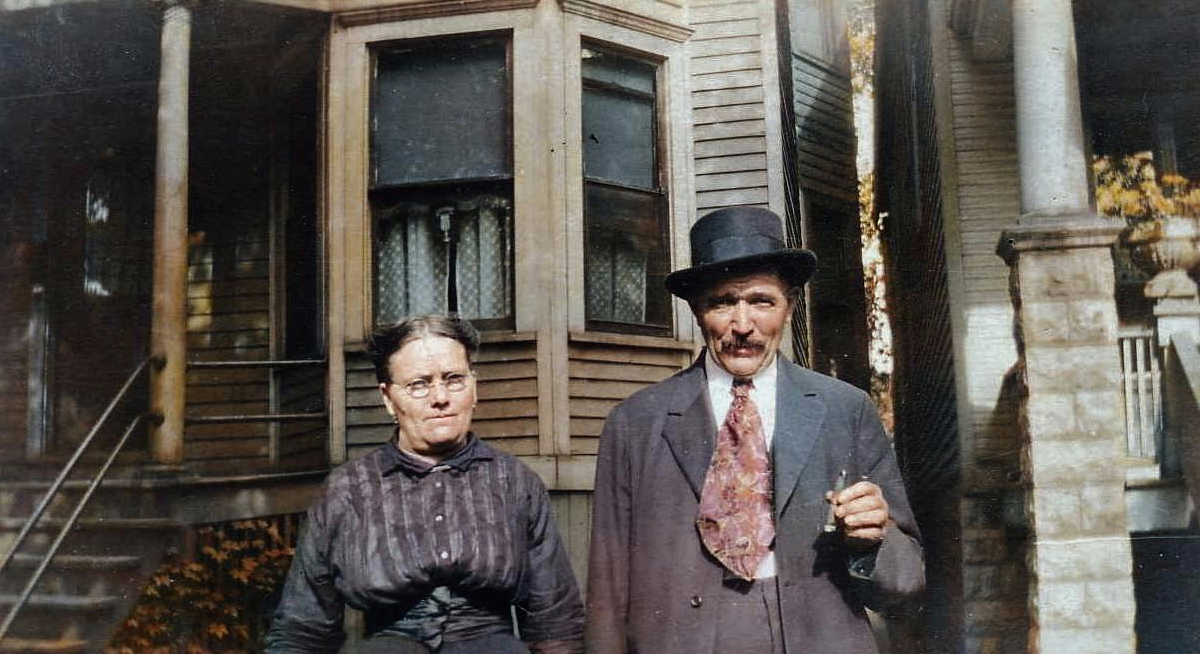
"Her husbands kept dying"
Does this lady have the look of a murderess? She does not, nor of a serial bride neither. She was Catharina Petersen, seen here with her second husband Thomas Mikkelsen in front of their new home on Loomis Street in southside Chicago around 1907.
Catharina (later Catherine) had only two husbands according to the records: Hans Peter Petersen, her first cousin, whom she married after her family emigrated from Schleswig-Holstein in 1878. Hans had already established a farm with his parents in Nebraska and that's where Hans and Catharina lived, and where their first five children were born between 1880 and 1888.
The family relocated to Chicago and then to Brookfield, Wisconsin. Another six children were born to the couple, who continued to farm until Hans became disabled and could no longer work. He died at age 55 in a drowning accident on the couple's farm in 1905.
Catherine and her children came back to Chicago where she encountered an old family friend (and a cousin by marriage), Thomas Mikkelsen. Thomas was a mechanic for the city railway who had known Hans and Catherine back in Schleswig-Holstein. He himself was a widower, a veteran of two previous marriages: one to Helene Sievertsen (who left him in 1887 after emigrating to Chicago with Thomas and their children) and one to Maria Hansen, who died in 1902.
Thomas and Catherine married in 1906, had a daughter Florence in 1907, and were together in their blended household until Thomas succumbed to carcinoma in 1921. By all accounts it was a happy union. Catherine retained her close relationship with Thomas' grown children from his first marriage until her own death in 1944.
For some reason my parents promulgated the myth that Catherine was married multiple times and her husbands kept mysteriously dying. This is nothing like the truth. Perhaps the story had its origins with Catherine's son Alva Elwood MacLaughlan who, having changed his own name from Alfred Emil Petersen, had myths of his own to build.
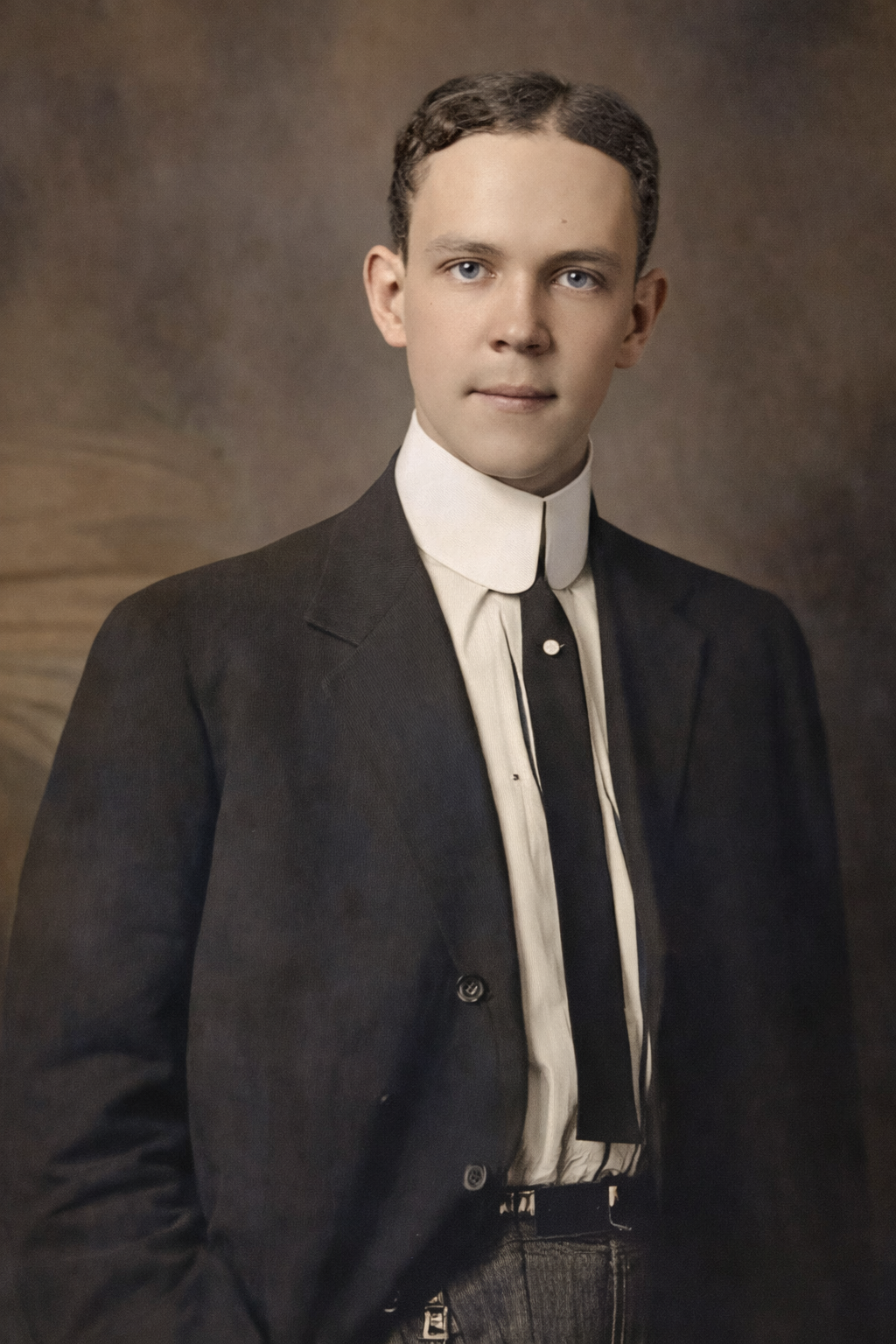
"We had a castle in Germany"
Short answer: we did not.
Some of our Jatho relatives were fed a family legend that our ancestral surname was Von Jatho and that we left behind a magnificent castle when our ancestors emigrated from Germany.
Sadly this is not the case. How do we know? For one thing, people with castles and money stay where the money is. They don't leave it behind, and they don't emigrate to the New World if they have castles in their background.
Records back as far as 1625 show that our ancestral surname was always Jatho, no Von -- pronounced Yatto in the old German fashion. And they were all what we would now call middle-class folks: in Germany they were schoolmasters, an insurance administrator, an innkeeper; in the United States a watchmaker, merchants, salesmen.
Norwood Jatho (left), born in 1887 in Charleston, South Carolina to Edmond Jatho and Edith Ripley, was a printer salesman in New Orleans. He established a small dynasty in New Orleans but none of them were wealthy. Perhaps to shore up a sense of self the family invented (or accepted from others) a tale about the Von Jatho surname (which never existed) and the lost castles of Germany (which never existed for them either).
To this day the family still wants to believe those old tales of yore. But our ancestral documents prove otherwise.
"Names were changed at Ellis Island"
Actually, they weren't. And there's a very good reason why this was so.
There have been a number of scholarly studies refuting this persistent myth, and this is one of them. Whether your were from Lithuania or Ukraine, Italy, Ireland, Denmark, Germany, or whatever country your ancestors came from, no one at Ellis Island or its preceding processing place, Castle Island, was there to force, suggest, or coerce immigrants to change their names.
In fact, the clerks processing immigrants from 1892 through 1954 did not write down names upon arrival. They used the previously prepared ship manifest -- which had names and details written out prior to the voyage -- as a checklist, asking questions at arrival (with the help of interpreters where necessary) but not actually inscribing the surname of the traveler.
You could, in fact, travel under any name you chose, whether the one you were born with or one you made up yourself. All you had to do was answer to it when asked. And once you arrived in America you could start to use any name you wanted as soon as your intake processing at your point of disembarkation was complete.
Some folks did change their names after arrival for reasons of their own. That had nothing to do with Ellis Island, or Charleston, or Baltimore, or Galveston, or any other arrival port. The clerk in charge of intake was only responsible for checking your name, country or town of origin, profession, and where your final destination was located. In the early 1900s manifests often became more detailed with the names of relatives you'd left behind and those whom you were traveling to meet, very helpful to the genealogist studying family migration.
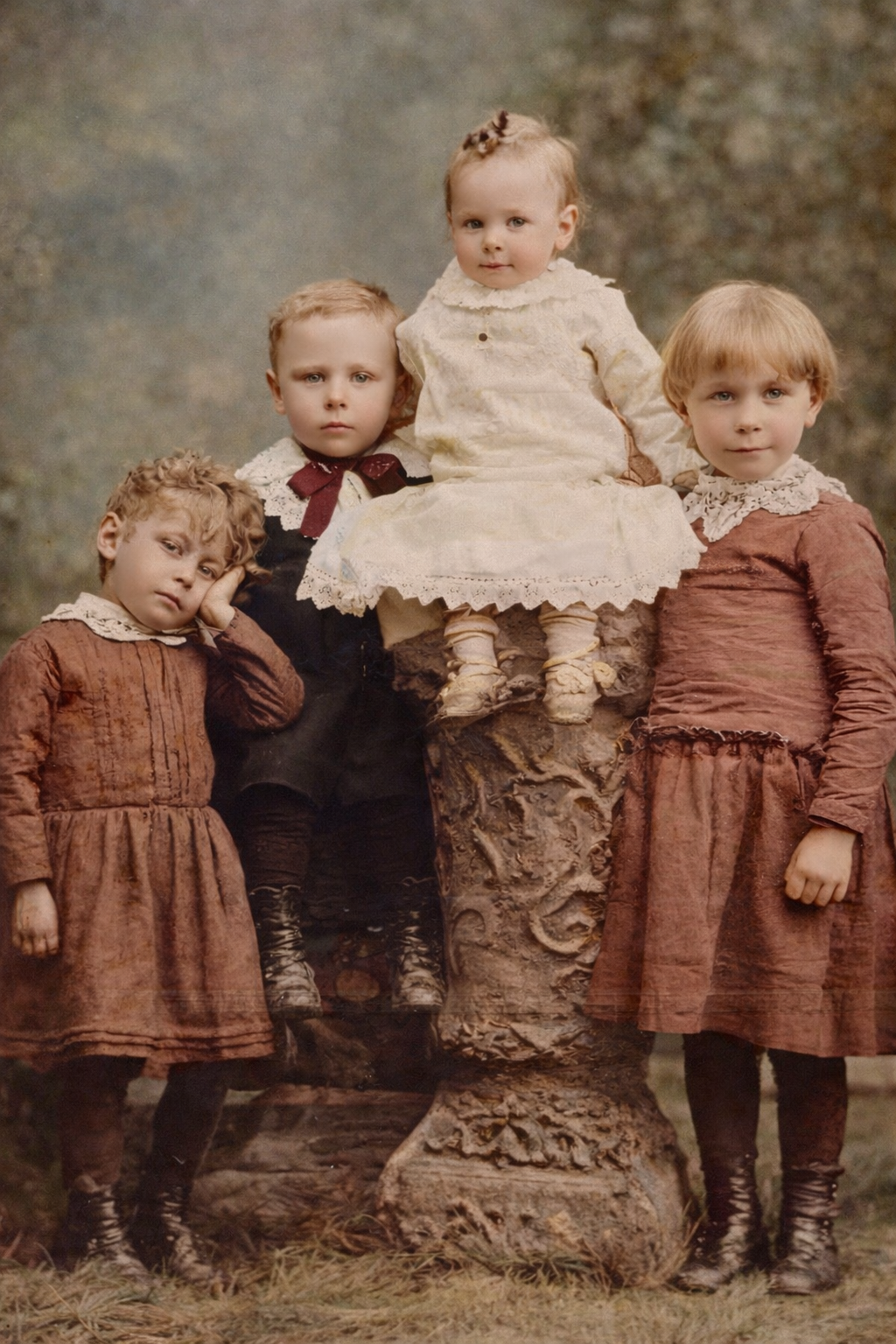
These immigrant children, above right, belonged to the Murphy family who left County Down, Ireland in 1887 and arrived in New York a few weeks later. They were Murphy in the Old Country and remained Murphy once they arrived in Chicago. But once in the New World they would have been free to transform themselves into anyone they wanted to be...as some did.
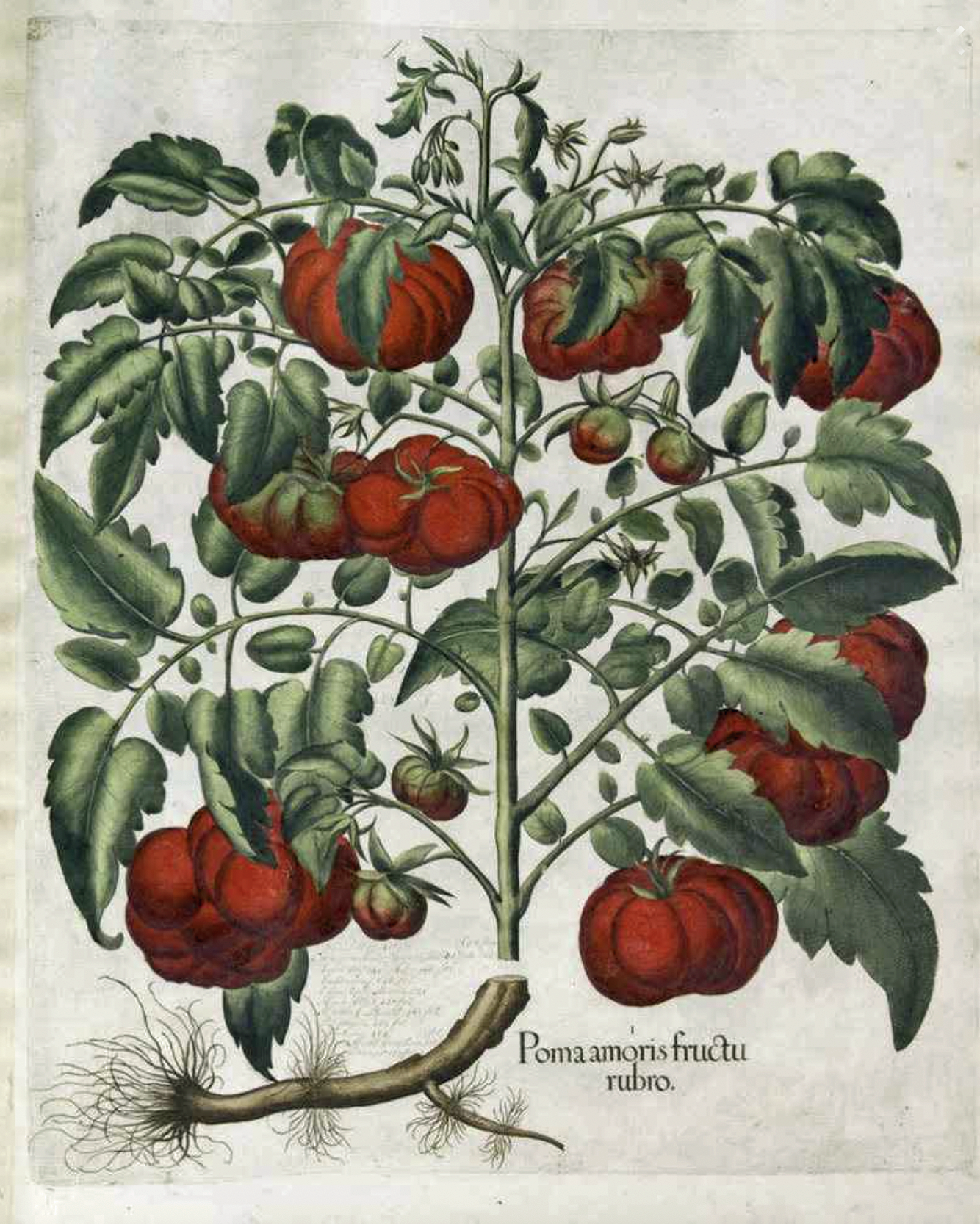
The tomato: an immigrant's tale
This story doesn't appear to be widespread but the fact that it appears in two oral histories separated by region and surname suggests that there might be similar stories among immigrant memories. I'm not ready to declare this a myth, but it's a peculiar coincidence.
In the two tales that I've encountered, a young immigrant, sometimes a child, mistakes a New World tomato for an apple, eats it, and is terrified by its unexpected flavor and texture.
In the first story Carl Friedrich August Breetzke, born in 1852 in Woltersdorf, Pomerania emigrates to the United States about 1871. His family has uploaded an oral history of his time in the town of Blankenhagen where he lived with his blacksmith father and family.
Deciding to emigrate to escape military conscription (a common theme and likely true albeit not documentable), August Breetzke arrived in New York with little money to his name. "When he landed in New York" (his descendant Irene Arbuckle Letsky tells us) "he had almost no money. He spent his last coins on what he thought was a beautiful red apple, and it turned out to be a tomato. What a blow! He had never seen or tasted a tomato and he hated it."
Interestingly a similar story is told by Frieda Fialco Dumes and captured in an oral history recording by her niece Ruth Fishman. Frieda was married to William Dumes, who emigrated to the U.S. with his family when he was ten years old in 1912. On the boat, said Frieda, "He saw a beautiful red thing that he thought was an apple. He bit it, and it was a tomato. The juice went all over his face."
William Dumes was from Latvia (then Russia) in a small town called Vishki near the Russian border. Vishki is about 500 miles from western Pomerania (now part of Poland), and it's possible that the tomato, which had spread as an edible fruit from Spain to Italy to Europe (including Poland) by the 19th century, was not common in local cuisines.
In earlier times the tomato was tainted with suspicion, some believing that it was poisonous, some confused by its pungent leaves or reputation as a cousin of deadly nightshade. In these two stories its appearance is combined with the unfamiliar New World environment. Perhaps it was meant to be a cautionary tale about dangers likely to befall an unsuspecting immigrant, especially new and unfamiliar (possibly dangerous) foods. Whatever it is, the similarity of the stories -- a tomato mistaken for an apple, the surprising and unexpected taste -- is notable.
I haven't been able to locate similar stories, although they may be lurking in other Eastern and Northern European oral histories. It probably won't be found in immigration tales from the Mediterranean, North Africa, the Middle East, or Southeast Asia where tomatoes were widely grown and accepted, nor from Central or South America and Mexico where tomatoes originated and had been a standard food item for centuries. But if such a story exists in your family tales I'd be interested in hearing about it.
"We are Scottish"
No, we are not, and never were.
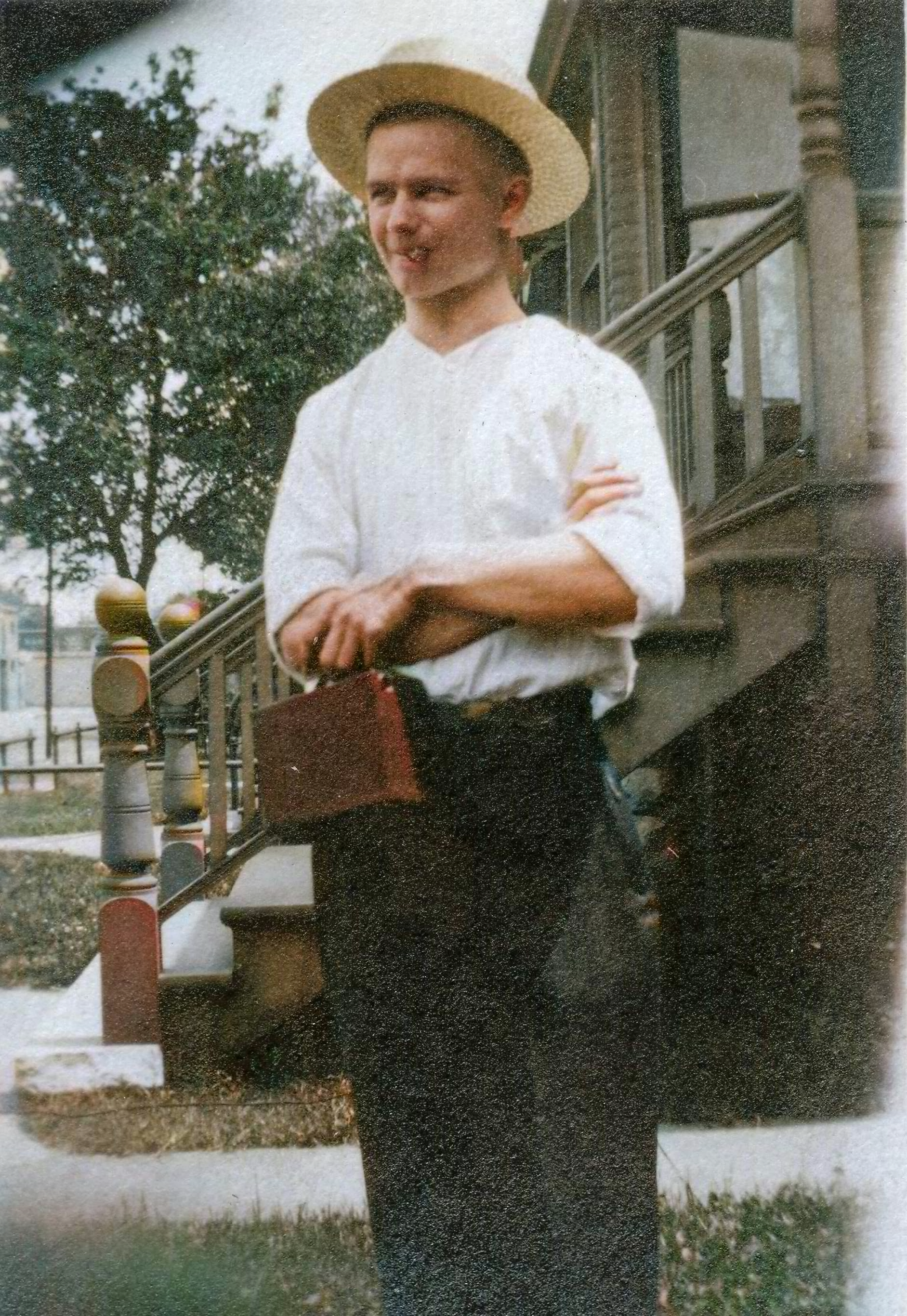
One of the best-kept secrets in our family was the ancestral origin of the MacLaughlans. My grandfather, at right, used the name Alva Elwood MacLaughlan, his son (my father) insisted we were Scottish, and the name would appear to bear this out. Only it was a complete invention.
For reasons that remain unclear, Alva decided to reinvent himself around 1914. Born Alfred Emil Petersen, he became a MacLaughlan via personal decree. He does not appear to have changed his name officially, but there was nothing illegal about that as long as you didn't attempt to defraud anyone.
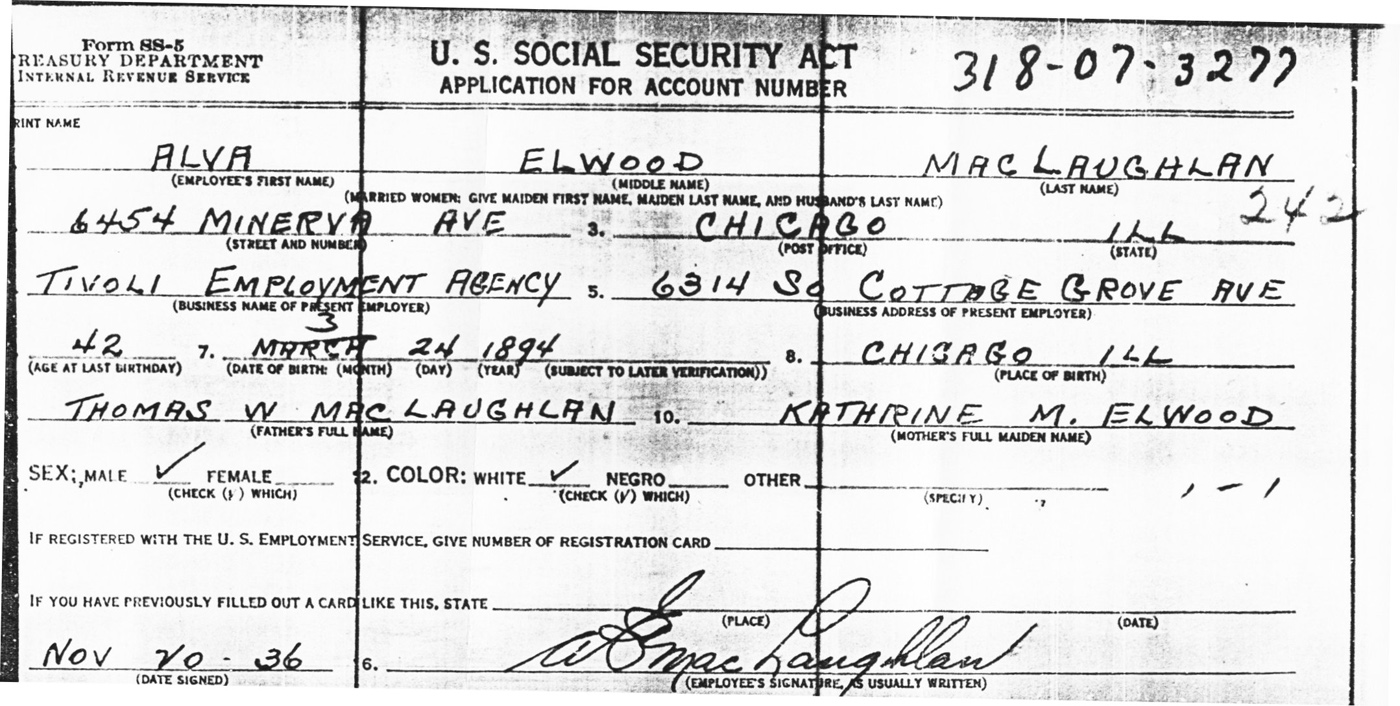
It's debatable whether applying for a Social Security number in 1936 required the applicant to be absolutely truthful in his supplied information. Alva didn't do this. He invented names for his parents: Thomas W. MacLaughlan for his father (this was actually Alva's older son), and Kathrine M. Elwood for his mother (a partial fabrication, her surname was Petersen). But no one appears to have checked his information and he was assigned his number without causing any alarm.
Alva's siblings all remained Petersen. They may have been perplexed by this development but they seem to have accepted it. The motivation may have been economic; it was easier to get decent work in the world if you weren't associated with immigrants.
Alva was born in Chicago but his parents weren't, they were from Schleswig-Holstein. They spoke German as well as Danish, and English of course once they arrived in America. But there was a decided prejudice against German-Americans in the 1910s and thereafter, so Alva may have decided to be practical about it in his own way.
What's curious is how Alva's children (who knew the truth, more or less) kept up with the charade. His son Tom flat-out refused to acknowledge the situation, maintaining that he didn't know the name of his own grandmother Catherine Petersen Mikkelsen -- even though he was often photographed at her home, in front of her house, and was twenty-eight years old when she died in 1944.
Discovering this secret took some sleuthing, such as finding Alva with his mother, step-father, and siblings in the 1910 census in Chicago; discovering his mother's bible entries with his correct name and birthdate spelled out; finding his baptism record at Chicago's St. Martini Lutheran Church in 1894 with his parents clearly listed. And of course finding cousins who remembered Alva and knew that he changed his name, religion, and heritage -- that helped too.
It would have been a lot easier to document family lineage if Alva had been straightforward about his past. But perhaps he wanted to leave a challenge for his descendants to discover.
"Uncle Rudy's job was catching flies"
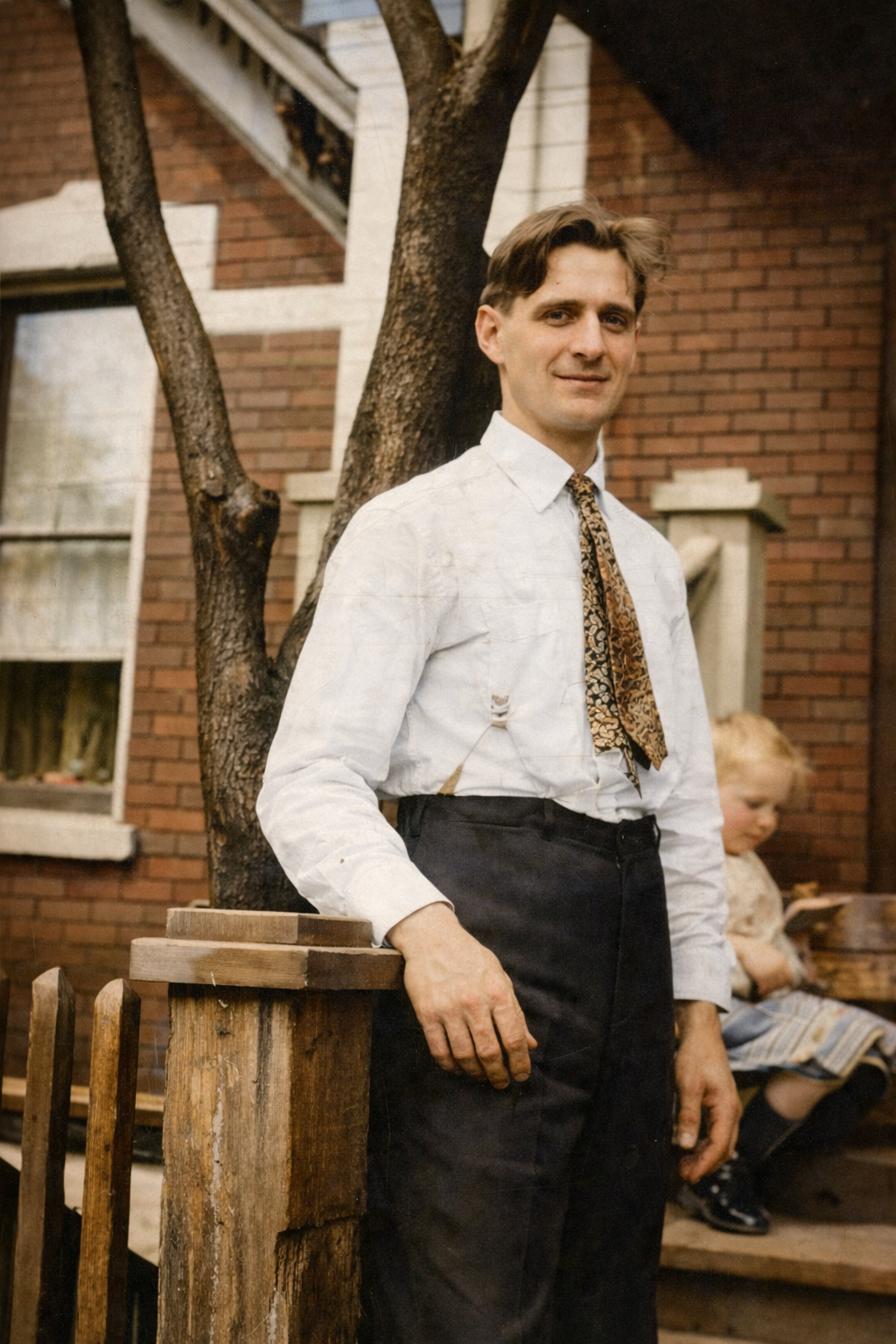
For some reason my mother repeated this story about her Uncle Rudy Gohr, leading to the inevitable assumption that Uncle Rudy was incapable of living an otherwise productive life. This was not remotely accurate.
My mother's mother had issues with sibling rivalry and maybe the story originated with her. Bertha Gohr Bruns had a long-standing feud with her younger sister Alma involving an accusation of spoiling Alma's children. Maybe there were also some issues about the only surviving son of their parents, Rudy Gohr, who was born in 1883 in Chicago. Perhaps these issues translated into this fanciful story.
Two of the Gohr offspring didn't marry. One was Minnie (Wilhelmine), who was born deaf and non-verbal and who lived with her adult sisters and in the Elgin State Hospital. Rudy also didn't marry, living with various sisters in Chicago throughout his life.
Rudy had demonstrable skills as a printer, binder, and mail order clerk in a print shop, according to various census records, as well as a laborer in a manufacturing company, according to his WWI registration, which also cited no physical disabilities that would disqualify him from service.
The 1940 census says that Rudy completed 4th grade, which wasn't that unusual in the late 1890s when children were expected to find work rather than complete their education. It's worth noting that Rudy's sisters Anna and Carrie only completed third grade. It was their sister Minnie who benefited from her time at the Illinois Institution for the Education of the Deaf and Dumb, which housed educable hard-of-hearing students throughout the state at no cost to their families. Minnie finished eighth grade and gained a profession as a result.
The Gohrs were not wealthy and Rudy's financial contribution to his widowed father and later to his adult sisters was probably much appreciated. The 1900 census shows that Rudy and his older sisters all worked: Anna and Carrie as domestic servants, Minnie (despite her disability) as a dressmaker, Rudy as a laborer like his father William.
Yet my mother insisted that all Rudy was capable of doing was sitting on the front porch and catching flies. Maybe she thought this tale was funny. I think it does her uncle a disservice, glossing over his obvious capabilities. As a genealogist it's important to be accurate about the truth of our ancestor's lives rather than spreading myths, and this one gets debunked right here.
More stories to come
Do you have any myths and mysteries to share from your own family? If you'd like to email us with details of your tale we'll upload it here.